Loading...
Min Aung Hlaing vs Mohan Singh
Mohan Singh leads by 2.7 pts · 2 figures compared
…

Min Aung Hlaing
General · Modern
43.9Total
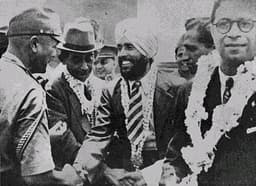
Mohan Singh
General · Modern
46.6Total
Basic Information
Born
1956
1909
Died
—
1989
Era
Modern
Modern
Nationality
Myanmar
India
Occupation
General
General
Civilization
Eastern
Indian
Score Comparison
Military (10%)
46.7
50.0
Political (20%)
27.9
36.5
Influence (20%)
50.2
57.2
Legacy (20%)
40.8
48.3
Leadership (15%)
47.3
36.9
Strategy (15%)
51.7
41.7
TOTAL
43.9
46.6
Min Aung Hlaing — Complete Timeline
2011 AD
Appointed Commander-in-Chief of Myanmar Armed ForcesPolitical Action◆ Major
Min Aung Hlaing was appointed Commander-in-Chief of the Tatmadaw (Myanmar Armed Forces). He succeeded Than Shwe and became the most powerful military figure, overseeing the armed forces during the country's political transition.
MilitaryMyanmarLeadership
Impact: national
2017 AD
Rakhine State CrackdownWar
Under Min Aung Hlaing's command, the Myanmar military launched a brutal crackdown in Rakhine State following attacks by the Arakan Rohingya Salvation Army. The operation resulted in mass killings, rape, and the displacement of over 700,000 Rohingya Muslims to Bangladesh, leading to accusations of genocide.
RohingyaMyanmarHuman RightsGenocide
Impact: regionaldestructive
2021 AD
Led the 2021 Myanmar CoupPolitical Action
Min Aung Hlaing led a military coup that overthrew the democratically elected government of Aung San Suu Kyi. The coup was justified by unsubstantiated claims of election fraud, and it plunged Myanmar into a civil war and economic crisis.
CoupMyanmarDemocracy
Impact: nationaldestructive
Declared Himself Prime MinisterPolitical Action◆ Major
Following the coup, Min Aung Hlaing declared himself Prime Minister of the newly formed State Administration Council. He assumed executive power, reversing the country's democratic transition and consolidating military control.
CoupMyanmarLeadership
Impact: nationaldestructive
Imposed International SanctionsPolitical Action◆ Major
In response to the coup and human rights abuses, the United States, European Union, and other nations imposed sanctions on Min Aung Hlaing and his associates. The sanctions targeted his assets and restricted travel, but failed to force a return to civilian rule.
SanctionsMyanmarInternational Relations
Impact: global
Mohan Singh — Complete Timeline
1942 AD
Founding of the Indian National ArmyPolitical Action◆ Major
Mohan Singh founded the Indian National Army (INA) in Singapore with captured Indian soldiers from the British Indian Army. He aimed to fight alongside Japan for Indian independence, but later fell out with Japanese leadership.
Indian National ArmyWorld War IIIndependence
Impact: nationalconstructive
Dissolution of the First INAPolitical Action◆ Major
Mohan Singh dissolved the first Indian National Army after disagreements with the Japanese over its command and objectives. He was arrested by the Japanese, and the INA was later revived by Subhas Chandra Bose.
Indian National ArmyJapanese ConflictDissolution
Impact: nationaldestructive
1945 AD
Imprisonment by BritishPolitical Action
Mohan Singh was imprisoned by the British after World War II for his role in the INA. He was tried and sentenced, but later released after Indian independence, becoming a symbol of resistance.
ImprisonmentBritish EmpireINA
Impact: nationaltragic
Expert Analysis
Origins
**Min Aung Hlaing** was born on July 3, 1956, in Tavoy (now Dawei), Myanmar. His father, Thaung Hlaing, was a civil engineer. He attended the Defence Services Academy (DSA) in Pyin Oo Lwin, graduating in 1977 as part of the 19th intake. His early military career was conventional, with postings in various infantry units.
**Mohan Singh** was born on January 3, 1909, in Ugoke, Punjab (now in Pakistan). He joined the British Indian Army in 1927 and was commissioned as a second lieutenant. He served in the 14th Punjab Regiment and saw action in Malaya during World War II. His capture by Japanese forces in 1942 became a turning point.
Rise to Power
Min Aung Hlaing rose through the ranks of the Tatmadaw, benefiting from the military's dominance in Myanmar. He was appointed Commander-in-Chief in 2011, succeeding Senior General Than Shwe. His rise was steady, without dramatic upsets, as he aligned with the military establishment.
Mohan Singh's rise was abrupt. After being captured by the Japanese in 1942, he was approached to lead Indian prisoners of war. He founded the Indian National Army (INA) in September 1942 in Singapore, with Japanese support. However, disagreements over command led to his arrest by the Japanese in December 1942, and the first INA dissolved.
Leadership & Governance
Min Aung Hlaing's leadership is authoritarian. He centralized power after the 2021 coup, declaring himself Prime Minister. His governance relies on military force, suppressing dissent with violence. He scores 27.9 in political skill, reflecting his inability to build broad support. His strategy score is 51.7, but his military score is 46.7, indicating limited tactical success.
Mohan Singh's leadership was more ideological. He aimed to create a nationalist army free from Japanese control, but his political score of 36.5 shows his challenges. He lacked the diplomatic skill to manage Japanese expectations. His military score of 50.0 is modest, as he never led major battles.
Triumph & Tragedy
Min Aung Hlaing's triumph is his successful coup in 2021, seizing power from Aung San Suu Kyi's government. However, his tragedy is the resulting civil war and international isolation. Sanctions have crippled Myanmar's economy, and his forces have lost territory to resistance groups. His legacy score of 40.8 reflects widespread condemnation.
Mohan Singh's triumph is founding the INA, which later inspired Subhas Chandra Bose and the Indian independence movement. His tragedy is his failure to sustain the INA due to conflict with the Japanese. He was imprisoned by the British after the war, though later released.
Character & Destiny
Min Aung Hlaing is calculating and ruthless, willing to use extreme violence. His decisions, like the Rakhine crackdown, have led to genocide charges. His character has made him a pariah, but he clings to power.
Mohan Singh was idealistic but naive. He trusted Japanese promises and lacked the political acumen to navigate their interests. His fate was to be overshadowed by Bose, who rebuilt the INA. He lived a quiet life after independence, dying in 1989.
Legacy
Min Aung Hlaing's legacy is negative: he is associated with human rights abuses and democratic backsliding. His impact on Myanmar is destructive, with the country fragmenting. His influence score of 50.2 reflects global attention, but for the wrong reasons.
Mohan Singh's legacy is mixed. He is remembered as a pioneer of the INA, but not its most famous leader. His actions contributed to Indian nationalism, and his score of 48.3 in legacy shows moderate recognition. His total score of 46.6 edges Min Aung Hlaing's 43.9.
Conclusion
Mohan Singh had a greater impact on history. Despite his failures, he catalyzed the INA, which influenced India's independence. Min Aung Hlaing's impact is destructive and localized. While Singh's score is only 2.7 points higher, his contribution to a major historical movement outweighs Hlaing's authoritarian rule. Singh's ideals outlasted him; Hlaing's regime is likely to collapse.
Rankings
🥇
Mohan SinghLeader
Mil: 50.0Pol: 36.5Inf: 57.2
46.6
🥈
Min Aung Hlaing
Mil: 46.7Pol: 27.9Inf: 50.2
43.9
+2.7 behind
How This Comparison Works
Algorithm
Each figure is scored on 6 dimensions (0—100 scale) based on structured historical data: Military (10%), Political (20%), Influence (20%), Legacy (20%), Leadership (15%), Strategy (15%). The weighted total produces the final ranking.
Data Sources
Scores are computed from structured sub-indicators in the database. Scale factors adjust for era (Ancient ×0.85, Modern ×1.0) and civilization size (Eastern ×1.05, Other ×0.80) to account for differences in population and military scale.
Maximum 3 Figures
Comparisons are limited to 2—3 figures to ensure readability and statistical meaningfulness.
Error Margins
±5 points per dimension — Sub-scores are derived from historical records with inherent uncertainty. Two figures within 5 points on a dimension should be considered roughly equivalent in that area.
Total Score Accuracy
±3 points overall — The weighted combination of 6 dimensions produces a total score with approximately ±3 points of uncertainty. Differences of less than 3 points are not statistically significant— the figures are effectively tied.
Known Limitations
- Historical records are incomplete and uneven across civilizations
- Figures from oral-tradition societies may be underrepresented
- Occupation labels can misclassify multi-role figures
- Scores measure capability and impact, not moral character
- Quantitative scoring is a comparison tool, not absolute truth
Capability Radar
Military (10%) — Battles & Warfare
Battles
35
15
Win Rate
30
10
Expansion
20
10
Political (20%) — Governance & Reform
Reform
10
25
Diplomacy
15
30
Economy
10
10
Influence (20%) — Cultural & Global Reach
Cultural
10
30
Global
20
25
Legacy (20%) — Historical Impact
Historical
20
40
Longevity
15
30
Leadership (15%) — Power & Stability
Tenure
40
20
Stability
5
10
Strategy (15%) — Tactics & Innovation
Strategy
45
25
Tactics
40
20
Reform
25
30
Similar Comparisons
Comments & Discussion
No comments yet. Be the first to share your thoughts!