Loading...
This comparison has not been analyzed yet.
One-time AI generation (~1 minute). Scores and timeline are already available below.
Maximian vs Zhang Han
Maximian leads by 1.5 pts · 2 figures compared
…
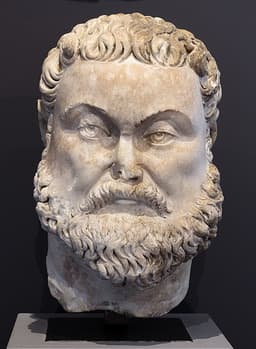
Maximian
General · Ancient
49.8Total

Zhang Han
General · Ancient
48.3Total
Basic Information
Born
250
-250
Died
310
-205
Era
Ancient
Ancient
Nationality
Roman Empire
China
Occupation
General
General
Civilization
Western
Eastern
Score Comparison
Military (10%)
65.0
82.0
Political (20%)
35.1
35.0
Influence (20%)
51.8
50.2
Legacy (20%)
42.5
46.7
Leadership (15%)
61.1
30.0
Strategy (15%)
52.5
61.3
TOTAL
49.8
48.3
Maximian — Complete Timeline
285 AD
Appointment as Caesar by DiocletianPolitical Action◆ Major
Diocletian appointed Maximian as Caesar (junior emperor) to govern the Western provinces. This was part of Diocletian's reorganization of the empire, creating a dyarchy. Maximian was given the task of suppressing revolts in Gaul and defending the Rhine frontier.
TetrarchyImperial AppointmentDyarchy
Impact: regional
286 AD
Campaigns in Gaul and BritainWar◆ Major
Maximian campaigned against the Bagaudae rebels in Gaul and later against the usurper Carausius in Britain. He failed to defeat Carausius, who established a breakaway empire in Britain and northern Gaul. The campaign demonstrated the limits of Maximian's military success.
RebellionUsurpationTetrarchy
Impact: regional
Elevation to AugustusPolitical Action◆ Major
Diocletian elevated Maximian to the rank of Augustus, making him co-emperor of the West. Maximian adopted the title Herculius, symbolizing his role as the active, laboring partner to Diocletian's Jovian. This formalized the division of the empire into two halves.
TetrarchyCo-EmperorImperial Division
Impact: regional
305 AD
Forced Abdication and RetirementPolitical Action◆ Major
Maximian abdicated as Augustus alongside Diocletian in a coordinated ceremony at Milan. He retired to a villa in Lucania, but his retirement was forced by Diocletian's plan for an orderly succession. Maximian resented his loss of power and later attempted to reclaim the throne.
AbdicationTetrarchyRetirement
Impact: regional
310 AD
Suicide by HangingOther◆ Major
After multiple failed attempts to regain power, including a rebellion against Constantine, Maximian was captured at Massilia. Constantine spared his life but forced him to commit suicide. Maximian hanged himself, ending the life of the former co-emperor of the Tetrarchy.
SuicideRebellionTetrarchy
Impact: regionaltragic
Zhang Han — Complete Timeline
209 BC
Suppression of the Chen Sheng and Wu Guang rebellionWar◆ Major
Zhang Han, as a Qin general, led a force of convicts and slaves to defeat the rebel army of Chen Sheng and Wu Guang at Chen County. He then pursued and killed Chen Sheng, temporarily stabilizing Qin control.
Qin DynastyRebellionBattle
Impact: national
208 BC
Defeat of the rebel army at the Battle of DingtaoWar◆ Major
Zhang Han defeated the Chu rebel army led by Xiang Liang at Dingtao. Xiang Liang was killed in the battle. This victory temporarily reversed rebel gains and restored Qin authority in the region.
Qin DynastyRebellionBattleChu
Impact: national
207 BC
Defeat at the Battle of JuluWar
Zhang Han's army was besieged at Julu by the rebel forces of Xiang Yu. After a prolonged siege and the destruction of Qin supply lines, Zhang Han's army was defeated. He surrendered to Xiang Yu.
Qin DynastyRebellionBattleDefeat
Impact: nationaltragic
Surrender to Xiang Yu and executionPolitical Action◆ Major
Zhang Han surrendered his remaining 200,000 troops to Xiang Yu at Xianyang. Despite the surrender, Xiang Yu executed Zhang Han and had his army buried alive. This ended the last major Qin military resistance.
Qin DynastySurrenderExecution
Impact: nationaltragic
This comparison has not been analyzed yet.
One-time AI generation (~1 minute). Scores and timeline are already available below.
Rankings
🥇
MaximianLeader
Mil: 65.0Pol: 35.1Inf: 51.8
49.8
🥈
Zhang Han
Mil: 82.0Pol: 35.0Inf: 50.2
48.3
+1.5 behind
How This Comparison Works
Algorithm
Each figure is scored on 6 dimensions (0—100 scale) based on structured historical data: Military (10%), Political (20%), Influence (20%), Legacy (20%), Leadership (15%), Strategy (15%). The weighted total produces the final ranking.
Data Sources
Scores are computed from structured sub-indicators in the database. Scale factors adjust for era (Ancient ×0.85, Modern ×1.0) and civilization size (Eastern ×1.05, Other ×0.80) to account for differences in population and military scale.
Maximum 3 Figures
Comparisons are limited to 2—3 figures to ensure readability and statistical meaningfulness.
Error Margins
±5 points per dimension — Sub-scores are derived from historical records with inherent uncertainty. Two figures within 5 points on a dimension should be considered roughly equivalent in that area.
Total Score Accuracy
±3 points overall — The weighted combination of 6 dimensions produces a total score with approximately ±3 points of uncertainty. Differences of less than 3 points are not statistically significant— the figures are effectively tied.
Known Limitations
- Historical records are incomplete and uneven across civilizations
- Figures from oral-tradition societies may be underrepresented
- Occupation labels can misclassify multi-role figures
- Scores measure capability and impact, not moral character
- Quantitative scoring is a comparison tool, not absolute truth
Capability Radar
Military (10%) — Battles & Warfare
Battles
55
75
Win Rate
50
70
Expansion
40
65
Political (20%) — Governance & Reform
Reform
40
10
Diplomacy
50
30
Economy
45
15
Influence (20%) — Cultural & Global Reach
Cultural
30
30
Global
30
20
Legacy (20%) — Historical Impact
Historical
40
50
Longevity
25
40
Leadership (15%) — Power & Stability
Tenure
65
40
Stability
40
20
Strategy (15%) — Tactics & Innovation
Strategy
50
75
Tactics
45
80
Reform
30
20
Similar Comparisons
Comments & Discussion
No comments yet. Be the first to share your thoughts!