Loading...
Guan Yu vs Zhang Han
Guan Yu leads by 9.3 pts · 2 figures compared
…
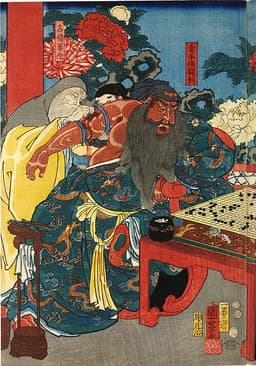
Guan Yu
General · Ancient
57.6Total

Zhang Han
General · Ancient
48.3Total
Basic Information
Born
160
-250
Died
220
-205
Era
Ancient
Ancient
Nationality
China
China
Occupation
General
General
Civilization
Eastern
Eastern
Score Comparison
Military (10%)
61.7
82.0
Political (20%)
35.0
35.0
Influence (20%)
72.0
50.2
Legacy (20%)
68.0
46.7
Leadership (15%)
40.9
30.0
Strategy (15%)
50.0
61.3
TOTAL
57.6
48.3
Guan Yu — Complete Timeline
200 AD
Battle of BomaWar
Guan Yu, serving under Cao Cao, killed the enemy general Yan Liang in battle at Boma. This act demonstrated his martial prowess and loyalty to Cao Cao at the time. The victory helped Cao Cao's forces in the campaign against Yuan Shao.
Three KingdomsBattleMartial Skill
Impact: regional
Departure from Cao Cao to Rejoin Liu BeiPolitical Action◆ Major
After learning of Liu Bei's whereabouts, Guan Yu left Cao Cao's service, crossing five passes and killing six generals to rejoin his sworn brother. This act of loyalty became legendary, symbolizing unwavering commitment to one's oath.
LoyaltyOathThree Kingdoms
Impact: regional
219 AD
Battle of FanchengWar◆ Major
Guan Yu led a campaign against Cao Cao's forces at Fancheng. He achieved initial success, flooding the city, but was ultimately defeated by reinforcements led by Xu Huang. This battle marked the turning point in his military career.
Three KingdomsSiegeTurning Point
Impact: regional
220 AD
Capture and Execution by Sun Quan's ForcesWar◆ Major
After the defeat at Fancheng, Guan Yu retreated but was ambushed and captured by Sun Quan's general L
ExecutionThree KingdomsRevenge
Impact: regionaltragic
Zhang Han — Complete Timeline
209 BC
Suppression of the Chen Sheng and Wu Guang rebellionWar◆ Major
Zhang Han, as a Qin general, led a force of convicts and slaves to defeat the rebel army of Chen Sheng and Wu Guang at Chen County. He then pursued and killed Chen Sheng, temporarily stabilizing Qin control.
Qin DynastyRebellionBattle
Impact: national
208 BC
Defeat of the rebel army at the Battle of DingtaoWar◆ Major
Zhang Han defeated the Chu rebel army led by Xiang Liang at Dingtao. Xiang Liang was killed in the battle. This victory temporarily reversed rebel gains and restored Qin authority in the region.
Qin DynastyRebellionBattleChu
Impact: national
207 BC
Defeat at the Battle of JuluWar
Zhang Han's army was besieged at Julu by the rebel forces of Xiang Yu. After a prolonged siege and the destruction of Qin supply lines, Zhang Han's army was defeated. He surrendered to Xiang Yu.
Qin DynastyRebellionBattleDefeat
Impact: nationaltragic
Surrender to Xiang Yu and executionPolitical Action◆ Major
Zhang Han surrendered his remaining 200,000 troops to Xiang Yu at Xianyang. Despite the surrender, Xiang Yu executed Zhang Han and had his army buried alive. This ended the last major Qin military resistance.
Qin DynastySurrenderExecution
Impact: nationaltragic
Expert Analysis
Origins
Guan Yu (160–220) was born in Xie County, Hedong (modern Yuncheng, Shanxi). Little is known of his early life, but he fled his hometown after killing a local bully. He later met Liu Bei and Zhang Fei, forming a sworn brotherhood that would define his life. Zhang Han (unknown birth year, died 205 BCE) was a Qin general during the dynasty's collapse. He rose from obscurity, possibly as a convict or low-ranking officer, and was tasked with suppressing rebellions.
Rise to Power
Guan Yu's rise began when he joined Liu Bei's forces in the Yellow Turban Rebellion (184). He gained fame for his martial prowess, especially after killing Yan Liang at the Battle of Boma (200) while temporarily serving Cao Cao. Despite Cao Cao's rewards, Guan Yu left to rejoin Liu Bei, an act of loyalty celebrated in history. Zhang Han's rise came during the Qin dynasty's final years. In 209 BCE, he led a force of convicts and slaves to crush the Chen Sheng and Wu Guang rebellion, defeating them at Chen County. He then defeated Xiang Liang at the Battle of Dingtao (208 BCE), killing the rebel leader. These victories made him the Qin's last effective general.
Leadership & Governance
Guan Yu's leadership was based on personal loyalty and martial honor. He governed Jing Province after Liu Bei's conquest, but his arrogance alienated allies, including Sun Quan. He refused diplomatic marriage proposals, souring relations. Zhang Han commanded through discipline and strategy, using convict armies effectively. However, his political naivety was evident when he surrendered to Xiang Yu after the Battle of Julu (207 BCE), trusting Xiang Yu's promise of mercy. Xiang Yu executed him and massacred his army.
Triumph & Tragedy
Guan Yu's greatest triumph was his campaign at Fancheng (219), where he flooded the city and nearly captured it. His greatest tragedy was his defeat and execution after Sun Quan's betrayal. Zhang Han's triumph was suppressing the early rebellions, temporarily saving Qin. His tragedy was his defeat at Julu and his naive surrender, leading to his death and the massacre of his troops. Guan Yu scored 61.7 in military, Zhang Han 82.0, reflecting Zhang Han's tactical success. But Guan Yu's influence (72.0) and legacy (68.0) far exceed Zhang Han's (50.2 and 46.7).
Character & Destiny
Guan Yu's character—proud, loyal, and honorable—shaped his fate. His loyalty to Liu Bei earned him deification, but his pride led to his death. Zhang Han's character was more pragmatic, but his political misjudgment and lack of strategic foresight doomed him. Historical assessments contrast Guan Yu's moral stature with Zhang Han's tactical competence.
Legacy
Guan Yu's legacy is immense: he was deified as Guandi, the God of War, and worshipped in temples across China. His story is central to the novel 'Romance of the Three Kingdoms'. Zhang Han is remembered as a capable general who failed to save a dying dynasty. His legacy is overshadowed by Xiang Yu and the Qin collapse.
Conclusion
While Zhang Han scored higher in military (82.0 vs 61.7) and strategy (61.3 vs 50.0), Guan Yu's total score (57.6) exceeds Zhang Han's (48.3) due to his influence and legacy. Guan Yu's cultural impact as a deity and symbol of loyalty is unparalleled. Zhang Han, despite tactical brilliance, left no enduring legacy. Thus, Guan Yu had greater historical impact.
Rankings
🥇
Guan YuLeader
Mil: 61.7Pol: 35.0Inf: 72.0
57.6
🥈
Zhang Han
Mil: 82.0Pol: 35.0Inf: 50.2
48.3
+9.3 behind
How This Comparison Works
Algorithm
Each figure is scored on 6 dimensions (0—100 scale) based on structured historical data: Military (10%), Political (20%), Influence (20%), Legacy (20%), Leadership (15%), Strategy (15%). The weighted total produces the final ranking.
Data Sources
Scores are computed from structured sub-indicators in the database. Scale factors adjust for era (Ancient ×0.85, Modern ×1.0) and civilization size (Eastern ×1.05, Other ×0.80) to account for differences in population and military scale.
Maximum 3 Figures
Comparisons are limited to 2—3 figures to ensure readability and statistical meaningfulness.
Error Margins
±5 points per dimension — Sub-scores are derived from historical records with inherent uncertainty. Two figures within 5 points on a dimension should be considered roughly equivalent in that area.
Total Score Accuracy
±3 points overall — The weighted combination of 6 dimensions produces a total score with approximately ±3 points of uncertainty. Differences of less than 3 points are not statistically significant— the figures are effectively tied.
Known Limitations
- Historical records are incomplete and uneven across civilizations
- Figures from oral-tradition societies may be underrepresented
- Occupation labels can misclassify multi-role figures
- Scores measure capability and impact, not moral character
- Quantitative scoring is a comparison tool, not absolute truth
Capability Radar
Military (10%) — Battles & Warfare
Battles
65
75
Win Rate
55
70
Expansion
45
65
Political (20%) — Governance & Reform
Reform
10
10
Diplomacy
25
30
Economy
15
15
Influence (20%) — Cultural & Global Reach
Cultural
85
30
Global
70
20
Legacy (20%) — Historical Impact
Historical
80
50
Longevity
90
40
Leadership (15%) — Power & Stability
Tenure
30
40
Stability
20
20
Strategy (15%) — Tactics & Innovation
Strategy
50
75
Tactics
70
80
Reform
10
20
Similar Comparisons
Comments & Discussion
No comments yet. Be the first to share your thoughts!