Loading...
Dou Xian vs Maximian
Dou Xian leads by 5.9 pts · 2 figures compared
…

Dou Xian
General · Ancient
55.7Total
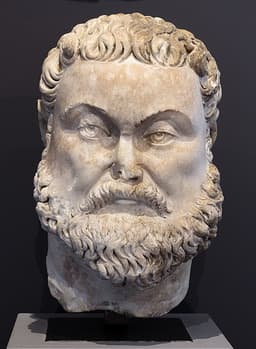
Maximian
General · Ancient
49.8Total
Basic Information
Born
50
250
Died
92
310
Era
Ancient
Ancient
Nationality
China
Roman Empire
Occupation
General
General
Civilization
Eastern
Western
Score Comparison
Military (10%)
88.0
65.0
Political (20%)
30.8
35.1
Influence (20%)
58.0
51.8
Legacy (20%)
49.2
42.5
Leadership (15%)
57.6
61.1
Strategy (15%)
68.0
52.5
TOTAL
55.7
49.8
Dou Xian — Complete Timeline
88 AD
Regent for Emperor He of HanPolitical Action◆ Major
Dou Xian served as regent for the young Emperor He of Han after Emperor Zhang's death. He dominated the court, appointing his relatives to key positions. His regency was marked by military success but also by corruption and nepotism.
RegencyHan DynastyPower
Impact: national
89 AD
Battle of Ikh BayanWar
Dou Xian led a Han expedition against the Northern Xiongnu at the Battle of Ikh Bayan. His forces killed over 13,000 Xiongnu and captured 200,000 livestock. The victory shattered the Northern Xiongnu confederation, ending their threat to the Han dynasty.
BattleXiongnuHan Dynasty
Impact: regional
Inscription on Mount YanranCultural
After the Battle of Ikh Bayan, Dou Xian erected a stone inscription on Mount Yanran (modern-day Mongolia) to commemorate the victory. The inscription, written by Ban Gu, celebrated the Han triumph and marked the furthest extent of Han military reach.
InscriptionCommemorationHan Dynasty
Impact: regional
92 AD
Downfall and DeathPolitical Action◆ Major
Emperor He, with the help of eunuchs, orchestrated a coup against Dou Xian in 92 AD. Dou Xian was stripped of his titles and forced to commit suicide. His family and supporters were purged, ending the Dou clan's dominance.
CoupPurgeHan Dynasty
Impact: nationaldestructive
Maximian — Complete Timeline
285 AD
Appointment as Caesar by DiocletianPolitical Action◆ Major
Diocletian appointed Maximian as Caesar (junior emperor) to govern the Western provinces. This was part of Diocletian's reorganization of the empire, creating a dyarchy. Maximian was given the task of suppressing revolts in Gaul and defending the Rhine frontier.
TetrarchyImperial AppointmentDyarchy
Impact: regional
286 AD
Campaigns in Gaul and BritainWar◆ Major
Maximian campaigned against the Bagaudae rebels in Gaul and later against the usurper Carausius in Britain. He failed to defeat Carausius, who established a breakaway empire in Britain and northern Gaul. The campaign demonstrated the limits of Maximian's military success.
RebellionUsurpationTetrarchy
Impact: regional
Elevation to AugustusPolitical Action◆ Major
Diocletian elevated Maximian to the rank of Augustus, making him co-emperor of the West. Maximian adopted the title Herculius, symbolizing his role as the active, laboring partner to Diocletian's Jovian. This formalized the division of the empire into two halves.
TetrarchyCo-EmperorImperial Division
Impact: regional
305 AD
Forced Abdication and RetirementPolitical Action◆ Major
Maximian abdicated as Augustus alongside Diocletian in a coordinated ceremony at Milan. He retired to a villa in Lucania, but his retirement was forced by Diocletian's plan for an orderly succession. Maximian resented his loss of power and later attempted to reclaim the throne.
AbdicationTetrarchyRetirement
Impact: regional
310 AD
Suicide by HangingOther◆ Major
After multiple failed attempts to regain power, including a rebellion against Constantine, Maximian was captured at Massilia. Constantine spared his life but forced him to commit suicide. Maximian hanged himself, ending the life of the former co-emperor of the Tetrarchy.
SuicideRebellionTetrarchy
Impact: regionaltragic
Expert Analysis
Origins
Dou Xian was born around 45 AD into the powerful Dou clan, a prominent family in the Eastern Han dynasty. His grandfather, Dou Rong, had been a general, and his sister became Empress Dou, wife of Emperor Zhang. Dou Xian's early life was marked by privilege and connections, but also by the violent feuds of court politics. He was initially a palace attendant, gaining influence through his sister's position.
Maximian was born around 250 AD in Sirmium (modern Sremska Mitrovica, Serbia) into a humble family of Illyrian origin. Little is known of his early life, but he rose through the military ranks, a common path for Roman emperors during the Crisis of the Third Century. His career was shaped by the need for strong military leaders to defend the empire's borders.
Rise to Power
Dou Xian's rise began when his sister became empress. After Emperor Zhang's death in 88 AD, Dou Xian served as regent for the young Emperor He, effectively controlling the court. He appointed relatives to key positions and eliminated rivals, including the prince Liu Kang. His military opportunity came when the Northern Xiongnu were weakened by internal strife. In 89 AD, Dou Xian led a coalition of Han forces, southern Xiongnu, and other allies in a campaign that culminated in the Battle of Ikh Bayan. He achieved a decisive victory, killing over 13,000 Xiongnu and capturing 200,000, and erecting an inscription on Mount Yanran to commemorate the triumph.
Maximian's rise was orchestrated by Diocletian, who appointed him Caesar (junior emperor) in 285 AD to govern the Western provinces. Diocletian recognized Maximian's military competence and loyalty. In 286 AD, Maximian was elevated to Augustus, becoming co-emperor. He adopted the title Herculius, symbolizing his role as Hercules to Diocletian's Jupiter. Maximian's early campaigns included suppressing the Bagaudae rebels in Gaul (285-286 AD) and fighting Germanic tribes along the Rhine.
Leadership & Governance
Dou Xian's leadership was autocratic and nepotistic. As regent, he centralized power, appointing his brothers Dou Du and Dou Jing to high offices. He controlled the emperor and the bureaucracy, but his governance was seen as corrupt and heavy-handed. His military leadership was effective: he commanded a large, multi-ethnic army and used strategic alliances with the southern Xiongnu and Wuhuan. However, his political acumen was low (score 30.8), as he failed to secure his position against court intrigues.
Maximian's leadership was more collaborative, as he shared power with Diocletian in the Tetrarchy system. He governed the West, focusing on frontier defense and internal security. He built fortifications, reformed the tax system, and suppressed rebellions. However, his military score of 65.0 reflects mixed success: he failed to defeat the usurper Carausius in Britain (286-293 AD), leading to a separate breakaway state. Maximian was a capable soldier but less innovative than Diocletian.
Triumph & Tragedy
Dou Xian's greatest triumph was the Battle of Ikh Bayan, which shattered the Northern Xiongnu and secured Han dominance in Central Asia. The victory was celebrated with the Mount Yanran inscription, a symbol of Han power. His tragedy was his downfall: in 92 AD, Emperor He, aided by eunuchs, orchestrated a coup. Dou Xian was stripped of titles and forced to commit suicide. His entire clan was purged, erasing his political legacy.
Maximian's triumphs included stabilizing Gaul and the Rhine frontier, and his role in the Tetrarchy, which brought order after decades of chaos. He also suppressed the Bagaudae and fought against Germanic tribes. His tragedies include the failure in Britain, the forced abdication in 305 AD, and his subsequent attempts to regain power. After Diocletian's retirement, Maximian tried to seize power again, first supporting his son Maxentius, then rebelling against Constantine. He was captured at Massilia and forced to commit suicide by hanging in 310 AD.
Character & Destiny
Dou Xian was ambitious and ruthless, but politically naïve. He relied on military success and family connections, ignoring the need to build broader support. His character led to his isolation and eventual destruction. Historical assessments note his military brilliance but his failure as a statesman. He scored 30.8 in political skill, reflecting his inability to navigate court politics.
Maximian was a loyal soldier but lacked political sophistication. He was content to follow Diocletian's lead, but after abdication, he showed indecision and desperation. His character was marked by ambition tempered by deference, but ultimately unable to adapt to the new power dynamics under Constantine. His political score of 35.1 slightly exceeds Dou Xian's, but still low.
Legacy
Dou Xian's legacy is primarily military: his campaign against the Xiongnu is considered one of the greatest Han victories. The Mount Yanran inscription became a symbol of Chinese power. However, his political legacy is negligible due to his purge. His influence score of 58.0 reflects the impact of his victory on Han foreign policy, but his overall legacy score is 49.2.
Maximian's legacy is tied to the Tetrarchy and the reforms of Diocletian. His rule helped stabilize the Western Roman Empire, but his failures in Britain and his later rebellions tarnished his reputation. He is remembered as a competent but secondary figure. His legacy score of 42.5 is lower than Dou Xian's.
Conclusion
Dou Xian had a greater impact than Maximian, despite his lower total score (55.7 vs 49.8). His military achievement at Ikh Bayan was more decisive and far-reaching: it eliminated the Northern Xiongnu threat and expanded Chinese influence into Central Asia. Maximian's achievements were more localized and less enduring. While both met tragic ends, Dou Xian's victory left a lasting mark on history, whereas Maximian's role was largely as a subordinate to Diocletian. Dou Xian's military score of 88.0 far outpaces Maximian's 65.0, and his influence score of 58.0 exceeds Maximian's 51.8. Though both had low political scores, Dou Xian's strategic impact was greater. Therefore, Dou Xian is the more significant historical figure.
Rankings
🥇
Dou XianLeader
Mil: 88.0Pol: 30.8Inf: 58.0
55.7
🥈
Maximian
Mil: 65.0Pol: 35.1Inf: 51.8
49.8
+5.9 behind
How This Comparison Works
Algorithm
Each figure is scored on 6 dimensions (0—100 scale) based on structured historical data: Military (10%), Political (20%), Influence (20%), Legacy (20%), Leadership (15%), Strategy (15%). The weighted total produces the final ranking.
Data Sources
Scores are computed from structured sub-indicators in the database. Scale factors adjust for era (Ancient ×0.85, Modern ×1.0) and civilization size (Eastern ×1.05, Other ×0.80) to account for differences in population and military scale.
Maximum 3 Figures
Comparisons are limited to 2—3 figures to ensure readability and statistical meaningfulness.
Error Margins
±5 points per dimension — Sub-scores are derived from historical records with inherent uncertainty. Two figures within 5 points on a dimension should be considered roughly equivalent in that area.
Total Score Accuracy
±3 points overall — The weighted combination of 6 dimensions produces a total score with approximately ±3 points of uncertainty. Differences of less than 3 points are not statistically significant— the figures are effectively tied.
Known Limitations
- Historical records are incomplete and uneven across civilizations
- Figures from oral-tradition societies may be underrepresented
- Occupation labels can misclassify multi-role figures
- Scores measure capability and impact, not moral character
- Quantitative scoring is a comparison tool, not absolute truth
Capability Radar
Military (10%) — Battles & Warfare
Battles
85
55
Win Rate
90
50
Expansion
85
40
Political (20%) — Governance & Reform
Reform
20
40
Diplomacy
70
50
Economy
30
45
Influence (20%) — Cultural & Global Reach
Cultural
40
30
Global
50
30
Legacy (20%) — Historical Impact
Historical
65
40
Longevity
40
25
Leadership (15%) — Power & Stability
Tenure
60
65
Stability
40
40
Strategy (15%) — Tactics & Innovation
Strategy
85
50
Tactics
80
45
Reform
30
30
Similar Comparisons
Comments & Discussion
No comments yet. Be the first to share your thoughts!