Loading...
Agathocles of Syracuse vs Maximian
Agathocles of Syracuse leads by 7.2 pts · 2 figures compared
…

Agathocles of Syracuse
General · Ancient
57.0Total
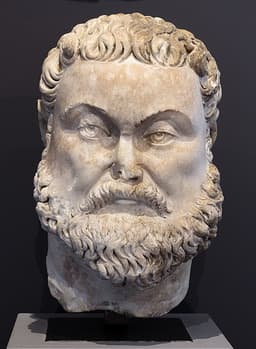
Maximian
General · Ancient
49.8Total
Basic Information
Born
-361
250
Died
-289
310
Era
Ancient
Ancient
Nationality
Sicily
Roman Empire
Occupation
General
General
Civilization
Western
Western
Score Comparison
Military (10%)
78.5
65.0
Political (20%)
43.7
35.1
Influence (20%)
56.4
51.8
Legacy (20%)
47.5
42.5
Leadership (15%)
61.1
61.1
Strategy (15%)
75.0
52.5
TOTAL
57.0
49.8
Agathocles of Syracuse — Complete Timeline
317 BC
Seized Power as Tyrant of SyracusePolitical Action
Agathocles returned from exile and, with a mercenary army, overthrew the oligarchic government of Syracuse. He massacred thousands of wealthy citizens and established himself as tyrant, ruling Syracuse for the next 28 years.
SyracuseTyrannyCivil War
Impact: regionaldestructive
310 BC
Invaded Carthage in North AfricaWar◆ Major
Agathocles launched a daring invasion of Carthage's North African homeland while Syracuse was besieged by a Carthaginian army. He burned his ships to motivate his troops and won several battles, forcing Carthage to recall forces from Sicily.
CarthageInvasionSicilian Wars
Impact: regional
307 BC
Defeated at the Battle of White TunisWar◆ Major
Agathocles suffered a decisive defeat at the Battle of White Tunis against a Carthaginian army led by Hamilcar. The loss forced him to abandon his African campaign and return to Sicily, ending his attempt to conquer Carthage.
CarthageBattleDefeat
Impact: regionaltragic
289 BC
Assassinated by PoisonOther◆ Major
Agathocles was poisoned by his grandson Archagathus, who feared being passed over for succession. His death led to the collapse of his empire in Sicily and southern Italy, as his generals and enemies quickly divided his territories.
AssassinationSuccessionSyracuse
Impact: regionaltragic
Maximian — Complete Timeline
285 AD
Appointment as Caesar by DiocletianPolitical Action◆ Major
Diocletian appointed Maximian as Caesar (junior emperor) to govern the Western provinces. This was part of Diocletian's reorganization of the empire, creating a dyarchy. Maximian was given the task of suppressing revolts in Gaul and defending the Rhine frontier.
TetrarchyImperial AppointmentDyarchy
Impact: regional
286 AD
Campaigns in Gaul and BritainWar◆ Major
Maximian campaigned against the Bagaudae rebels in Gaul and later against the usurper Carausius in Britain. He failed to defeat Carausius, who established a breakaway empire in Britain and northern Gaul. The campaign demonstrated the limits of Maximian's military success.
RebellionUsurpationTetrarchy
Impact: regional
Elevation to AugustusPolitical Action◆ Major
Diocletian elevated Maximian to the rank of Augustus, making him co-emperor of the West. Maximian adopted the title Herculius, symbolizing his role as the active, laboring partner to Diocletian's Jovian. This formalized the division of the empire into two halves.
TetrarchyCo-EmperorImperial Division
Impact: regional
305 AD
Forced Abdication and RetirementPolitical Action◆ Major
Maximian abdicated as Augustus alongside Diocletian in a coordinated ceremony at Milan. He retired to a villa in Lucania, but his retirement was forced by Diocletian's plan for an orderly succession. Maximian resented his loss of power and later attempted to reclaim the throne.
AbdicationTetrarchyRetirement
Impact: regional
310 AD
Suicide by HangingOther◆ Major
After multiple failed attempts to regain power, including a rebellion against Constantine, Maximian was captured at Massilia. Constantine spared his life but forced him to commit suicide. Maximian hanged himself, ending the life of the former co-emperor of the Tetrarchy.
SuicideRebellionTetrarchy
Impact: regionaltragic
Expert Analysis
Origins
Agathocles was born in 361 BC in Thermae, Sicily, to a potter named Carcinus. His family was of humble origins, but Agathocles received a military education. He served in the Syracusan army under the tyrant Damas and later under the oligarchic government. His early life was marked by ambition and a willingness to use violence to advance.
Maximian was born around 250 AD in Sirmium, Pannonia (modern Serbia), into a family of low status. He rose through the Roman military ranks, serving under emperors like Aurelian and Probus. His background was typical of the Illyrian soldier-emperors of the late third century.
Rise to Power
Agathocles seized power in Syracuse in 317 BC after returning from exile with a mercenary army. He overthrew the oligarchic government and massacred thousands of wealthy citizens to consolidate his rule. He then fought against the Carthaginians, who controlled western Sicily, and in 311 BC he was besieged in Syracuse.
Maximian was appointed Caesar (junior emperor) by Diocletian in 285 AD, tasked with governing the Western provinces. He was elevated to Augustus in 286 AD, becoming co-emperor of the West. He adopted the title Herculius, symbolizing his role as the strong arm of Diocletian's reforms.
Leadership & Governance
Agathocles ruled Syracuse as a tyrant, relying on mercenaries and suppressing dissent. His governance was harsh, but he also promoted public works and strengthened the city's defenses. He extended his control over much of eastern Sicily and parts of southern Italy.
Maximian governed the West with a focus on military campaigns. He crushed the Bagaudae rebels in Gaul and fought against Germanic tribes along the Rhine. He also attempted to recover Britain from the usurper Carausius but failed. His administration was subordinate to Diocletian's overall plan, and he lacked independent policy.
Triumph & Tragedy
Agathocles's greatest triumph was his daring invasion of Carthage's North African homeland in 310 BC. While Syracuse was besieged, he sailed with an army and burned his ships to motivate his troops. He won several battles and forced Carthage to recall its forces from Sicily. However, his campaign ended in defeat at the Battle of White Tunis in 307 BC, and he was forced to abandon Africa. His greatest failure was his brutal reign, which ended with his assassination by his grandson in 289 BC, leading to the collapse of his empire.
Maximian's triumph was his role in stabilizing the Western Roman Empire under Diocletian's Tetrarchy. He successfully suppressed revolts in Gaul and defended the Rhine frontier. His tragedy was his inability to secure power after abdication. He attempted to regain the throne twice, first against his son Maxentius and then against Constantine, leading to his capture and forced suicide in 310 AD.
Character & Destiny
Agathocles was ruthless and ambitious, willing to massacre thousands to gain and hold power. He was also a skilled military commander, as shown by his African campaign. His destiny was shaped by his inability to trust even his own family, leading to his poisoning.
Maximian was a capable but subordinate general. His character was marked by loyalty to Diocletian during their joint rule, but he grew restless in retirement. His destiny was sealed by his repeated attempts to reclaim power, which ultimately led to his death.
Legacy
Agathocles is remembered as a typical Sicilian tyrant, a precursor to later Hellenistic rulers. His military score of 78.5 reflects his strategic daring, but his political score of 43.7 and legacy of 47.5 indicate limited long-term impact. His invasion of Africa was a bold move but ultimately failed.
Maximian's legacy is tied to the Tetrarchy. He scored 65.0 in military and 35.1 in political, with a legacy of 42.5. He is often overshadowed by Diocletian and Constantine. His failure in Britain and his rebellions tarnished his reputation.
Conclusion
Agathocles of Syracuse had a greater impact than Maximian, as evidenced by his higher total score of 57.0 versus Maximian's 49.8. Agathocles's invasion of Carthage was a unique and daring operation that influenced later military thinking, while Maximian's contributions were largely administrative and subordinate. Agathocles's military score of 78.5 and strategy of 75.0 far exceed Maximian's 65.0 and 52.5. Although Maximian was part of a larger imperial system, his individual achievements were less significant. Agathocles, despite his brutal tyranny, demonstrated greater initiative and strategic boldness.
Rankings
🥇
Agathocles of SyracuseLeader
Mil: 78.5Pol: 43.7Inf: 56.4
57.0
🥈
Maximian
Mil: 65.0Pol: 35.1Inf: 51.8
49.8
+7.2 behind
How This Comparison Works
Algorithm
Each figure is scored on 6 dimensions (0—100 scale) based on structured historical data: Military (10%), Political (20%), Influence (20%), Legacy (20%), Leadership (15%), Strategy (15%). The weighted total produces the final ranking.
Data Sources
Scores are computed from structured sub-indicators in the database. Scale factors adjust for era (Ancient ×0.85, Modern ×1.0) and civilization size (Eastern ×1.05, Other ×0.80) to account for differences in population and military scale.
Maximum 3 Figures
Comparisons are limited to 2—3 figures to ensure readability and statistical meaningfulness.
Error Margins
±5 points per dimension — Sub-scores are derived from historical records with inherent uncertainty. Two figures within 5 points on a dimension should be considered roughly equivalent in that area.
Total Score Accuracy
±3 points overall — The weighted combination of 6 dimensions produces a total score with approximately ±3 points of uncertainty. Differences of less than 3 points are not statistically significant— the figures are effectively tied.
Known Limitations
- Historical records are incomplete and uneven across civilizations
- Figures from oral-tradition societies may be underrepresented
- Occupation labels can misclassify multi-role figures
- Scores measure capability and impact, not moral character
- Quantitative scoring is a comparison tool, not absolute truth
Capability Radar
Military (10%) — Battles & Warfare
Battles
75
55
Win Rate
70
50
Expansion
70
40
Political (20%) — Governance & Reform
Reform
55
40
Diplomacy
60
50
Economy
50
45
Influence (20%) — Cultural & Global Reach
Cultural
45
30
Global
35
30
Legacy (20%) — Historical Impact
Historical
55
40
Longevity
40
25
Leadership (15%) — Power & Stability
Tenure
65
65
Stability
40
40
Strategy (15%) — Tactics & Innovation
Strategy
75
50
Tactics
80
45
Reform
60
30
Similar Comparisons
Comments & Discussion
No comments yet. Be the first to share your thoughts!