Loading...
Maximian vs Napoleon Bonaparte
Napoleon Bonaparte leads by 21.1 pts · 2 figures compared
…
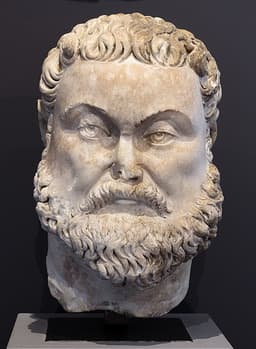
Maximian
General · Ancient
49.8Total

Napoleon Bonaparte
General · Modern
70.9Total
Basic Information
Born
250
1769
Died
310
1821
Era
Ancient
Modern
Nationality
Roman Empire
France
Occupation
General
General
Civilization
Western
Western
Score Comparison
Military (10%)
65.0
94.0
Political (20%)
35.1
72.0
Influence (20%)
51.8
40.0
Legacy (20%)
42.5
80.0
Leadership (15%)
61.1
78.0
Strategy (15%)
52.5
90.0
TOTAL
49.8
70.9
Maximian — Complete Timeline
285 AD
Appointment as Caesar by DiocletianPolitical Action◆ Major
Diocletian appointed Maximian as Caesar (junior emperor) to govern the Western provinces. This was part of Diocletian's reorganization of the empire, creating a dyarchy. Maximian was given the task of suppressing revolts in Gaul and defending the Rhine frontier.
TetrarchyImperial AppointmentDyarchy
Impact: regional
286 AD
Campaigns in Gaul and BritainWar◆ Major
Maximian campaigned against the Bagaudae rebels in Gaul and later against the usurper Carausius in Britain. He failed to defeat Carausius, who established a breakaway empire in Britain and northern Gaul. The campaign demonstrated the limits of Maximian's military success.
RebellionUsurpationTetrarchy
Impact: regional
Elevation to AugustusPolitical Action◆ Major
Diocletian elevated Maximian to the rank of Augustus, making him co-emperor of the West. Maximian adopted the title Herculius, symbolizing his role as the active, laboring partner to Diocletian's Jovian. This formalized the division of the empire into two halves.
TetrarchyCo-EmperorImperial Division
Impact: regional
305 AD
Forced Abdication and RetirementPolitical Action◆ Major
Maximian abdicated as Augustus alongside Diocletian in a coordinated ceremony at Milan. He retired to a villa in Lucania, but his retirement was forced by Diocletian's plan for an orderly succession. Maximian resented his loss of power and later attempted to reclaim the throne.
AbdicationTetrarchyRetirement
Impact: regional
310 AD
Suicide by HangingOther◆ Major
After multiple failed attempts to regain power, including a rebellion against Constantine, Maximian was captured at Massilia. Constantine spared his life but forced him to commit suicide. Maximian hanged himself, ending the life of the former co-emperor of the Tetrarchy.
SuicideRebellionTetrarchy
Impact: regionaltragic
Napoleon Bonaparte — Complete Timeline
1799 AD
Coup of 18 BrumaireOther◆ Major
Napoleon Bonaparte, with support from his brother Lucien and key political figures, overthrew the Directory in a bloodless coup. He established the Consulate with himself as First Consul, effectively becoming the ruler of France. This event ended the French Revolution's most unstable period.
French RevolutionCoupRise to Power
Impact: regional
1804 AD
Promulgation of the Napoleonic CodeOther◆ Major
Napoleon enacted the Civil Code of the French, known as the Napoleonic Code, a comprehensive set of laws that replaced the fragmented feudal legal systems. The code established legal equality, protected property rights, and secularized law. It became the basis for legal systems in many European and world countries.
Legal ReformNapoleonic CodeCivil Law
Impact: globalconstructive
1805 AD
Battle of AusterlitzWar◆ Major
Napoleon's Grande Arm
Napoleonic WarsBattleDecisive Victory
Impact: global
1812 AD
Invasion of RussiaWar◆ Major
Napoleon led the Grande Arm
Napoleonic WarsInvasionDisaster
Impact: globaldestructive
1815 AD
Battle of WaterlooWar◆ Major
Napoleon's French army was defeated by the combined forces of the Duke of Wellington's Anglo-Allied army and Gebhard Leberecht von Bl
Napoleonic WarsBattleFinal Defeat
Impact: globaldestructive
Expert Analysis
maximian-vs-napoleon-bonaparte
# The Emperor's Shadow and the Emperor's Sun
In the summer of 310, a broken man hanged himself in the city of Massilia. He was Maximian, once co-emperor of Rome, Hercules to Diocletian's Jupiter. Eleven years later, on a remote Atlantic island, another fallen emperor died in exile, his last words a jumble of battle cries and the name of his first love. Between these two deaths lies a chasm not merely of time—sixteen centuries—but of destiny. Why did one man, Napoleon Bonaparte, become a name that reshaped the world, while Maximian, who once ruled half the Roman Empire, is now barely a footnote? The answer is not in their victories, which both knew, but in what they built from their defeats.
Origins
Maximian was born around 250 AD in Sirmium, in the rough Balkan provinces that bred Rome's toughest soldiers. His father was a laborer, his mother a woman of modest means. He rose through the ranks on sheer physical courage and loyalty—the kind of man who could inspire troops by fighting beside them, but who never questioned the system that elevated him. The Roman Empire of the third century was a world in crisis, where emperors were made and unmade by legions, and survival meant finding a stronger partner.
Napoleon Bonaparte, born in 1769 on Corsica, entered a world equally turbulent but fundamentally different. The French Revolution had shattered the old order, replacing birthright with merit. Napoleon's father was a minor Corsican nobleman, but the family's real currency was ambition. Where Maximian learned to serve the existing power structure, Napoleon learned to exploit its collapse. He devoured military history and Enlightenment philosophy, dreaming not of restoring Rome but of surpassing it.
Rise to Power
Maximian's path was linear: in 285, the emperor Diocletian appointed him Caesar, then elevated him to Augustus in 286. Diocletian needed a reliable partner to crush revolts in Gaul and Britain, and Maximian was that man—strong, obedient, and unimaginative. His adoption of the title "Herculius" signaled his role: the muscle to Diocletian's mind. When he campaigned against the Bagaudae rebels and the usurper Carausius, he did so with brutal efficiency, but he never conceived of a strategy beyond the next battle.
Napoleon's rise was a series of calculated gambles. At 26, he commanded the Army of Italy and turned a starving, mutinous force into a conquering machine. The Italian campaign of 1796-1797 was not just a military triumph but a political one: he negotiated his own treaties, built his own reputation, and returned to Paris as the hero of the hour. Where Maximian waited for Diocletian's orders, Napoleon created his own opportunities, staging a coup in 1799 to become First Consul. The difference was not talent—both were capable commanders—but vision. Maximian saw power as something to be given; Napoleon saw it as something to be taken.
Leadership & Governance
As emperor of the West, Maximian governed through force and delegation. His military score of 66.5 and strategy of 57.6 reflect a commander competent but not brilliant. He suppressed revolts, built roads, and defended frontiers, but he left no lasting reforms. His political score of 64.1 shows a man who could manage crises but not create systems. When Diocletian abdicated in 305, Maximian followed—not from conviction, but from loyalty. He retired to a villa in Lucania, a man who had ruled half the world and had nothing to show for it.
Napoleon, by contrast, governed with a fury of creation. His military score of 94 and strategy of 93 place him among history's greatest commanders, but his political score of 75 and legacy of 78 reveal a more complex figure. The Napoleonic Code, which standardized French law and influenced legal systems across Europe, was his true monument. He reformed education, established the Bank of France, and built roads and canals that outlasted his empire. Yet his governance was also a dictatorship, suppressing dissent and crowning himself emperor in 1804. Where Maximian ruled by custom, Napoleon ruled by will—and that will demanded constant expansion.
Triumph & Tragedy
Maximian's greatest moment was perhaps his joint rule with Diocletian, the Tetrarchy system that stabilized Rome for two decades. But his tragedy was personal: after abdication, he could not let go. In 308, he attempted to seize power from his own son-in-law Constantine, failed, and fled to Massilia. Captured and disgraced, he chose suicide by hanging in 310. His legacy score of 59.5 reflects a man who was never truly his own master.
Napoleon's triumph was Austerlitz in 1805, where he destroyed a combined Russian and Austrian army with a masterpiece of deception and timing. His tragedy was Waterloo in 1815, where he lost not just a battle but a world. Yet even in defeat, Napoleon shaped his own narrative. Exiled to Saint Helena, he dictated memoirs that transformed him from a tyrant into a romantic hero. His influence score of 82 shows how he conquered not just Europe but its imagination. Maximian died forgotten; Napoleon died a legend.
Character & Destiny
The deepest difference lies in personality. Maximian was a survivor, a man who adapted to circumstances rather than creating them. His leadership score of 77.4 suggests competence, but his strategy of 57.6 reveals a mind that could not see beyond the horizon. He was the perfect lieutenant, the imperfect emperor.
Napoleon was a force of nature, driven by an insatiable hunger for glory. "Impossible," he once said, "is a word to be found only in the dictionary of fools." His leadership score of 80 and strategy of 93 reflect a man who saw every battle as a canvas. But his total score of 82.4, while impressive, also hints at his flaw: he could win wars but not peace. His ambition consumed him, and in consuming him, it consumed his empire.
Legacy
Maximian's legacy is architectural: the Baths of Diocletian in Rome bear his name only because he shared power with his mentor. He is remembered, if at all, as a supporting actor in the Tetrarchy's drama, a man who stood in the shadow of greater minds.
Napoleon's legacy is everywhere. The Napoleonic Code governs millions, his military tactics are still studied, and his name defines an era. Yet his shadow is ambiguous: he spread revolutionary ideals across Europe but also restored slavery and crowned himself emperor. He liberated and enslaved, inspired and destroyed.
Conclusion
Standing at the edge of history, we see two men who rose from modest beginnings to rule the world, and who fell from those heights into despair. Maximian's suicide was a quiet end to a quiet life; Napoleon's death was a final act in a drama he had written himself. The difference between them is not talent or luck, but imagination. Maximian could only rule; Napoleon could dream. And dreams, even when they fail, echo across centuries.
Rankings
🥇
Napoleon BonaparteLeader
Mil: 94.0Pol: 72.0Inf: 40.0
70.9
🥈
Maximian
Mil: 65.0Pol: 35.1Inf: 51.8
49.8
+21.1 behind
How This Comparison Works
Algorithm
Each figure is scored on 6 dimensions (0—100 scale) based on structured historical data: Military (10%), Political (20%), Influence (20%), Legacy (20%), Leadership (15%), Strategy (15%). The weighted total produces the final ranking.
Data Sources
Scores are computed from structured sub-indicators in the database. Scale factors adjust for era (Ancient ×0.85, Modern ×1.0) and civilization size (Eastern ×1.05, Other ×0.80) to account for differences in population and military scale.
Maximum 3 Figures
Comparisons are limited to 2—3 figures to ensure readability and statistical meaningfulness.
Error Margins
±5 points per dimension — Sub-scores are derived from historical records with inherent uncertainty. Two figures within 5 points on a dimension should be considered roughly equivalent in that area.
Total Score Accuracy
±3 points overall — The weighted combination of 6 dimensions produces a total score with approximately ±3 points of uncertainty. Differences of less than 3 points are not statistically significant— the figures are effectively tied.
Known Limitations
- Historical records are incomplete and uneven across civilizations
- Figures from oral-tradition societies may be underrepresented
- Occupation labels can misclassify multi-role figures
- Scores measure capability and impact, not moral character
- Quantitative scoring is a comparison tool, not absolute truth
Capability Radar
Military (10%) — Battles & Warfare
Battles
55
95
Win Rate
50
90
Expansion
40
95
Political (20%) — Governance & Reform
Reform
40
95
Diplomacy
50
80
Economy
45
85
Influence (20%) — Cultural & Global Reach
Cultural
30
85
Global
30
90
Legacy (20%) — Historical Impact
Historical
40
95
Longevity
25
90
Leadership (15%) — Power & Stability
Tenure
65
85
Stability
40
70
Strategy (15%) — Tactics & Innovation
Strategy
50
95
Tactics
45
98
Reform
30
92
Similar Comparisons
Comments & Discussion
No comments yet. Be the first to share your thoughts!