Loading...
Matthias Corvinus vs Tervel of Bulgaria
Matthias Corvinus leads by 14.1 pts · 2 figures compared
…
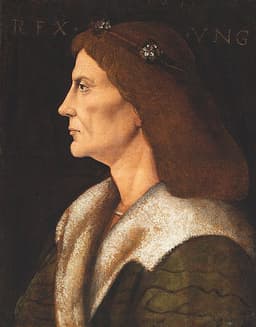
Matthias Corvinus
Emperor · Medieval
60.7Total

Tervel of Bulgaria
Emperor · Medieval
46.6Total
Basic Information
Born
1443
675
Died
1490
721
Era
Medieval
Medieval
Nationality
Hungary
Bulgaria
Occupation
Emperor
Emperor
Civilization
Western
Western
Score Comparison
Military (10%)
80.0
20.0
Political (20%)
59.3
40.8
Influence (20%)
55.0
53.3
Legacy (20%)
52.0
45.8
Leadership (15%)
66.0
62.2
Strategy (15%)
72.0
43.3
TOTAL
60.7
46.6
Matthias Corvinus — Complete Timeline
1458 AD
Coronation as King of HungaryPolitical Action◆ Major
Matthias Corvinus was elected and crowned King of Hungary at the age of 14, following the death of his father John Hunyadi. His coronation was supported by the Hungarian nobility, who expected him to be a figurehead.
CoronationHungaryHunyadi
Impact: nationalconstructive
1460 AD
Establishment of the Black ArmyReform◆ Major
Matthias created a professional standing army, the Black Army, composed of mercenaries and paid soldiers. This force became one of the most effective in Europe, enabling his military campaigns and reducing reliance on feudal levies.
Military ReformBlack ArmyMercenaries
Impact: regionalconstructive
1470 AD
Foundation of the Bibliotheca CorvinianaCultural◆ Major
Matthias established one of the largest and most renowned libraries in Renaissance Europe, the Bibliotheca Corviniana in Buda. The library housed thousands of manuscripts and printed books, attracting scholars from across Europe.
LibraryRenaissanceCulture
Impact: regionalconstructive
1477 AD
War with Frederick III of HabsburgWar◆ Major
Matthias waged a war against Holy Roman Emperor Frederick III over claims to the Hungarian throne and Austrian territories. The conflict ended with the Peace of Pressburg, which recognized Matthias's conquests but failed to secure the imperial crown.
WarHabsburgAustria
Impact: regional
1485 AD
Conquest of ViennaWar◆ Major
Matthias captured Vienna after a prolonged siege, making it his new capital. This conquest marked the peak of Hungarian power, extending his rule over much of Austria and challenging the Habsburgs.
ConquestViennaHabsburg
Impact: regional
Tervel of Bulgaria — Complete Timeline
705 AD
Assistance to Emperor Justinian II in regaining the thronePolitical Action◆ Major
Tervel provided military support to the exiled Byzantine Emperor Justinian II, helping him regain the throne. In return, Tervel was awarded the title of Caesar and received territorial concessions.
AllianceByzantine PoliticsBulgarian-Byzantine Relations
Impact: regional
716 AD
Treaty with the Byzantine Empire (716)Political Action
Tervel signed a treaty with the Byzantine Emperor Theodosius III that established borders, regulated trade, and included a clause for mutual defense. This treaty strengthened Bulgarian-Byzantine relations.
TreatyDiplomacyBulgarian-Byzantine Relations
Impact: regionalconstructive
718 AD
Relief of Constantinople from the Arab Siege (717-718)War◆ Major
Tervel, Khan of Bulgaria, sent a Bulgarian army to aid the Byzantine Empire during the Second Arab Siege of Constantinople. The Bulgarian forces attacked the Arab rear, contributing to the lifting of the siege and saving the city.
SiegeArab-Byzantine WarsBulgarian-Byzantine Alliance
Impact: regionalconstructive
Expert Analysis
Origins
Matthias Corvinus was born in 1443 in Kolozsvár, Kingdom of Hungary, as the second son of John Hunyadi, a leading military and political figure. His father was Regent of Hungary, and his mother was Erzsébet Szilágyi. Matthias received a humanist education, learning Latin, military tactics, and statecraft. His early life was shaped by the turbulent politics of Central Europe, with the Ottoman threat looming. Tervel, born around 675 in the First Bulgarian Empire, was a member of the Dulo clan, the ruling dynasty of the Bulgars. His father was Khan Asparuh, the founder of the Bulgarian state. Tervel's upbringing was rooted in the nomadic warrior traditions of the Bulgars, with emphasis on horsemanship and tribal leadership. The two figures emerged from vastly different cultural and political backgrounds: Matthias from a Christian kingdom integrating Renaissance ideas, Tervel from a pagan-turned-Christian khanate defending its borders.
Rise to Power
Matthias Corvinus was elected King of Hungary in 1458 at age 14, following his father's death and the execution of his older brother László by King Ladislaus V. His election was supported by the Hungarian nobility, who saw him as a figurehead. However, Matthias quickly asserted independence, defeating rival factions and securing the throne. His rise was marked by the need to assert authority over the magnates and the Habsburgs. Tervel became Khan of Bulgaria around 700, succeeding his father Asparuh. He consolidated power by maintaining the Bulgar tribal confederation and expanding into Byzantine territories. His rise was cemented by his intervention in Byzantine affairs, notably supporting the exiled Emperor Justinian II in 705. In return, Justinian awarded Tervel the title of Caesar, a rare honor for a foreign ruler, and gave him gifts and territory. This alliance elevated Tervel's status as a key player in the region.
Leadership & Governance
Matthias Corvinus was an absolute ruler who centralized power, curbing the nobility's influence. He created a professional standing army, the Black Army, which scored 72.0 in strategy and 80.0 in military. His governance included tax reforms, promotion of trade, and patronage of arts and learning. He founded the Bibliotheca Corviniana, one of Europe's largest libraries, with over 2,000 manuscripts. Matthias also established a court of law and encouraged the spread of Renaissance humanism. In contrast, Tervel's leadership was more traditional, relying on tribal alliances and military prowess. His governance involved treaties, such as the 716 treaty with Byzantium, which set borders and regulated trade. Tervel's political score of 40.8 reflects limited institutional development. He ruled through a khanate structure, with less centralization than Matthias. While Matthias built a state apparatus, Tervel focused on external relations and military campaigns.
Triumph & Tragedy
Matthias's greatest triumph was the conquest of Vienna in 1485, making it his capital and extending Hungarian rule over Austria. His Black Army achieved victories against the Ottomans and Habsburgs. However, his failure was the lack of a legitimate heir; his only son John Corvinus was illegitimate and unable to secure the throne after Matthias's death. This led to the collapse of his centralized system and the rise of the Jagellonians. Tervel's triumph was the relief of Constantinople during the Second Arab Siege in 717-718. His forces attacked the Arab rear, contributing to the Byzantine victory that saved Europe from Islamic expansion. Tervel's tragedy is less documented, but his later years saw a strained relationship with Byzantium; he was killed in battle against the Byzantines in 718 or 719, according to some sources, after the alliance collapsed. His death marked the end of Bulgarian dominance for a time.
Character & Destiny
Matthias was ambitious, intelligent, and ruthless. He was known for his patronage of learning and his military acumen, but also for his betrayal of allies and harsh treatment of opponents. His character shaped his destiny: his drive for power led to military success but also alienated the nobility, ensuring his reforms did not outlast him. Tervel was pragmatic and strategic, using diplomacy and military force to secure Bulgarian interests. His decision to aid Justinian II was a calculated move that gained him prestige. However, his reliance on Byzantine alliances ultimately failed when relations soured. Historical assessments note Tervel as a capable leader who exploited opportunities but lacked the institutional foundation to sustain his gains.
Legacy
Matthias Corvinus is remembered as a Renaissance king who brought culture and centralization to Hungary. His Bibliotheca Corviniana became a symbol of learning, though it was dispersed after his death. The Black Army set a precedent for professional armies in Europe. His influence scored 55.0, reflecting his impact on Hungarian national identity. However, his legacy is mixed due to his inability to secure succession. Tervel is celebrated in Bulgaria as a national hero who defended Europe from the Arab threat. The relief of Constantinople is a pivotal event in Byzantine and European history. His legacy score of 45.8 indicates recognition but limited long-term structural impact. Tervel's title of Caesar and his role in Byzantine politics highlight Bulgarian influence in the early 8th century.
Conclusion
Matthias Corvinus had a greater overall impact than Tervel, supported by his higher total score of 60.7 versus 46.6. Matthias's military (80.0) and strategy (72.0) scores reflect his superior military achievements, while his political (59.3) and influence (55.0) scores show his broader state-building efforts. Tervel's military (20.0) and political (40.8) scores are lower, but his influence (53.3) and leadership (62.2) are competitive. Matthias's creation of a Renaissance court and professional army had lasting effects on Hungary and Central Europe, whereas Tervel's success was more situational. The score gap of 14.1 points confirms Matthias's greater historical weight. While Tervel's defense of Constantinople was crucial, Matthias's multifaceted contributions to governance, culture, and military organization give him the edge.
Rankings
🥇
Matthias CorvinusLeader
Mil: 80.0Pol: 59.3Inf: 55.0
60.7
🥈
Tervel of Bulgaria
Mil: 20.0Pol: 40.8Inf: 53.3
46.6
+14.1 behind
How This Comparison Works
Algorithm
Each figure is scored on 6 dimensions (0—100 scale) based on structured historical data: Military (10%), Political (20%), Influence (20%), Legacy (20%), Leadership (15%), Strategy (15%). The weighted total produces the final ranking.
Data Sources
Scores are computed from structured sub-indicators in the database. Scale factors adjust for era (Ancient ×0.85, Modern ×1.0) and civilization size (Eastern ×1.05, Other ×0.80) to account for differences in population and military scale.
Maximum 3 Figures
Comparisons are limited to 2—3 figures to ensure readability and statistical meaningfulness.
Error Margins
±5 points per dimension — Sub-scores are derived from historical records with inherent uncertainty. Two figures within 5 points on a dimension should be considered roughly equivalent in that area.
Total Score Accuracy
±3 points overall — The weighted combination of 6 dimensions produces a total score with approximately ±3 points of uncertainty. Differences of less than 3 points are not statistically significant— the figures are effectively tied.
Known Limitations
- Historical records are incomplete and uneven across civilizations
- Figures from oral-tradition societies may be underrepresented
- Occupation labels can misclassify multi-role figures
- Scores measure capability and impact, not moral character
- Quantitative scoring is a comparison tool, not absolute truth
Capability Radar
Military (10%) — Battles & Warfare
Battles
75
45
Win Rate
80
50
Expansion
75
30
Political (20%) — Governance & Reform
Reform
80
25
Diplomacy
70
55
Economy
75
30
Influence (20%) — Cultural & Global Reach
Cultural
75
25
Global
55
35
Legacy (20%) — Historical Impact
Historical
70
45
Longevity
60
30
Leadership (15%) — Power & Stability
Tenure
70
40
Stability
65
40
Strategy (15%) — Tactics & Innovation
Strategy
80
45
Tactics
85
40
Reform
85
20
Similar Comparisons
Comments & Discussion
No comments yet. Be the first to share your thoughts!