Loading...
Henry VIII vs Matthias Corvinus
Matthias Corvinus leads by 0.5 pts · 2 figures compared
…

Henry VIII
Emperor · Medieval
60.2Total
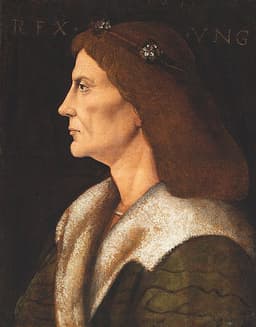
Matthias Corvinus
Emperor · Medieval
60.7Total
Basic Information
Born
1491
1443
Died
1547
1490
Era
Medieval
Medieval
Nationality
England
Hungary
Occupation
Emperor
Emperor
Civilization
Western
Western
Score Comparison
Military (10%)
55.0
80.0
Political (20%)
72.0
59.3
Influence (20%)
65.0
55.0
Legacy (20%)
40.0
52.0
Leadership (15%)
78.0
66.0
Strategy (15%)
60.0
72.0
TOTAL
60.2
60.7
Henry VIII — Complete Timeline
1513 AD
Battle of the SpursWar
Henry VIII led English forces to victory against the French at the Battle of the Spurs in northern France. The battle was part of the War of the League of Cambrai and resulted in the capture of several French nobles, boosting Henry's military reputation.
WarFranceMilitary Campaign
Impact: regional
1533 AD
Marriage to Catherine of Aragon AnnulledPolitical Action◆ Major
Thomas Cranmer, Archbishop of Canterbury, annulled Henry VIII's marriage to Catherine of Aragon. This act defied Pope Clement VII and led to England's break from the Catholic Church, as Henry sought a male heir with Anne Boleyn.
MarriageReformationPapal Authority
Impact: national
1534 AD
Act of Supremacy PassedPolitical Action
Henry VIII secured passage of the Act of Supremacy, declaring himself Supreme Head of the Church of England. This formalized the break from the Roman Catholic Church, following the Pope's refusal to annul his marriage to Catherine of Aragon.
ReformationChurch of EnglandRoyal Supremacy
Impact: national
1536 AD
Dissolution of the MonasteriesPolitical Action◆ Major
Henry VIII ordered the dissolution of monasteries in England, Wales, and Ireland. The Crown seized monastic lands and wealth, redistributing them to loyal nobles and enriching the treasury, while destroying a major pillar of Catholic influence.
ReformationLand ReformReligious Change
Impact: nationaldestructive
Execution of Anne BoleynPolitical Action◆ Major
Henry VIII had his second wife, Anne Boleyn, executed on charges of treason, adultery, and incest. Her death removed a political rival and allowed Henry to marry Jane Seymour, but it also demonstrated his ruthless consolidation of power.
MarriageExecutionCourt Politics
Impact: nationaltragic
Matthias Corvinus — Complete Timeline
1458 AD
Coronation as King of HungaryPolitical Action◆ Major
Matthias Corvinus was elected and crowned King of Hungary at the age of 14, following the death of his father John Hunyadi. His coronation was supported by the Hungarian nobility, who expected him to be a figurehead.
CoronationHungaryHunyadi
Impact: nationalconstructive
1460 AD
Establishment of the Black ArmyReform◆ Major
Matthias created a professional standing army, the Black Army, composed of mercenaries and paid soldiers. This force became one of the most effective in Europe, enabling his military campaigns and reducing reliance on feudal levies.
Military ReformBlack ArmyMercenaries
Impact: regionalconstructive
1470 AD
Foundation of the Bibliotheca CorvinianaCultural◆ Major
Matthias established one of the largest and most renowned libraries in Renaissance Europe, the Bibliotheca Corviniana in Buda. The library housed thousands of manuscripts and printed books, attracting scholars from across Europe.
LibraryRenaissanceCulture
Impact: regionalconstructive
1477 AD
War with Frederick III of HabsburgWar◆ Major
Matthias waged a war against Holy Roman Emperor Frederick III over claims to the Hungarian throne and Austrian territories. The conflict ended with the Peace of Pressburg, which recognized Matthias's conquests but failed to secure the imperial crown.
WarHabsburgAustria
Impact: regional
1485 AD
Conquest of ViennaWar◆ Major
Matthias captured Vienna after a prolonged siege, making it his new capital. This conquest marked the peak of Hungarian power, extending his rule over much of Austria and challenging the Habsburgs.
ConquestViennaHabsburg
Impact: regional
Expert Analysis
Origins
**Henry VIII** (1491–1547) was born the second son of Henry VII and Elizabeth of York. He was not groomed for kingship until his elder brother Arthur died in 1502. Henry received a humanist education under scholars like John Skelton, learning Latin, theology, and music. His father, the first Tudor king, had consolidated power after the Wars of the Roses, leaving Henry a stable throne and a full treasury. Henry's early piety was genuine: he attended mass daily and wrote a defense of the seven sacraments against Martin Luther, earning him the title 'Defender of the Faith' from Pope Leo X.
**Matthias Corvinus** (1443–1490) was born in Cluj-Napoca, the second son of John Hunyadi, a leading military commander and regent of Hungary. His family was not royal but rose through military prowess. After his father's death, Matthias was elected king at age 14, with support from the lesser nobility and the influence of his uncle, Michael Szilágyi. His early years were dominated by struggles with the Habsburgs and internal factions. He received a Renaissance education, learning Latin, history, and military science, which later shaped his cultural patronage.
Rise to Power
Henry VIII ascended the throne in 1509 at age 17, a popular and athletic king. His early reign was marked by war with France, notably the capture of Tournai and Thérouanne in 1513. He relied on Cardinal Thomas Wolsey to manage domestic and foreign policy. Henry's desire for a male heir and his infatuation with Anne Boleyn led him to seek an annulment of his marriage to Catherine of Aragon. When Pope Clement VII refused, Henry broke with Rome, passing the Act of Supremacy in 1534, which made him Supreme Head of the Church of England. This was the turning point of his reign, concentrating both spiritual and temporal authority in his hands.
Matthias Corvinus's rise was precarious. After his father's death, the Hungarian nobility elected the young king but under the regency of his uncle. Civil war erupted as the Habsburgs contested the throne. Matthias defeated the Habsburg claimant Frederick III and secured his position by 1463. He then turned to consolidating power, centralizing the administration, and building a professional army. His military campaigns against the Ottomans and his conquest of Moravia, Silesia, and Austria expanded Hungarian influence. By 1485, he captured Vienna, making it his capital.
Leadership & Governance
Henry VIII ruled as a strong-willed monarch, centralizing power through the Reformation. He dissolved monasteries between 1536 and 1541, seizing their wealth to enrich the crown and reward loyal supporters. His government relied on ministers like Thomas Cromwell, who implemented administrative reforms. Henry's leadership was personal and often arbitrary: he executed two of his six wives, several ministers, and many nobles. His governance was effective in consolidating royal authority but wasteful in foreign wars and lavish court spending.
Matthias Corvinus was a reformer and patron. He established a centralized royal administration, reducing the power of the magnates. He created the Black Army, a standing mercenary force of up to 30,000 men, which was loyal to the king rather than nobles. He reformed the legal system, introduced a new tax system, and promoted trade. His court in Buda became a center of Renaissance culture, housing the Bibliotheca Corviniana with over 2,000 manuscripts. Matthias's leadership was strategic and forward-looking, but his centralization alienated the nobility, leading to instability after his death.
Triumph & Tragedy
Henry VIII's greatest triumph was the establishment of the Church of England and the break from Rome, which laid the foundation for English Protestantism and national identity. His dissolution of monasteries redistributed land and wealth, but the social costs were high: many monks and nuns were displaced, and the poor lost charitable support. His military campaigns were mixed: he conquered Boulogne in 1544 but failed to achieve lasting gains. His personal tragedy was his failure to secure a stable succession: his only surviving son, Edward VI, was sickly, and his daughters were declared illegitimate at various times.
Matthias Corvinus's triumph was the creation of a powerful kingdom that rivaled the Habsburgs. His Black Army was a formidable force, and his conquest of Vienna in 1485 marked the zenith of Hungarian power. His library and patronage of Italian artists and scholars made Buda a Renaissance hub. However, his centralization and high taxes bred resentment among the nobility. His greatest tragedy was that his reforms did not outlast him: after his death in 1490, the Black Army was disbanded, the kingdom fragmented, and Hungary fell to the Ottomans in 1526. His library was scattered, and only about 200 volumes survive.
Character & Destiny
Henry VIII was intelligent, confident, and increasingly paranoid. His desire for a male heir drove his marital and religious decisions. He was ruthless and self-centered, executing those who crossed him. His character shaped a reign of dramatic change but also of instability. Historians note his score of 78.0 in leadership reflects his ability to command loyalty and enforce his will, but his military score of 55.0 shows his limitations as a commander.
Matthias Corvinus was ambitious, cultured, and pragmatic. He was a skilled military leader (scoring 80.0) and a strategist (72.0). He valued learning and surrounded himself with scholars. However, his lack of a legitimate heir led to a succession crisis. His character was that of a Renaissance prince: a blend of warrior and patron. His political score of 59.3 reflects the fragility of his achievements.
Legacy
Henry VIII's legacy is profound. He transformed England's religion and government, setting the stage for the English Reformation and the rise of parliamentary sovereignty. The Church of England remains today. His reign centralized power and expanded the navy. However, his legacy is also one of tyranny and cultural destruction. His overall score of 60.2 reflects mixed impact.
Matthias Corvinus left a legacy of military and cultural achievement but lacked enduring institutions. His Black Army and library were short-lived. He is remembered as a national hero in Hungary, but his kingdom collapsed soon after his death. His influence score of 55.0 indicates limited long-term impact compared to Henry.
Conclusion
While both kings were significant in their realms, Henry VIII had a greater lasting impact on world history. His break with Rome altered the religious landscape of Europe and his centralization of power shaped the modern British state. Matthias Corvinus's achievements were impressive but ephemeral. With a total score of 60.2 versus 60.7, the difference is narrow, but Henry's legacy in terms of influence and lasting institutions is more profound. Henry VIII's political score of 72.0 and leadership of 78.0 outweighed Matthias's military prowess. Thus, Henry VIII is the more historically consequential figure.
Rankings
🥇
Matthias CorvinusLeader
Mil: 80.0Pol: 59.3Inf: 55.0
60.7
🥈
Henry VIII
Mil: 55.0Pol: 72.0Inf: 65.0
60.2
+0.5 behind
How This Comparison Works
Algorithm
Each figure is scored on 6 dimensions (0—100 scale) based on structured historical data: Military (10%), Political (20%), Influence (20%), Legacy (20%), Leadership (15%), Strategy (15%). The weighted total produces the final ranking.
Data Sources
Scores are computed from structured sub-indicators in the database. Scale factors adjust for era (Ancient ×0.85, Modern ×1.0) and civilization size (Eastern ×1.05, Other ×0.80) to account for differences in population and military scale.
Maximum 3 Figures
Comparisons are limited to 2—3 figures to ensure readability and statistical meaningfulness.
Error Margins
±5 points per dimension — Sub-scores are derived from historical records with inherent uncertainty. Two figures within 5 points on a dimension should be considered roughly equivalent in that area.
Total Score Accuracy
±3 points overall — The weighted combination of 6 dimensions produces a total score with approximately ±3 points of uncertainty. Differences of less than 3 points are not statistically significant— the figures are effectively tied.
Known Limitations
- Historical records are incomplete and uneven across civilizations
- Figures from oral-tradition societies may be underrepresented
- Occupation labels can misclassify multi-role figures
- Scores measure capability and impact, not moral character
- Quantitative scoring is a comparison tool, not absolute truth
Capability Radar
Military (10%) — Battles & Warfare
Battles
35
75
Win Rate
40
80
Expansion
25
75
Political (20%) — Governance & Reform
Reform
90
80
Diplomacy
70
70
Economy
65
75
Influence (20%) — Cultural & Global Reach
Cultural
80
75
Global
75
55
Legacy (20%) — Historical Impact
Historical
85
70
Longevity
80
60
Leadership (15%) — Power & Stability
Tenure
85
70
Stability
55
65
Strategy (15%) — Tactics & Innovation
Strategy
45
80
Tactics
30
85
Reform
60
85
Similar Comparisons
Comments & Discussion
No comments yet. Be the first to share your thoughts!