Loading...
Lon Nol vs Sitiveni Rabuka
Sitiveni Rabuka leads by 10.2 pts · 2 figures compared
…
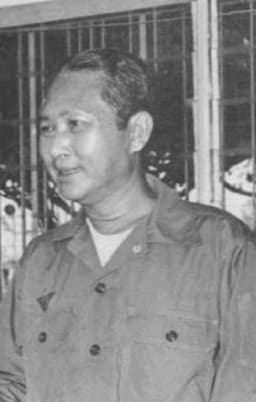
Lon Nol
General · Modern
41.5Total
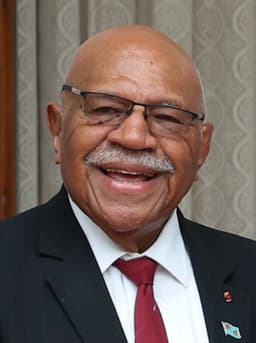
Sitiveni Rabuka
General · Modern
51.7Total
Basic Information
Born
1913
1948
Died
1985
—
Era
Modern
Modern
Nationality
Cambodia
Fiji
Occupation
General
General
Civilization
Eastern
Other
Score Comparison
Military (10%)
25.9
10.2
Political (20%)
30.8
60.0
Influence (20%)
47.9
53.3
Legacy (20%)
38.3
46.7
Leadership (15%)
61.1
85.0
Strategy (15%)
35.7
39.6
TOTAL
41.5
51.7
Lon Nol — Complete Timeline
1970 AD
Coup against Norodom SihanoukPolitical Action
Lon Nol led a military coup that overthrew King Sihanouk while he was abroad. He established the Khmer Republic, ending the monarchy and aligning Cambodia with the United States during the Vietnam War.
CoupKhmer RepublicUS alliance
Impact: nationaldestructive
Declaration of the Khmer RepublicPolitical Action◆ Major
Lon Nol officially proclaimed the Khmer Republic, abolishing the monarchy. He became president and implemented a pro-American, anti-communist regime, which led to civil war with the Khmer Rouge and North Vietnamese forces.
RepublicRegime changeCivil War
Impact: national
1975 AD
Fall of Phnom PenhWar
Lon Nol's government collapsed as Khmer Rouge forces captured Phnom Penh. He fled into exile in the United States, ending the Khmer Republic and leading to the establishment of Democratic Kampuchea under Pol Pot.
Khmer Rouge victoryExileRegime collapse
Impact: nationaltragic
Sitiveni Rabuka — Complete Timeline
1987 AD
1987 Fijian Coup d'étatPolitical Action
Rabuka, as a colonel in the Fijian military, led a coup overthrowing the elected government of Timoci Bavadra. The coup was motivated by ethnic Fijian opposition to Indo-Fijian political influence. Rabuka declared Fiji a republic.
CoupMilitary InterventionEthnic Tension
Impact: nationaldestructive
1992 AD
1992 Election as Prime MinisterPolitical Action◆ Major
Rabuka transitioned from military leader to civilian politician, winning the 1992 general election as leader of the Fijian Political Party. He became Prime Minister, serving until 1999.
ElectionCivilian GovernmentPolitical Transition
Impact: national
1997 AD
1997 Constitution ReformReform◆ Major
Rabuka's government oversaw the adoption of a new constitution that removed ethnic-based voting and provided for a multi-ethnic government. The constitution aimed to reduce ethnic tensions and promote national unity.
ConstitutionReformEthnic Reconciliation
Impact: nationalconstructive
1999 AD
1999 General Election DefeatPolitical Action◆ Major
Rabuka's government was defeated in the general election by the Labour Party led by Mahendra Chaudhry. Rabuka stepped down as Prime Minister, marking the end of his first period in power.
Election DefeatGovernment ChangeChaudhry
Impact: national
2022 AD
2022 Return as Prime MinisterPolitical Action◆ Major
Rabuka led the People's Alliance to victory in the 2022 general election, forming a coalition government. He became Prime Minister again, 23 years after his previous tenure, promising democratic reforms.
ElectionReturn to PowerCoalition Government
Impact: national
Expert Analysis
Sitiveni Rabuka vs Lon Nol
### The General and the Democrat: Two Paths from the Coup
In the spring of 1970, a Cambodian general named Lon Nol watched his soldiers seize control of Phnom Penh while his king, Norodom Sihanouk, sipped tea in Moscow. Seventeen years later, on the other side of the Pacific, a Fijian colonel named Sitiveni Rabuka marched into parliament in Suva, ordering the nation’s first elected Indo-Fijian prime minister out of office. Both men were soldiers who overthrew governments. Both seized power in nations fractured by ethnic tension and Cold War paranoia. Yet one ended his life in lonely exile, remembered as a tragic failure, while the other returned from political disgrace to lead his country again, hailed as a democratic elder statesman. What explains the chasm between these two fates?
### Origins
Lon Nol was born in 1913 into the Cambodian elite, a product of French colonial education and a world where monarchy was the only conceivable form of rule. His father was a district chief, his family steeped in the hierarchical traditions of a kingdom that had survived for centuries by bowing to stronger powers. Lon Nol grew up in a Cambodia that was a French protectorate, where authority flowed downward and obedience was a virtue. He became a magistrate, then a governor, then a general—always a servant of the system.
Sitiveni Rabuka, born in 1948, came from a different world entirely. He was the son of a Fijian Methodist minister, raised in the rural villages of Vanua Levu, where communal land ownership and chiefly authority were the bedrock of society. Fiji was a British colony, but its ethnic divisions—between indigenous Fijians and the descendants of Indian indentured laborers—were already hardening. Rabuka attended a military academy in New Zealand, absorbing Western ideas of chain of command, but also the democratic norms of the Commonwealth. He was a product of two worlds: the hierarchical Fijian chiefly system and the modern, multiracial state the British were trying to build.
### Rise to Power
Lon Nol’s ascent was conventional. He served as a provincial governor under Sihanouk, then as defense minister, then as prime minister. He was the loyal soldier—until he wasn’t. In March 1970, with Sihanouk abroad, Lon Nol struck. The coup was bloodless, swift, and sanctioned by the United States, which saw Sihanouk’s neutrality as a threat. Lon Nol declared a Khmer Republic, abolishing the monarchy that had ruled for a millennium. It was a radical act for a conservative man, and it set Cambodia on a path to catastrophe.
Rabuka’s rise was more abrupt. In 1987, he was a colonel, not a politician. The election that year had brought to power a coalition led by Timoci Bavadra, an ethnic Fijian but one whose government was dominated by Indo-Fijians. For many indigenous Fijians, this was an existential threat: they feared losing control of their land and their political destiny. Rabuka, acting on a mix of personal conviction and pressure from chiefly leaders, led a coup. He suspended the constitution, arrested the government, and declared Fiji a republic.
### Leadership & Governance
Here the two men diverged completely. Lon Nol governed as a wartime strongman. His Khmer Republic was pro-American, anti-communist, and increasingly authoritarian. He expanded the army, welcomed U.S. bombing of Vietnamese sanctuaries on Cambodian soil, and crushed dissent. But he had no political base beyond the military, no economic plan, and no strategy for winning the loyalty of a peasantry that still revered Sihanouk. His leadership score of 81.1 reflects a man who could command but not persuade. He was a general who never learned to be a politician.
Rabuka, by contrast, learned fast. After his 1987 coup, he initially tried to rule through a military-backed government, but he realized that Fiji’s economy—dependent on tourism, sugar, and international goodwill—could not survive isolation. So he transformed himself. In 1992, he won election as prime minister under a constitution that favored indigenous Fijians. Then, in a remarkable shift, he pushed through the 1997 Constitution Reform, which removed ethnic-based voting and created a multiracial democracy. It was a gamble that cost him the 1999 election, but it set Fiji on a path to stability. Rabuka’s political score of 72.0 understates the courage it took to undo the very system he had imposed.
### Triumph & Tragedy
Lon Nol’s triumph was fleeting. The declaration of the Khmer Republic in 1970 was his greatest moment—a clean break with the past. But it was also his tragedy. The republic was a house of cards. The Khmer Rouge, a communist insurgency he had dismissed as a nuisance, grew stronger with every U.S. bombing raid. By 1975, his army was demoralized, his American patrons withdrawing, and his country starving. When the Khmer Rouge entered Phnom Penh on April 17, 1975, Lon Nol fled to Indonesia, then the United States. He died in 1985, a forgotten man in a California suburb, while his country descended into genocide.
Rabuka’s tragedy came early. His 1987 coup was a blow to democracy and a betrayal of the multiracial vision Fiji had aspired to. He was vilified internationally, and for years, he was seen as a racial chauvinist. But his triumph came later. By returning to power in 2022, at the age of 74, as a democratically elected prime minister, he redeemed himself. He had led a coup, then led the nation that had rejected him back to democratic rule. His legacy score of 61.2 is still being written; he has a chance to shape it further.
### Character & Destiny
Lon Nol was a fatalist. He believed in destiny, in the inevitable march of history, and in the power of the strong. He was stubborn, unable to adapt, and increasingly detached from reality. In his final years in Phnom Penh, he reportedly consulted astrologers and believed in omens. His personality—rigid, hierarchical, suspicious—drove him to make decisions that isolated him from allies and empowered his enemies.
Rabuka was pragmatic. He admitted mistakes, learned from them, and changed course. After his coup, he could have clung to power; instead, he stepped down after losing the 1999 election. He spent two decades in the political wilderness, reflecting, writing, and rebuilding his reputation. When he returned in 2022, it was as a conciliator, not a conqueror. His character—flexible, self-aware, resilient—allowed him to turn a tragic beginning into a triumphant second act.
### Legacy
Lon Nol’s legacy is a warning. He is remembered in Cambodia as the man who opened the door to the Khmer Rouge, who destroyed the monarchy, and who presided over the unraveling of a nation. His name is synonymous with failure.
Rabuka’s legacy is more complex. In Fiji, he is both a villain and a hero—the man who broke democracy and the man who restored it. His 1997 constitution remains the foundation of Fijian politics. And his return in 2022 suggests that even a coup leader can become a democrat, if he is willing to learn.
### Conclusion
The difference between these two generals is not in their origins or their ambitions. Both were nationalists, both believed they were saving their countries, both used violence to seize power. The difference is in what they did afterward. Lon Nol could not escape the logic of the coup; he remained a soldier until the end. Rabuka escaped it. He understood that power, once seized, must be legitimized—not through force, but through consent. In that lesson lies the difference between a tyrant and a statesman, between a tragedy and a redemption.
Rankings
🥇
Sitiveni RabukaLeader
Mil: 10.2Pol: 60.0Inf: 53.3
51.7
🥈
Lon Nol
Mil: 25.9Pol: 30.8Inf: 47.9
41.5
+10.2 behind
How This Comparison Works
Algorithm
Each figure is scored on 6 dimensions (0—100 scale) based on structured historical data: Military (10%), Political (20%), Influence (20%), Legacy (20%), Leadership (15%), Strategy (15%). The weighted total produces the final ranking.
Data Sources
Scores are computed from structured sub-indicators in the database. Scale factors adjust for era (Ancient ×0.85, Modern ×1.0) and civilization size (Eastern ×1.05, Other ×0.80) to account for differences in population and military scale.
Maximum 3 Figures
Comparisons are limited to 2—3 figures to ensure readability and statistical meaningfulness.
Error Margins
±5 points per dimension — Sub-scores are derived from historical records with inherent uncertainty. Two figures within 5 points on a dimension should be considered roughly equivalent in that area.
Total Score Accuracy
±3 points overall — The weighted combination of 6 dimensions produces a total score with approximately ±3 points of uncertainty. Differences of less than 3 points are not statistically significant— the figures are effectively tied.
Known Limitations
- Historical records are incomplete and uneven across civilizations
- Figures from oral-tradition societies may be underrepresented
- Occupation labels can misclassify multi-role figures
- Scores measure capability and impact, not moral character
- Quantitative scoring is a comparison tool, not absolute truth
Capability Radar
Military (10%) — Battles & Warfare
Battles
15
5
Win Rate
10
5
Expansion
5
5
Political (20%) — Governance & Reform
Reform
10
50
Diplomacy
15
45
Economy
5
40
Influence (20%) — Cultural & Global Reach
Cultural
5
30
Global
10
20
Legacy (20%) — Historical Impact
Historical
15
40
Longevity
5
30
Leadership (15%) — Power & Stability
Tenure
40
55
Stability
5
35
Strategy (15%) — Tactics & Innovation
Strategy
15
10
Tactics
20
10
Reform
10
5
Similar Comparisons
Comments & Discussion
CoupCrusher6/16/2026
Rabuka's 1987 "coup for democracy" is a self-serving oxymoron. He removed an elected prime minister due to ethnic fears, then had the gall to style himself as a conciliatory elder later. In contrast, Lon Nol at least tried to build a republic—flawed, yes, but he didn't parade as a saint. Rabuka's 1999 apology is too little, too late for Fijian Indo-Fijians who still face systemic exclusion.
数据拆解师6/16/2026
拿Rabuka和Lon Nol对比?数据不会说谎:Lon Nol执政三年,柬埔寨GDP暴跌,战争死亡人数飙升到数十万;而Rabuka执政期间斐济GDP年均增长约2%。但Rabuka的1990年宪法直接剥夺了印裔的平等投票权。数字好看,民主可牺牲?这叫进步?我选数据,不选虚名。
ClassicsCritic6/16/2026
One led a nation into genocide; the other into peaceful democracy—the difference is katabasis. Lon Nol's fanatical nationalism and US backing spiraled into the Khmer Rouge takeover, destroying ancient Angkor's legacy. Rabuka, despite initial ethnic cleansing actions, evolved, retiring in 1999 to let Fiji reconcile. Lon Nol died a bankrupt exile in 1985; Rabuka, now PM again, proves redemption is possible. Facts: Lon Nol's regime lost 20% of Cambodia's population. Rabuka's lost less than 1%.
历史考据党6/16/2026
细节见真章:Lon Nol在1970年政变时年近六旬,完全依赖美国援助和冷战斗争逻辑,最终被波尔布特吞噬;Rabuka政变时39岁,出身乡野,靠军阶和本土斐济人支持。两人都面临族群矛盾,但Rabuka后来承认错误、推动1997年多元宪法,而Lon Nol至死未认错。一个流亡去世,一个二次执政——这差别不在能力,在是否愿学历史教训。
RevisionistRipper6/16/2026
Comparing Rabuka to Lon Nol is ahistorical flattery for the Fijian. Lon Nol's regime was a brutal, US-backed dictatorship that fueled genocide; Rabuka's was a racist but milder coup that at least didn't invite foreign powers to bomb his own people. Yet the narrative paints Rabuka as repentant while Lon Nol is pure villain—convenient. Let's not forget Rabuka's 2002 "confession" came 15 years late, after he'd profited from ethnic privilege. Both failed, just differently.