Loading...
Lon Nol vs Ramon Castilla
Ramon Castilla leads by 18.2 pts · 2 figures compared
…
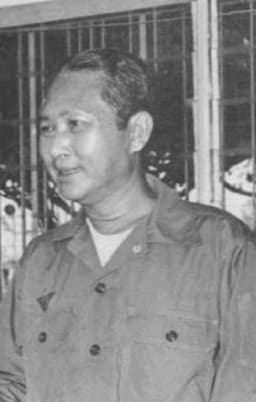
Lon Nol
General · Modern
41.5Total
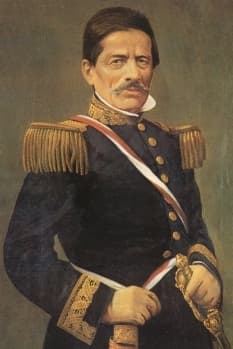
Ramon Castilla
General · Modern
59.7Total
Basic Information
Born
1913
1797
Died
1985
1867
Era
Modern
Modern
Nationality
Cambodia
Peru
Occupation
General
General
Civilization
Eastern
Western
Score Comparison
Military (10%)
25.9
40.0
Political (20%)
30.8
72.0
Influence (20%)
47.9
56.7
Legacy (20%)
38.3
52.0
Leadership (15%)
61.1
78.0
Strategy (15%)
35.7
60.0
TOTAL
41.5
59.7
Lon Nol — Complete Timeline
1970 AD
Coup against Norodom SihanoukPolitical Action
Lon Nol led a military coup that overthrew King Sihanouk while he was abroad. He established the Khmer Republic, ending the monarchy and aligning Cambodia with the United States during the Vietnam War.
CoupKhmer RepublicUS alliance
Impact: nationaldestructive
Declaration of the Khmer RepublicPolitical Action◆ Major
Lon Nol officially proclaimed the Khmer Republic, abolishing the monarchy. He became president and implemented a pro-American, anti-communist regime, which led to civil war with the Khmer Rouge and North Vietnamese forces.
RepublicRegime changeCivil War
Impact: national
1975 AD
Fall of Phnom PenhWar
Lon Nol's government collapsed as Khmer Rouge forces captured Phnom Penh. He fled into exile in the United States, ending the Khmer Republic and leading to the establishment of Democratic Kampuchea under Pol Pot.
Khmer Rouge victoryExileRegime collapse
Impact: nationaltragic
Ramon Castilla — Complete Timeline
1824 AD
Battle of AyacuchoWar
Castilla fought as a junior officer in the decisive Battle of Ayacucho, which ended Spanish rule in Peru. This victory secured Peruvian independence and marked the end of the Spanish Empire in South America, shaping Castilla's nationalist views.
Peruvian War of IndependenceBattleLiberation
Impact: regional
1845 AD
First Presidency of PeruPolitical Action◆ Major
Castilla was elected President of Peru in 1845, serving until 1851. His first term focused on economic development, including the guano boom, and infrastructure projects such as railroads and ports, modernizing the Peruvian state.
PresidencyEconomic DevelopmentGuano
Impact: nationalconstructive
1854 AD
Abolition of Slavery in PeruReform◆ Major
During his second presidency, Castilla issued a decree abolishing slavery in Peru on December 3, 1854. This reform freed approximately 25,000 slaves and was part of a broader liberal agenda, though it faced opposition from slave-owning elites.
AbolitionSlaveryHuman Rights
Impact: nationalprogressive
Abolition of Indigenous TributeReform◆ Major
Castilla also abolished the indigenous tribute tax in 1854, which had been a burden on native communities since colonial times. This measure aimed to integrate indigenous peoples into the Peruvian state as equal citizens, though its implementation was uneven.
Indigenous RightsTax ReformCitizenship
Impact: nationalprogressive
1855 AD
Second Presidency and Guano BoomPolitical Action◆ Major
Castilla served a second term from 1855 to 1862, during the peak of the guano export boom. He used guano revenues to fund public works, pay off foreign debt, and modernize the military, but also faced criticism for corruption and over-reliance on a single resource.
PresidencyGuanoModernization
Impact: nationalconstructive
1860 AD
Constitutional Reform of 1860Reform◆ Major
Castilla oversaw the adoption of a new constitution in 1860, which established a centralized republic with a strong executive. The constitution remained in effect until 1920 and shaped Peru's political structure, though it limited regional autonomy.
ConstitutionPolitical ReformCentralization
Impact: nationalconstructive
Expert Analysis
Ramon Castilla vs Lon Nol
# The General and the Reformer: Two Paths from the Barracks to Power
On a humid November morning in 1970, Lon Nol stood before a crowd in Phnom Penh, his uniform crisp, his voice ringing with certainty as he proclaimed the Khmer Republic. Half a world away and more than a century earlier, in December 1854, Ramon Castilla signed a decree that would echo through Peruvian history: the abolition of slavery. Both men were generals who seized the levers of power. Both believed they were saving their nations. Yet one is remembered as a liberator, the other as a tragic architect of catastrophe. What explains the chasm between them?
Origins
Lon Nol was born in 1913 into a provincial Cambodian elite, the son of a district chief who served under French colonial rule. He grew up in a world of hierarchy and deference, where power flowed from patrons and kings. The French had drained Cambodia of its sovereignty, and the young Lon Nol absorbed a deep, anxious nationalism—a desire to restore dignity to a kingdom he felt was being erased. He entered the colonial military, a path of order and obedience, where he learned that authority came from the barrel of a gun.
Ramon Castilla, born in 1797 in Tarapacá, then part of the Viceroyalty of Peru, came from a different crucible. His father was a Spanish official, his mother a local criolla. The world of his youth was one of revolution and collapse. The Spanish Empire was crumbling, and South America was in flames. Castilla joined the royalist army as a young man, fighting for the crown, but after the tide turned, he switched sides—a pragmatic choice that would define his career. He was not a man of fixed loyalties but of flexible ambition, shaped by an era where old certainties died and new ones had to be forged.
Rise to Power
Lon Nol’s ascent was slow, cautious, and utterly dependent on a single figure: Prince Norodom Sihanouk. Sihanouk, the charismatic king turned politician, had dominated Cambodia since the 1950s, balancing Cold War pressures with deft neutrality. Lon Nol served him loyally as a general and prime minister, suppressing rebellions and enforcing Sihanouk’s will. But by 1970, Sihanouk’s balancing act had frayed. The Vietnam War spilled into Cambodia; the economy faltered; and Sihanouk’s leftward tilt alarmed the United States. Lon Nol, watching from the wings, saw his moment. While Sihanouk was abroad in Moscow and Beijing, Lon Nol struck. On March 18, 1970, tanks rolled into Phnom Penh, and the National Assembly voted to depose the prince. Lon Nol became president of the new Khmer Republic.
Castilla’s rise was more circuitous, a product of war and opportunity. He fought at the Battle of Ayacucho in 1824, the final clash that ended Spanish rule in Peru, as a junior officer on the patriot side. The victory made him a minor hero, but Peru’s early republic was a chaos of caudillos—warlords who fought for power with armies of personal followers. Castilla survived by switching allegiances, serving under different strongmen until he built his own base. In 1845, after years of maneuvering, he was elected president. He was forty-eight years old, a general who had learned that power in Peru required not just military might but political deals.
Leadership & Governance
Lon Nol ruled Cambodia with a general’s impatience for politics. His leadership score of 81.1 reflects a man who commanded loyalty, but his military score of 44.6 and strategy of 66.7 reveal deeper flaws. He abolished the monarchy, alienating the rural masses who revered Sihanouk as a semi-divine figure. He embraced the United States openly, inviting American bombing of Vietnamese communist sanctuaries on Cambodian soil—a decision that devastated the countryside and radicalized the peasantry. He tried to build a modern, pro-Western republic, but his government was corrupt, brutal, and isolated. His political score of 74.3 could not compensate for his inability to understand that legitimacy in Cambodia came from tradition, not from Washington.
Castilla, by contrast, governed with a reformer’s vision. His political score of 77.4 and leadership of 84.0 reflect a man who used power to change society. During his first term (1845–1851), he stabilized Peru’s chaotic finances. But his greatest achievements came in his second term (1855–1862), during the guano boom. Bird droppings from the coastal islands had become a global fertilizer, and Peru was suddenly rich. Castilla used this wealth not for personal enrichment but for national transformation. He abolished slavery in 1854, freeing thousands of African-Peruvians. He abolished the indigenous tribute tax, a colonial relic that had crushed native communities. And in 1860, he oversaw a new constitution that centralized the state and strengthened the executive—a framework that would last for decades. He was a general, but he governed like a statesman.
Triumph & Tragedy
Lon Nol’s greatest moment was also his undoing. The declaration of the Khmer Republic in 1970 was a triumph of ambition—he had overthrown a king. But the republic was a house of cards. The Khmer Rouge, a communist insurgency that had been a minor nuisance under Sihanouk, exploded in strength after the coup. Lon Nol’s army, poorly led and demoralized, could not hold the countryside. By 1975, Phnom Penh was encircled. On April 17, 1975, the city fell. Lon Nol fled to the United States, where he lived in obscurity until his death in 1985. His tragedy was that he destroyed the old order without building anything that could survive.
Castilla’s triumph was the abolition of slavery, a moral and political victory that reshaped Peru. But his tragedy was subtler. The guano boom he managed so well created a dependency on a single resource, and when the deposits ran out, Peru’s economy collapsed. His reforms did not reach the deep inequalities of Peruvian society; the indigenous majority remained poor and excluded. He died in 1867, respected but not beloved, a man who had modernized a country that remained fundamentally broken.
Character & Destiny
Lon Nol was a man of rigid certainty. He believed in order, in hierarchy, in the necessity of force. He could not compromise, could not see that Cambodia’s peasants did not want a republic—they wanted their king. His character was his destiny: a general who could only command, never persuade, and who therefore led his nation into catastrophe.
Castilla was a man of flexible intelligence. He had fought for Spain, then against it; he had served dictators, then become one; he had used guano to buy reform, not palaces. He understood that power required consent, that a nation could not be ruled by bayonets alone. His character allowed him to adapt, to learn from failure, and to leave behind institutions that outlasted him.
Legacy
Lon Nol’s legacy is a warning. The Khmer Republic collapsed into the horror of the Khmer Rouge, which killed nearly two million Cambodians. His name is synonymous with failure, with the tragedy of a leader who reached beyond his grasp and destroyed his country. His total score of 65.7 and legacy of 53.6 reflect this: a figure of influence but not of honor.
Castilla’s legacy is more complex. He is remembered as a liberator, a modernizer, the man who ended slavery and wrote a constitution. Peru’s historians rank him among its greatest presidents. His total score of 72.0 and legacy of 75.0 reflect this esteem. But there is also a shadow: the guano boom he managed so well left Peru addicted to extractive wealth, a pattern that would repeat for generations. He was a reformer who could not reform everything.
Conclusion
Standing on the balcony of the presidential palace in Phnom Penh in 1970, Lon Nol must have felt like a man who had seized history by the throat. In Lima, in 1854, Ramon Castilla signed a decree that changed lives forever. Both were generals who believed they knew what their nations needed. But one trusted in force, the other in reform. One looked to the past for legitimacy, the other to the future. Their stories remind us that the path from the barracks to the palace is never straight, and that the difference between a hero and a catastrophe is often not ambition or courage, but wisdom.
Rankings
🥇
Ramon CastillaLeader
Mil: 40.0Pol: 72.0Inf: 56.7
59.7
🥈
Lon Nol
Mil: 25.9Pol: 30.8Inf: 47.9
41.5
+18.2 behind
How This Comparison Works
Algorithm
Each figure is scored on 6 dimensions (0—100 scale) based on structured historical data: Military (10%), Political (20%), Influence (20%), Legacy (20%), Leadership (15%), Strategy (15%). The weighted total produces the final ranking.
Data Sources
Scores are computed from structured sub-indicators in the database. Scale factors adjust for era (Ancient ×0.85, Modern ×1.0) and civilization size (Eastern ×1.05, Other ×0.80) to account for differences in population and military scale.
Maximum 3 Figures
Comparisons are limited to 2—3 figures to ensure readability and statistical meaningfulness.
Error Margins
±5 points per dimension — Sub-scores are derived from historical records with inherent uncertainty. Two figures within 5 points on a dimension should be considered roughly equivalent in that area.
Total Score Accuracy
±3 points overall — The weighted combination of 6 dimensions produces a total score with approximately ±3 points of uncertainty. Differences of less than 3 points are not statistically significant— the figures are effectively tied.
Known Limitations
- Historical records are incomplete and uneven across civilizations
- Figures from oral-tradition societies may be underrepresented
- Occupation labels can misclassify multi-role figures
- Scores measure capability and impact, not moral character
- Quantitative scoring is a comparison tool, not absolute truth
Capability Radar
Military (10%) — Battles & Warfare
Battles
15
45
Win Rate
10
50
Expansion
5
30
Political (20%) — Governance & Reform
Reform
10
85
Diplomacy
15
70
Economy
5
75
Influence (20%) — Cultural & Global Reach
Cultural
5
55
Global
10
50
Legacy (20%) — Historical Impact
Historical
15
65
Longevity
5
60
Leadership (15%) — Power & Stability
Tenure
40
65
Stability
5
60
Strategy (15%) — Tactics & Innovation
Strategy
15
45
Tactics
20
40
Reform
10
55
Similar Comparisons
Comments & Discussion
General's Gambit6/16/2026
Calling Castilla a "liberator" whitewashes his pragmatism. He abolished slavery in 1854 mainly to secure Black recruits for his civil war against Echenique, then used Chinese coolie labor to replace them. That's not moral courage; that's wartime opportunism. Meanwhile, Lon Nol was a genuine if tragic nationalist—removing Sihanouk wasn't pure folly but a desperate gamble against a creeping Viet Cong takeover. Flawed leaders both, but only one gets hagiography from lazy historians. Lon Nol's story
冷血军阀6/16/2026
说卡斯蒂利亚是“解放者”太天真了。他1854年废除奴隶制根本是为内战招兵买马,换来的却是“苦力贸易”——秘鲁从中国引进数万劳工在鸟粪矿里当新奴隶。这个人精得很,左手给自由,右手卖合同。反观朗诺,虽然是个失败者,但他至少敢在1970年对美国说不,试图用共和国梦想替代君主制。卡斯蒂利亚是精明的投机分子,不是圣人。|
Data Not Found6/16/2026
Stop romanticizing "liberators" and check the hard numbers. Under Castilla, Peru's guano exports soared, but 60% of revenue went to debt service, not schools or infrastructure. His 1854 abolition freed maybe 25,000 slaves, while a million indigenous Quechua speakers remained disenfranchised. Lon Nol at least tried land reform—his 1969 decree redistributed 14,000 hectares to peasants before the war crushed everything. Castilla kept a feudal system intact; Lon Nol attempted structural change and g
翻译官之怒6/16/2026
你们这些西方中心论者懂什么?卡斯蒂利亚废除奴隶制是1854年,比美国早11年,这确实了不起。但他是个典型的保守改革者——解放黑奴的同时强化大地主阶级,在1879年秘鲁对智利的战争里一败涂地。朗诺呢?他1970年发动政变推翻西哈努克,根本是中了美国CIA的计,把柬埔寨拖入五年战火。一个是精明但自私的将军,一个是天真但致命的傀儡。两个人都不是英雄,都是时代悲剧的演员。|
Revisionist's Scalpel6/16/2026
Here's the dirty truth neither side wants: Castilla wasn't a "reformer" but a survival artist who switched from royalist to patriot after the War of Independence ended. His 1854 abolition was literally a wartime bribe. Lon Nol wasn't just a "tragic architect"—he was a paranoid xenophobe who expelled 200,000 Vietnamese civilians in 1970, fueling the Khmer Rouge's rise. Both