Loading...
Laozi vs Socrates
Socrates leads by 7.4 pts · 2 figures compared
…

Laozi
Philosopher · Ancient
54.5Total
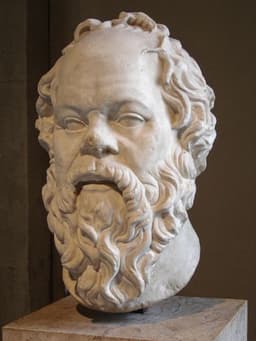
Socrates
Philosopher · Ancient
61.9Total
Basic Information
Born
-604
-470
Died
-531
-399
Era
Ancient
Ancient
Nationality
China
Greece
Occupation
Philosopher
Philosopher
Civilization
Eastern
Western
Score Comparison
Military (10%)
9.0
8.8
Political (20%)
27.5
35.0
Influence (20%)
80.0
88.0
Legacy (20%)
87.0
87.0
Leadership (15%)
21.7
51.7
Strategy (15%)
44.4
42.8
TOTAL
54.5
61.9
Socrates — Complete Timeline
432 BC
Service in the Peloponnesian WarWar
Socrates served as a hoplite (heavy infantryman) in the Athenian army during the Peloponnesian War. He fought in the battles of Potidaea, Delium, and Amphipolis, where he was noted for his bravery and endurance, saving the life of Alcibiades at Potidaea.
Military ServiceWarBravery
430 BC
Development of the Socratic MethodCultural◆ Major
Socrates developed a method of inquiry through questioning, known as the Socratic method. He engaged Athenians in dialogues to expose contradictions in their beliefs and stimulate critical thinking. This method became a cornerstone of Western philosophy and education.
PhilosophyMethodDialectic
Impact: globalprogressive
404 BC
Refusal to Obey the Thirty TyrantsPolitical Action
During the reign of the Thirty Tyrants, Socrates was ordered to arrest Leon of Salamis for execution. He refused, risking his own life, because he considered the order unjust. This act demonstrated his commitment to moral principles over political authority.
Civil DisobedienceMoralityTyranny
constructive
399 BC
Trial and Execution of SocratesPolitical Action
Socrates was tried by an Athenian jury on charges of impiety and corrupting the youth. He was found guilty and sentenced to death by drinking hemlock. His refusal to escape and calm acceptance of death became a foundational example of philosophical integrity.
TrialDeathPhilosophy
Impact: globaltragic
Expert Analysis
Origins
Laozi (c. 604–531 BCE) was born in the state of Chu during China's Spring and Autumn period, a time of political fragmentation and philosophical flourishing. Tradition holds he served as an archivist in the Zhou court, granting him access to ancient texts and statecraft. His early life remains shrouded in legend; some accounts describe his conception by a shooting star. In contrast, Socrates (c. 470–399 BCE) was born in Athens during its Golden Age. His father was a sculptor, his mother a midwife. Socrates received a basic education but never wrote texts; his thoughts survive through Plato's dialogues. While Laozi's formative years were steeped in bureaucratic and mystical traditions, Socrates grew up amidst democratic debates and the intellectual ferment of the Sophists.
Rise to Power
Laozi's rise was not political but intellectual. According to legend, he composed the *Tao Te Ching* at the request of a gatekeeper before disappearing westward. This text, 81 chapters advocating harmony with the Dao (the Way), became the foundation of Daoism. His influence grew posthumously, with Daoism becoming a state religion under the Tang dynasty. Socrates, however, rose through public engagement. He developed the Socratic method—a dialectical approach to expose contradictions—and attracted followers like Plato and Alcibiades. His questioning of Athenian values made him a controversial figure, culminating in his trial in 399 BCE on charges of impiety and corrupting youth. He was sentenced to death by hemlock, a turning point that immortalized him as a martyr for philosophy.
Leadership & Governance
Laozi's governance philosophy is encapsulated in *wu wei* (non-action) and ruling with minimal interference. He advised rulers to emulate water, which overcomes the hard by being soft. His ideal ruler is obscure, letting people follow their own nature. This contrasts with Socrates, who engaged actively in civic life. Socrates served as a hoplite in the Peloponnesian War, demonstrating physical courage at Potidaea and Delium. He defied the Thirty Tyrants by refusing to arrest Leon of Salamis, upholding rule of law over tyranny. While Laozi advocated withdrawal from political strife, Socrates engaged directly, though his method often challenged authority. Their leadership scores reflect this: Laozi scored 21.7 in leadership, Socrates 51.7.
Triumph & Tragedy
Laozi's greatest triumph is the creation of a philosophical system that has endured for over 2,500 years. The *Tao Te Ching* remains one of the most translated works in history, influencing not only religion but also art, martial arts, and politics. However, his tragedy lies in the historical obscurity of his life; his very existence is questioned by some scholars. Socrates' triumph is his method, which underpins Western critical thinking. His willingness to die for his principles set a standard for intellectual integrity. Yet his tragedy is immediate: his execution by a democratic state he served. Both figures scored high in influence (Laozi 80.0, Socrates 88.0) and legacy (both 87.0), but Socrates' death became a foundational myth for philosophy.
Character & Destiny
Laozi is portrayed as a wise, reclusive sage who valued simplicity and spontaneity. His destiny was to become a cultural icon, deified in religious Daoism. His character—detached and elusive—shaped a philosophy that prizes harmony over assertion. Socrates, by contrast, was gregarious, ironic, and relentless in questioning. His character led him to confront Athens' powerful figures, sealing his fate. Historians note that Socrates' daimonion (divine sign) warned him against politics, yet his philosophical mission was inherently political. Where Laozi's destiny was to vanish into legend, Socrates' was to become a martyr. Their political scores (Laozi 27.5, Socrates 35.0) reflect their different engagements with power.
Legacy
Laozi's legacy is vast: Daoism became one of China's three major teachings, influencing millions. The *Tao Te Ching* shaped Chinese poetry, painting, and even military strategy (Sun Tzu borrowed concepts). In the West, it inspired environmental movements and New Age spirituality. Socrates' legacy is equally monumental: his method is the foundation of Western philosophy, education, and law. His emphasis on ethics and self-examination influenced Stoicism, Christian theology, and modern liberalism. Both scored 87.0 in legacy, but their impacts differ: Laozi's influence is diffuse and spiritual, Socrates' is systematic and rational.
Conclusion
While both are titans of philosophy, Socrates had a greater impact on the trajectory of Western civilization. His method of critical inquiry became the bedrock of scientific and philosophical thought, directly shaping the Enlightenment and modern democracy. His total score of 61.9 edges out Laozi's 54.5, reflecting higher political engagement and leadership. However, Laozi's influence in the East is profound, and his text's global reach is immense. Yet in a world shaped by debates, evidence, and democratic institutions, Socrates' legacy is more immediately felt. The choice is not about superiority but about different kinds of impact: Socrates changed how we think; Laozi changed what we value. Ultimately, Socrates' method provided the tools for questioning all values, including Laozi's, giving him a broader legacy in the modern era.
Rankings
🥇
SocratesLeader
Mil: 8.8Pol: 35.0Inf: 88.0
61.9
🥈
Laozi
Mil: 9.0Pol: 27.5Inf: 80.0
54.5
+7.4 behind
How This Comparison Works
Algorithm
Each figure is scored on 6 dimensions (0—100 scale) based on structured historical data: Military (10%), Political (20%), Influence (20%), Legacy (20%), Leadership (15%), Strategy (15%). The weighted total produces the final ranking.
Data Sources
Scores are computed from structured sub-indicators in the database. Scale factors adjust for era (Ancient ×0.85, Modern ×1.0) and civilization size (Eastern ×1.05, Other ×0.80) to account for differences in population and military scale.
Maximum 3 Figures
Comparisons are limited to 2—3 figures to ensure readability and statistical meaningfulness.
Error Margins
±5 points per dimension — Sub-scores are derived from historical records with inherent uncertainty. Two figures within 5 points on a dimension should be considered roughly equivalent in that area.
Total Score Accuracy
±3 points overall — The weighted combination of 6 dimensions produces a total score with approximately ±3 points of uncertainty. Differences of less than 3 points are not statistically significant— the figures are effectively tied.
Known Limitations
- Historical records are incomplete and uneven across civilizations
- Figures from oral-tradition societies may be underrepresented
- Occupation labels can misclassify multi-role figures
- Scores measure capability and impact, not moral character
- Quantitative scoring is a comparison tool, not absolute truth
Capability Radar
Military (10%) — Battles & Warfare
Battles
17
16
Win Rate
16
14
Expansion
21
22
Political (20%) — Governance & Reform
Reform
10
0
Diplomacy
10
10
Economy
10
0
Influence (20%) — Cultural & Global Reach
Cultural
95
95
Global
85
90
Legacy (20%) — Historical Impact
Historical
95
95
Longevity
95
95
Leadership (15%) — Power & Stability
Tenure
10
0
Stability
10
0
Strategy (15%) — Tactics & Innovation
Strategy
23
24
Tactics
29
25
Reform
29
27
Similar Comparisons
Comments & Discussion
No comments yet. Be the first to share your thoughts!