Loading...
Laozi vs Qin Shi Huang
Qin Shi Huang leads by 30.7 pts · 2 figures compared
…

Laozi
Philosopher · Ancient
54.5Total
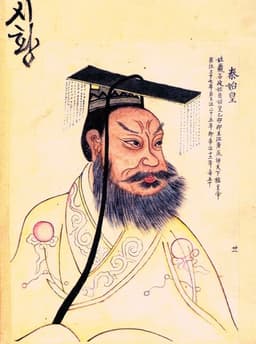
Qin Shi Huang
Emperor · Ancient
85.2Total
Basic Information
Born
-604
-259
Died
-531
-210
Era
Ancient
Ancient
Nationality
China
China
Occupation
Philosopher
Emperor
Civilization
Eastern
Eastern
Score Comparison
Military (10%)
9.0
80.0
Political (20%)
27.5
90.0
Influence (20%)
80.0
85.0
Legacy (20%)
87.0
90.0
Leadership (15%)
21.7
78.0
Strategy (15%)
44.4
82.0
TOTAL
54.5
85.2
Qin Shi Huang — Complete Timeline
246 BC
Construction of the Mausoleum and Terracotta ArmyOther◆ Major
Qin Shi Huang commissioned a vast mausoleum complex near Xi'an, guarded by thousands of life-sized terracotta soldiers, horses, and chariots. The project employed hundreds of thousands of workers and reflected his obsession with immortality and imperial power.
Impact: global
230 BC
Conquest of the Six Warring StatesWar
From 230 to 221 BCE, Ying Zheng led the Qin state in a series of campaigns that conquered the Han, Zhao, Wei, Chu, Yan, and Qi states. This unified China under a single ruler for the first time, ending the Warring States period.
Impact: global
221 BC
Standardization of Writing, Currency, and MeasurementsReform◆ Major
Qin Shi Huang ordered the standardization of Chinese script, currency, and weights and measures across the unified empire. This facilitated administration, trade, and cultural integration, laying a foundation for future dynasties.
Impact: globalconstructive
Proclamation of the Qin DynastyPolitical Action
After conquering the last independent state, Ying Zheng declared himself Shi Huangdi (First Emperor), founding the Qin Dynasty. He adopted a new title to signify his supreme authority and initiated centralized imperial rule.
Impact: global
214 BC
Initiation of the Great Wall ConstructionOther◆ Major
Qin Shi Huang ordered the connection and extension of existing northern fortifications to create a unified defensive wall against nomadic Xiongnu raids. This project involved massive conscripted labor and became the precursor to the later Great Wall.
Impact: regional
213 BC
Burning of Books and Burying of ScholarsPolitical Action◆ Major
On the advice of Li Si, Qin Shi Huang ordered the burning of historical records and philosophical texts not aligned with Legalist doctrine. He also had 460 Confucian scholars buried alive to suppress dissent and consolidate ideological control.
Impact: nationaldestructive
Expert Analysis
laozi-vs-qin-shi-huang
# The Emperor and the Sage: Two Souls That Shaped China
In the year 213 BCE, Qin Shi Huang ordered the burning of books and the burying of scholars alive. Among the texts condemned to flames were the very works of Laozi, who had died three centuries earlier. It is one of history’s bitter ironies: the First Emperor, who sought to erase all competing philosophies, could not erase the quiet voice of a man who had never commanded an army, never built a wall, never ruled a single province. Yet today, both men stand as twin pillars of Chinese civilization—one forged in iron and blood, the other woven from silence and water. How did two such opposite souls come to define the same land?
Origins
Qin Shi Huang was born Ying Zheng in 259 BCE, a prince of the Qin state during the chaotic Warring States period. His father was a hostage in another kingdom, his mother a former concubine. His childhood was steeped in court intrigue and the constant threat of assassination. The world he inherited was one of endless warfare, where seven kingdoms clawed at each other for supremacy. He learned early that power was the only currency that mattered, and that mercy was a weakness to be exploited.
Laozi, by contrast, was born around 604 BCE, in an era when the Zhou dynasty, though decaying, still held nominal authority. Tradition holds that he served as an archivist at the royal court in Luoyang—a keeper of records, a witness to history rather than its maker. If the Warring States period was a storm, Laozi lived in its gathering clouds. He saw the same violence and corruption that would later consume Qin Shi Huang, but he responded not with ambition, but with withdrawal. Where the future emperor saw chaos demanding control, the philosopher saw chaos demanding release.
Rise to Power
Qin Shi Huang ascended to the throne of Qin at age thirteen, in 246 BCE. For years, he was a figurehead, manipulated by his mother’s lover and powerful ministers. But he waited. At twenty-two, he staged a coup, exiling his mother and executing her paramour. From that moment, he ruled with absolute authority. Between 230 and 221 BCE, he unleashed a series of military campaigns that devoured the six rival states one by one: Han, Zhao, Wei, Chu, Yan, and finally Qi. By 221 BCE, he stood alone. He declared himself *Shi Huangdi*—the First Emperor—and invented a title that had never existed before.
Laozi’s rise was not a rise at all, but a departure. According to tradition, he grew disillusioned with the Zhou court’s decline and resigned his post. As he journeyed westward, a gatekeeper named Yinxi recognized him as a sage and begged him to leave behind his wisdom before disappearing into the unknown. Laozi complied, writing the *Tao Te Ching* in eighty-one chapters—a text he may never have intended to write, and certainly never sought to publish. His influence spread not through conquest, but through whispers carried by travelers and disciples.
Leadership & Governance
Qin Shi Huang’s governance was a revolution. He abolished the feudal system, divided the empire into administrative commanderies, and appointed officials based on merit rather than birth. He standardized writing, currency, and measurements across his realm—a feat of bureaucratic genius that made China governable for two millennia. He ordered the connection of northern fortifications into what would become the Great Wall, a project that consumed countless lives. His legalist philosophy, guided by the minister Li Si, held that law must be absolute, punishment severe, and opposition crushed. The burning of books in 213 BCE was not an act of madness but of policy: he sought to erase history that did not serve his narrative.
Laozi offered the opposite vision. In the *Tao Te Ching*, he wrote: “Governing a large country is like frying a small fish—you spoil it with too much poking.” His concept of *wu wei*—non-action or effortless action—did not mean doing nothing, but acting in harmony with the natural flow of things. He believed that the best ruler was one whose people barely knew he existed. Where Qin Shi Huang built walls, Laozi counseled that the softest thing in the world could overcome the hardest—water over stone, silence over noise.
Triumph & Tragedy
Qin Shi Huang’s greatest triumph was unification itself—a feat no Chinese ruler had achieved before. He built roads, canals, and a centralized state that would serve as the blueprint for every dynasty that followed. Yet his triumphs were shadowed by tragedy. His obsession with immortality drove him to consume mercury pills, likely poisoning him. He died in 210 BCE at age forty-nine, and within three years, the Qin dynasty collapsed in rebellion. His mausoleum, guarded by the Terracotta Army he commissioned in 246 BCE, stands as a monument to his ambition—and his loneliness.
Laozi’s triumph was invisible. He left no empire, no army, no wall. But his *Tao Te Ching* survived the book burnings, passed down by Daoist priests who hid the texts in caves and mountains. His tragedy was perhaps that he was never truly understood: his teachings were twisted by later rulers seeking legitimacy, and by alchemists promising immortality—the very obsession that killed the emperor he would have counseled to let go.
Character & Destiny
Qin Shi Huang was paranoid, ruthless, and driven by a fear of death and disorder. He slept in different rooms each night to avoid assassination, and he built a vast underground kingdom because he could not bear to leave the one above. His character shaped his destiny: his refusal to trust anyone, including his own heirs, ensured that his dynasty would not outlive him.
Laozi, if tradition is to be believed, was a man who let go. He resigned his post, wrote his book, and walked into the western mountains, never to be seen again. His character shaped a destiny of absence—and because he did not cling to power, his influence became immortal.
Legacy
Qin Shi Huang’s legacy is the Chinese state itself. The writing system he standardized is still used today. The Great Wall, though rebuilt many times, traces its origin to his command. He is remembered as both a tyrant and a unifier—a figure so monumental that his tomb remains unopened, perhaps for fear of what lies inside.
Laozi’s legacy is a way of thinking that permeates Chinese culture like water through stone. Daoism became one of China’s three great traditions, alongside Confucianism and Buddhism. His words—“The journey of a thousand miles begins with a single step”—echo in a hundred languages. He taught that the highest power is not the one that conquers, but the one that yields.
Conclusion
Standing before the Terracotta Army, one feels the weight of Qin Shi Huang’s ambition—thousands of soldiers, each with a unique face, frozen in eternal vigilance. Standing before a single line of the *Tao Te Ching*, one feels something else: the lightness of a truth that needs no army. These two men were contemporaries in the broad sweep of Chinese history, yet they inhabited different universes. The emperor built a world of stone and decree; the sage built a world of silence and flow. China needed both—the wall to hold back the barbarians, and the water to wear the wall down. In their opposition, they created a civilization.
Rankings
🥇
Qin Shi HuangLeader
Mil: 80.0Pol: 90.0Inf: 85.0
85.2
🥈
Laozi
Mil: 9.0Pol: 27.5Inf: 80.0
54.5
+30.7 behind
How This Comparison Works
Algorithm
Each figure is scored on 6 dimensions (0—100 scale) based on structured historical data: Military (10%), Political (20%), Influence (20%), Legacy (20%), Leadership (15%), Strategy (15%). The weighted total produces the final ranking.
Data Sources
Scores are computed from structured sub-indicators in the database. Scale factors adjust for era (Ancient ×0.85, Modern ×1.0) and civilization size (Eastern ×1.05, Other ×0.80) to account for differences in population and military scale.
Maximum 3 Figures
Comparisons are limited to 2—3 figures to ensure readability and statistical meaningfulness.
Error Margins
±5 points per dimension — Sub-scores are derived from historical records with inherent uncertainty. Two figures within 5 points on a dimension should be considered roughly equivalent in that area.
Total Score Accuracy
±3 points overall — The weighted combination of 6 dimensions produces a total score with approximately ±3 points of uncertainty. Differences of less than 3 points are not statistically significant— the figures are effectively tied.
Known Limitations
- Historical records are incomplete and uneven across civilizations
- Figures from oral-tradition societies may be underrepresented
- Occupation labels can misclassify multi-role figures
- Scores measure capability and impact, not moral character
- Quantitative scoring is a comparison tool, not absolute truth
Capability Radar
Military (10%) — Battles & Warfare
Battles
17
85
Win Rate
16
90
Expansion
21
90
Political (20%) — Governance & Reform
Reform
10
95
Diplomacy
10
75
Economy
10
90
Influence (20%) — Cultural & Global Reach
Cultural
95
95
Global
85
85
Legacy (20%) — Historical Impact
Historical
95
95
Longevity
95
95
Leadership (15%) — Power & Stability
Tenure
10
70
Stability
10
65
Strategy (15%) — Tactics & Innovation
Strategy
23
85
Tactics
29
80
Reform
29
95
Similar Comparisons
Comments & Discussion
The Scholar-Slayer's Ghost6/17/2026
Qin Shi Huang's book burning wasn't just ideological—it was personal. The man who unified China couldn't stand that Laozi's Way existed outside his control. Three centuries dead, and that quiet archivist still threatened an emperor's ego. History's ultimate irony: the tyrant who built walls around the world couldn't build one around his own insecurity. Guess which one's words outlasted the terra cotta?|1
混沌剑客6/17/2026
老子教会我们「上善若水」,秦始皇却用铁血证明「水能载舟,亦能覆舟」。一个是无为而治的哲学,一个是大一统的暴力美学。可悲的是,今天中国人既读《道德经》,也跪拜兵马俑——我们灵魂里永远住着这两个死对头。这就是中华文明的宿命:在沉默与呐喊之间反复撕扯。|3
Bamboo-Hat Data Nerd6/17/2026
Comparing their direct impact is apples and oranges. Laozi's Dao De Jing is 5,000 characters you can hold in one hand. Qin Shi Huang's standardized writing system, bronze coinage, and road networks fundamentally engineered China's administrative DNA. The philosopher whispered to the elite; the emperor coded the operating system for 2,000 years. Which legacy actually runs your daily life? Hint: check your banknote and your keyboard.