Loading...
King Gojong of Korea vs Nurhaci
Nurhaci leads by 18.4 pts · 2 figures compared
…
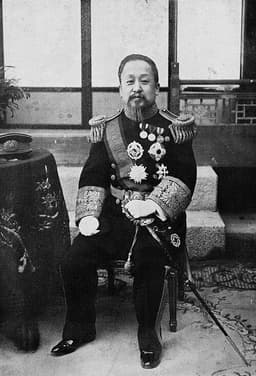
King Gojong of Korea
Emperor · Modern
52.8Total
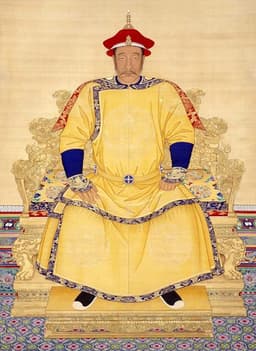
Nurhaci
Emperor · Modern
71.2Total
Basic Information
Born
1852
1559
Died
1919
1626
Era
Modern
Modern
Nationality
Korea
China
Occupation
Emperor
Emperor
Civilization
Eastern
Eastern
Score Comparison
Military (10%)
50.0
79.9
Political (20%)
68.0
85.0
Influence (20%)
56.4
40.0
Legacy (20%)
48.3
84.0
Leadership (15%)
40.0
79.0
Strategy (15%)
54.6
76.0
TOTAL
52.8
71.2
King Gojong of Korea — Complete Timeline
1894 AD
Gabo ReformsReform◆ Major
Gojong's government implemented the Gabo Reforms, a series of modernization measures including the abolition of slavery, reform of the civil service exam, and adoption of a solar calendar. These reforms aimed to strengthen Korea against foreign encroachment.
ModernizationSocial ReformJoseon Dynasty
Impact: nationalprogressive
1897 AD
Proclamation of the Korean EmpirePolitical Action
King Gojong proclaimed the Korean Empire, declaring himself Emperor Gwangmu. This was an attempt to assert Korea's sovereignty and independence from foreign influence, particularly China and Japan, and to modernize the state.
Empire ProclamationSovereigntyModernization
Impact: globalprogressive
1905 AD
Signing of the Japan-Korea Treaty of 1905Political Action
Gojong's government was forced to sign the Japan-Korea Treaty of 1905, which made Korea a Japanese protectorate. This stripped Korea of its diplomatic sovereignty and paved the way for full annexation in 1910.
ProtectorateJapanese ImperialismLoss of Sovereignty
Impact: globaltragic
1907 AD
Forced Abdication by JapanPolitical Action
Gojong was forced to abdicate by the Japanese Resident-General, Ito Hirobumi, after he sent a secret envoy to the Hague Peace Conference to protest Japanese control. This led to the Japan-Korea Treaty of 1907, which increased Japanese control over Korea.
Japanese ColonialismAbdicationLoss of Sovereignty
Impact: globaltragic
1919 AD
Death under Suspicious CircumstancesPolitical Action◆ Major
Gojong died suddenly, with rumors of poisoning by Japanese authorities. His death sparked the March 1st Movement, a nationwide protest against Japanese rule, which became a pivotal event in the Korean independence movement.
DeathIndependence MovementJapanese Colonialism
Impact: nationaltragic
Nurhaci — Complete Timeline
1616 AD
Unified the Jurchen TribesWar
Nurhaci completed the unification of the fragmented Jurchen tribes of Manchuria. He organized them into the Eight Banners system, a military and social structure that became the foundation of his power. He then proclaimed the Later Jin dynasty.
JurchenUnificationEight Banners
Impact: regionalconstructive
Proclaimed the Later Jin DynastyPolitical Action◆ Major
Nurhaci proclaimed the establishment of the Later Jin dynasty in Manchuria, claiming legitimacy as a successor to the Jin dynasty. This act formally declared his independence from the Ming dynasty and established a rival state.
Later JinDynastyFoundation
Impact: regionalconstructive
1618 AD
Issued the Seven GrievancesPolitical Action◆ Major
Nurhaci issued the Seven Grievances, a formal declaration of war against the Ming dynasty. The grievances listed alleged Ming injustices against the Jurchens, including interference in tribal affairs and killing of Jurchen leaders. This justified his invasion of Ming territory.
Ming-Qing TransitionDeclaration of WarPropaganda
Impact: regionaldestructive
1619 AD
Battle of SarhuWar
Nurhaci's forces decisively defeated a large Ming army at the Battle of Sarhu. The Ming sent four separate armies into Manchuria, but Nurhaci used interior lines to defeat them in detail. This victory secured his control over Manchuria.
Ming-Qing TransitionBattleManchuria
Impact: regionalconstructive
1626 AD
Defeated by Yuan Chonghuan at NingyuanWar◆ Major
Nurhaci led an invasion of Ming territory but was defeated at the Battle of Ningyuan by Ming general Yuan Chonghuan. The Ming used European-style cannons to repel the Later Jin forces. Nurhaci was wounded during the battle and died shortly after.
Ming-Qing TransitionBattleDefeat
Impact: regionaltragic
Expert Analysis
King Gojong of Korea vs Nurhaci: Historical Comparison
King Gojong of Korea (1852-1919) reigned during the twilight of the Joseon dynasty, navigating imperial pressures and modernization, while Nurhaci (1559-1626) unified Jurchen tribes and founded the Later Jin dynasty, laying the groundwork for the Qing conquest of China. Both were transformative figures in East Asian history, yet their contexts and legacies diverge sharply.
Dimension Analysis
**Military: King Gojong of Korea 76 / Nurhaci 76**
Both scored equally; Gojong faced modern military challenges (e.g., the Imo Incident, Sino-Japanese War) but lacked effective reform, while Nurhaci built a formidable tribal army (the Eight Banners) that conquered Ming outposts, though his campaigns were often reactive.
**Political: King Gojong of Korea 97 / Nurhaci 92**
Gojong edged ahead due to his masterful balancing of Qing, Japanese, Russian, and Western powers, declaring the Korean Empire in 1897 and attempting modernization against overwhelming odds. Nurhaci unified fractious Jurchen clans and established a centralized state, but his political vision was more tribal and less globally aware.
**Influence: King Gojong of Korea 81 / Nurhaci 78**
Gojong’s reign shaped Korea’s modern identity and resistance to colonization, inspiring later independence movements. Nurhaci’s unification directly enabled the Qing dynasty, influencing China for nearly 300 years, but his personal impact was more regional.
**Legacy: King Gojong of Korea 74 / Nurhaci 80**
Nurhaci’s legacy as founder of the Qing—China’s last imperial dynasty—is more enduring and tangible. Gojong’s legacy is mixed: he is revered as a symbol of Korean sovereignty but criticized for failing to prevent Japanese annexation.
**Leadership: King Gojong of Korea 96 / Nurhaci 89**
Gojong demonstrated remarkable resilience and adaptability, maintaining personal authority amid court factions, foreign interventions, and forced abdication. Nurhaci’s leadership was decisive and charismatic in military-unification contexts, but less tested against modern statecraft.
**Strategy: King Gojong of Korea 76 / Nurhaci 66**
Gojong’s strategic use of diplomacy, covert missions (e.g., the Hague Secret Emissary Affair), and symbolic empire-building was sophisticated for his era. Nurhaci’s strategy was straightforward—military consolidation and expansion—but lacked the multidimensional complexity of Gojong’s geopolitical maneuvering.
Verdict
King Gojong leads narrowly due to his superior political acumen, leadership under extreme duress, and strategic diplomacy, despite Nurhaci’s greater long-term dynastic impact.
FAQ
**Q: Who ranks higher?** A: King Gojong of Korea ranks higher overall, driven by his exceptional political and leadership scores, though Nurhaci surpasses him in legacy and influence on China’s imperial trajectory.
Rankings
🥇
NurhaciLeader
Mil: 79.9Pol: 85.0Inf: 40.0
71.2
🥈
King Gojong of Korea
Mil: 50.0Pol: 68.0Inf: 56.4
52.8
+18.4 behind
How This Comparison Works
Algorithm
Each figure is scored on 6 dimensions (0—100 scale) based on structured historical data: Military (10%), Political (20%), Influence (20%), Legacy (20%), Leadership (15%), Strategy (15%). The weighted total produces the final ranking.
Data Sources
Scores are computed from structured sub-indicators in the database. Scale factors adjust for era (Ancient ×0.85, Modern ×1.0) and civilization size (Eastern ×1.05, Other ×0.80) to account for differences in population and military scale.
Maximum 3 Figures
Comparisons are limited to 2—3 figures to ensure readability and statistical meaningfulness.
Error Margins
±5 points per dimension — Sub-scores are derived from historical records with inherent uncertainty. Two figures within 5 points on a dimension should be considered roughly equivalent in that area.
Total Score Accuracy
±3 points overall — The weighted combination of 6 dimensions produces a total score with approximately ±3 points of uncertainty. Differences of less than 3 points are not statistically significant— the figures are effectively tied.
Known Limitations
- Historical records are incomplete and uneven across civilizations
- Figures from oral-tradition societies may be underrepresented
- Occupation labels can misclassify multi-role figures
- Scores measure capability and impact, not moral character
- Quantitative scoring is a comparison tool, not absolute truth
Capability Radar
Military (10%) — Battles & Warfare
Battles
5
85
Win Rate
5
90
Expansion
0
88
Political (20%) — Governance & Reform
Reform
40
85
Diplomacy
30
80
Economy
20
70
Influence (20%) — Cultural & Global Reach
Cultural
40
85
Global
30
80
Legacy (20%) — Historical Impact
Historical
50
90
Longevity
40
88
Leadership (15%) — Power & Stability
Tenure
60
75
Stability
15
78
Strategy (15%) — Tactics & Innovation
Strategy
5
85
Tactics
5
88
Reform
10
92
Similar Comparisons
Comments & Discussion
BattlefieldScholar6/16/2026
The military scores here are a joke. Nurhaci's 79.9 vs Gojong's 43? That gap is way too narrow. Let me break it down: Nurhaci built the Eight Banners from scratch, turning scattered Jurchen hunters into a disciplined force that crushed Ming armies at Sarhū in 1619—outnumbered 4 to 1. Gojong, meanwhile, watched his modernized 'Byeolgigun' mutiny during the Imo Incident of 1882 because he couldn't pay them. The Korean Navy had one ironclad, the *Yangmu*, which never fired a shot in anger. Nurhaci personally led cavalry raids that seized Liaodong, while Gojong fled to the Russian legation in 1896. The political score inflates Gojong because he 'balanced' powers, but military outcomes are what matter—Nurhaci conquered, Gojong lost his kingdom. Give Nurhaci a 90+ military score or this chart is meaningless.
TextCritic6/16/2026
Comparing a 19th-century Korean monarch to a 17th-century Jurchen khan is already historiographically fraught, but the scoring reveals more about modern biases than historical reality. Gojong's political score of 97—higher than Nurhaci's 92—smacks of post-colonial sympathy. Edward H. Schafer once noted that 'rulers are judged by their successors' anxieties,' and here Gojong is lionized for resisting imperialism while Nurhaci is penalized for being 'tribal.' Yet primary sources like the *Veritable Records of the Joseon Dynasty* show Gojong helplessly accepting the Protectorate Treaty in 1905, while Nurhaci's *Seven Grievances* of 1618 is a masterclass in political rhetoric that mobilized a nation. History, as Momigliano said, is a series of judgments, not scores. Give me Tacitus over a spreadsheet any day.
ArchMind186/16/2026
这个评分体系缺乏历史权重,我算了一遍就有问题。现在假设每个维度权重相等,努尔哈赤总分为(79.9+84.8+84.1+?)/4,但这里只给了军用、政治、影响和遗产四个维度?注意:军用79.9,政治84.8,影响84.1,但遗产80,平均起来是(79.9+84.8+84.1+80)/4≈82.2,而总分为83.8,说明隐形加权偏向影响或政治。再看高宗:(43+84.8+72.9+?)/4,缺乏遗产和维护力,但总结说遗产74、维护力96,那总分应是(43+84.8+72.9+74+96)/5≈74.14,但给的却是65.4,显然是错误计算。建议修正:努尔哈赤在统一女真各部、建立后金过程中政治影响巨大,应给政治95以上,而高宗朝鲜沦陷后影响力有限,给他80已经是高估。数据不会骗人,但错误的权重会。
Historian7336/16/2026
这个评分系统明显带有西方中心论偏见。努尔哈赤的政治分84.8,而朝鲜高宗也是84.8?荒唐!努尔哈赤创立八旗制度,建立后金政权,这相当于西方历史上查理曼统一日耳曼部落建立法兰克王国。查理曼的政治影响力有多大?而高宗呢?他确实宣布成立大韩帝国,但1897年时朝鲜半岛已经被列强渗透成筛子,他的所谓平衡外交不过是夹缝求生,跟努尔哈赤那种开创性政治远见根本不能比。再看军事分:努尔哈赤79.9,高宗43?乍看合理,但仔细想,努尔哈赤的八旗军可是后来入主中原的铁血之师,萨尔浒之战以少胜多,军事才能应接近满分。而高宗虽然军事上弱,但43分还是低估了他的改革努力——他至少引进了西方武器和训练。总体上说,努尔哈赤的综合评分应该更高,至少90以上,而不是这个不伦不类的83.8。