Loading...
Joseph Stalin vs Yoweri Museveni
Joseph Stalin leads by 4.9 pts · 2 figures compared
…
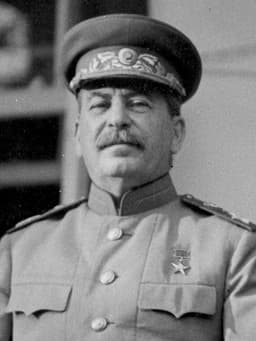
Joseph Stalin
Politician · Modern
68.8Total
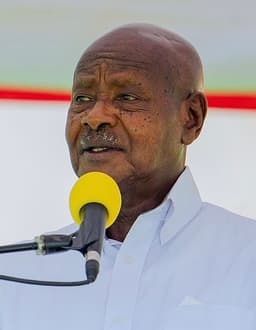
Yoweri Museveni
Politician · Modern
63.9Total
Basic Information
Born
1878
1944
Died
1953
—
Era
Modern
Modern
Nationality
Russia
Uganda
Occupation
Politician
Politician
Civilization
Western
Other
Score Comparison
Military (10%)
75.0
67.5
Political (20%)
70.0
72.0
Influence (20%)
72.0
61.0
Legacy (20%)
55.0
50.0
Leadership (15%)
80.0
80.0
Strategy (15%)
70.0
66.3
TOTAL
68.8
63.9
Joseph Stalin — Complete Timeline
1928 AD
Launched the First Five-Year PlanReform
Stalin initiated a series of centralized economic plans aimed at rapid industrialization and collectivization of agriculture. The First Five-Year Plan set ambitious targets for heavy industry, leading to significant growth but also severe shortages and human cost.
Impact: global
1929 AD
Implemented forced collectivization of agricultureReform
Stalin ordered the consolidation of individual peasant farms into collective farms (kolkhozy). This was met with resistance, leading to the liquidation of kulaks (wealthy peasants) as a class. The policy caused a catastrophic famine, particularly in Ukraine (Holodomor), resulting in millions of deaths.
Impact: nationaldestructive
1937 AD
Conducted the Great Purge (Great Terror)Political Action
Stalin orchestrated a campaign of political repression against alleged enemies of the state. Millions were arrested, executed, or sent to the Gulag labor camps. The purges targeted the Communist Party, military leadership, intellectuals, and ordinary citizens, consolidating Stalin's absolute power.
Impact: nationaldestructive
1945 AD
Led the Soviet Union to victory in World War IIWar
Stalin served as Supreme Commander of the Soviet armed forces. The Soviet Union bore the brunt of the war against Nazi Germany, suffering immense casualties. The Red Army's victory at Stalingrad and the capture of Berlin were key turning points. The war ended with Soviet domination of Eastern Europe.
Impact: global
Established the Eastern Bloc and the Iron CurtainPolitical Action◆ Major
After WWII, Stalin imposed communist governments in Eastern European countries occupied by the Red Army, creating a buffer zone against the West. This division of Europe into Soviet and Western spheres of influence marked the beginning of the Cold War.
Impact: globaldestructive
Yoweri Museveni — Complete Timeline
1986 AD
Bush War Victory and Capture of KampalaWar
Museveni's National Resistance Army (NRA) captured Kampala, ending the Ugandan Bush War. He was sworn in as President on January 29, 1986, overthrowing the government of Tito Okello and beginning his long rule.
Ugandan Bush WarSeizure of PowerNRA
Impact: national
Introduction of the Movement SystemPolitical Action◆ Major
Museveni established a 'no-party' Movement system, banning political party activity. This system concentrated power in the National Resistance Movement (NRM) and was justified as necessary to prevent ethnic conflict, but was criticized as authoritarian.
Political SystemNRMAuthoritarianism
Impact: national
1998 AD
Invasion of the Democratic Republic of CongoWar◆ Major
Ugandan forces, allied with Rwanda, invaded the Democratic Republic of Congo (DRC) to overthrow Laurent Kabila. This intervention escalated the Second Congo War, drawing in multiple African nations and causing widespread devastation.
Second Congo WarRegional ConflictIntervention
Impact: regionaldestructive
2005 AD
Constitutional Amendment Removing Term LimitsPolitical Action◆ Major
Museveni's government pushed through a constitutional amendment removing presidential term limits. This allowed him to run for a third term in 2006 and subsequent elections, consolidating his hold on power and drawing domestic and international criticism.
Constitutional ChangeTerm LimitsPower Consolidation
Impact: nationaldestructive
2014 AD
Anti-Homosexuality ActPolitical Action◆ Major
Museveni signed the Anti-Homosexuality Act, which imposed life imprisonment for certain same-sex acts. The law was widely condemned internationally, leading to aid cuts from some Western nations, though it was later annulled by the Constitutional Court on procedural grounds.
LGBTQ RightsLegislationInternational Condemnation
Impact: nationaldestructive
Expert Analysis
Joseph Stalin vs Yoweri Museveni
### The Revolutionary and the Guerrilla: Stalin and Museveni’s Long Shadows
In the winter of 1929, Joseph Stalin stood before a map of the Soviet Union, his finger tracing the vast, frozen expanse of Siberia. He was about to order the forced collectivization of agriculture, a decision that would uproot millions and starve a nation. Nearly six decades later, in the humid heat of 1986, Yoweri Museveni, a lean guerrilla commander, watched his ragtag army march into Kampala, Uganda, to seize power after a five-year bush war. Both men sought to remake their countries, but their paths—and the worlds they inherited—could not have been more different. Why did Stalin, a master of terror and industrialization, leave a legacy of blood and steel, while Museveni, a liberator turned autocrat, drifted into a quieter but no less profound authoritarianism? The answer lies in the soil of their origins and the shape of their ambitions.
### Origins
Stalin was born in 1878 in the Georgian town of Gori, the son of a drunken shoemaker and a devout mother. His childhood was a crucible of poverty and violence, marked by a bout of smallpox that scarred his face and a childhood injury that left his left arm slightly withered. He entered a Russian Orthodox seminary but was expelled for revolutionary activity, absorbing the brutal logic of Marxist-Leninism in an empire on the verge of collapse. The late Tsarist era was a world of extremes—opulent palaces and starving peasants, secret police and revolutionary cells—where survival demanded cunning and ruthlessness. Stalin emerged from this not as an intellectual but as a practitioner of power, a man who saw politics as a war of all against all.
Museveni, born in 1944 in western Uganda, grew up in a different kind of crucible: the twilight of British colonialism. His father was a cattle herder, and his mother a peasant, but Museveni was educated at missionary schools and later at the University of Dar es Salaam in Tanzania, where he absorbed the pan-Africanist and Marxist ideas of the era. Uganda, unlike Stalin’s Russia, was a small, artificial state carved by colonial borders, its ethnic divisions—between Buganda, Acholi, and others—already festering. Where Stalin inherited a vast empire in chaos, Museveni inherited a fragile nation still finding its feet. His youth was shaped not by the terror of the Tsarist secret police but by the optimism and disillusionment of African independence movements.
### Rise to Power
Stalin’s rise was a slow, bureaucratic crawl through the ranks of the Bolshevik Party. He was not a fiery orator like Leon Trotsky, nor a charismatic leader like Vladimir Lenin. Instead, he positioned himself as the unassuming party secretary, a man who collected files and favors, building a network of loyalists. The key turning point came in 1928, when he launched the First Five-Year Plan, a radical push for industrialization that bypassed the party’s internal debates. By 1937, he had consolidated power through the Great Purge, a wave of arrests and executions that eliminated rivals—and millions of ordinary citizens—in a campaign of paranoid violence. His power rested not on popular acclaim but on fear, control, and the machinery of the state.
Museveni’s path was the opposite: a guerrilla’s ascent. After leading a failed uprising against Idi Amin in the 1970s, he formed the National Resistance Army (NRA) and waged a bush war from the forests of central Uganda. His turning point came in 1986, when his forces captured Kampala, ending the Ugandan Bush War. He was sworn in as president, a liberator promising reconciliation. Unlike Stalin, who climbed a ladder of party intrigue, Museveni fought his way to power, his legitimacy rooted in the barrel of a gun and the support of a war-weary population.
### Leadership & Governance
Stalin’s leadership was a study in terror and transformation. He centralized the economy, forcing peasants into collective farms and cities into factories, a process that killed millions through famine and forced labor but also turned the Soviet Union into an industrial superpower. His military strategy was brutal: during World War II, he sacrificed entire armies to slow the German advance, then crushed the Nazis at Stalingrad and Berlin in 1945. Yet his political wisdom was a paranoid calculus. He trusted no one, purging his own generals and party members, and created a cult of personality that masked a hollow state. His reforms were achievements of iron—efficient but lifeless.
Museveni’s governance was softer but no less autocratic. He introduced a “Movement System,” banning political parties and concentrating power in his own hands, arguing that Uganda needed unity, not division. He reformed the economy, attracting foreign investment and stabilizing the country after years of chaos under Amin and Milton Obote. Militarily, he was cautious: his invasion of the Democratic Republic of Congo in 1998 was a strategic misstep, a war that drained resources and destabilized the region. Where Stalin used mass murder, Museveni used legal manipulation—like the 2005 constitutional amendment removing term limits—to stay in power.
### Triumph & Tragedy
Stalin’s greatest moment was his leadership in World War II. The Soviet Union bore the brunt of the Nazi onslaught, losing 27 million people, but emerged victorious, with Stalin standing alongside Allied leaders at the Yalta Conference. His tragedy was the human cost: the Great Purge, the Holodomor famine, and the Gulag system that consumed millions. He saved his nation from Hitler but destroyed it from within.
Museveni’s triumph was his rise from the bush to the presidency, ending decades of tyranny. His tragedy is his long decline: the 2014 Anti-Homosexuality Act, which imposed life imprisonment for same-sex acts, and the suppression of dissent, have tarnished his legacy. He liberated Uganda but then imprisoned its freedoms.
### Character & Destiny
Stalin’s personality was shaped by paranoia and a will to control. He saw conspiracies everywhere, a legacy of his revolutionary youth, and this drove him to purge even his closest allies. His decisions were cold, calculating, and often cruel, but they were also effective: he built a superpower. Destiny, for him, was a tragedy of hubris—he became the monster he fought against.
Museveni’s character is more pragmatic. He is a survivor, adapting his ideology—from Marxist to capitalist—to stay in power. His decisions are driven not by paranoia but by a desire for longevity. Destiny has been kinder to him: he has ruled for over three decades, but his legacy is fading, a cautionary tale of a liberator who became a dictator.
### Legacy
Stalin is remembered as a tyrant and a war hero, a figure of immense influence and horror. His scores—Military: 75, Political: 72, Legacy: 55—reflect a man who changed the world but left it scarred. In Russia, he is still debated, a symbol of victory and suffering.
Museveni’s legacy is more ambiguous. His scores—Leadership: 80.8, Legacy: 66.8—show a leader admired for stability but criticized for authoritarianism. He is a figure of Africa’s complex postcolonial story: a man who brought peace but stole democracy.
### Conclusion
Stalin and Museveni remind us that power is a mirror, reflecting not just the leader but the world that shaped them. Stalin’s Russia was a cauldron of empire and revolution; Museveni’s Uganda was a fragile state born from colonialism. One used terror to industrialize, the other used patience to entrench. Both began as revolutionaries and ended as autocrats, but their paths reveal a deeper truth: the means of power often determine the ends. As the historian Timothy Snyder wrote, “The twentieth century taught us that the greatest danger to democracy is not a foreign enemy but a leader who promises to save it.” In the end, both men saved their nations in their own image—and that was the tragedy.
Rankings
🥇
Joseph StalinLeader
Mil: 75.0Pol: 70.0Inf: 72.0
68.8
🥈
Yoweri Museveni
Mil: 67.5Pol: 72.0Inf: 61.0
63.9
+4.9 behind
How This Comparison Works
Algorithm
Each figure is scored on 6 dimensions (0—100 scale) based on structured historical data: Military (10%), Political (20%), Influence (20%), Legacy (20%), Leadership (15%), Strategy (15%). The weighted total produces the final ranking.
Data Sources
Scores are computed from structured sub-indicators in the database. Scale factors adjust for era (Ancient ×0.85, Modern ×1.0) and civilization size (Eastern ×1.05, Other ×0.80) to account for differences in population and military scale.
Maximum 3 Figures
Comparisons are limited to 2—3 figures to ensure readability and statistical meaningfulness.
Error Margins
±5 points per dimension — Sub-scores are derived from historical records with inherent uncertainty. Two figures within 5 points on a dimension should be considered roughly equivalent in that area.
Total Score Accuracy
±3 points overall — The weighted combination of 6 dimensions produces a total score with approximately ±3 points of uncertainty. Differences of less than 3 points are not statistically significant— the figures are effectively tied.
Known Limitations
- Historical records are incomplete and uneven across civilizations
- Figures from oral-tradition societies may be underrepresented
- Occupation labels can misclassify multi-role figures
- Scores measure capability and impact, not moral character
- Quantitative scoring is a comparison tool, not absolute truth
Capability Radar
Military (10%) — Battles & Warfare
Battles
85
65
Win Rate
80
70
Expansion
85
55
Political (20%) — Governance & Reform
Reform
90
60
Diplomacy
70
70
Economy
85
55
Influence (20%) — Cultural & Global Reach
Cultural
70
45
Global
95
50
Legacy (20%) — Historical Impact
Historical
95
55
Longevity
80
50
Leadership (15%) — Power & Stability
Tenure
95
85
Stability
60
50
Strategy (15%) — Tactics & Innovation
Strategy
85
80
Tactics
60
75
Reform
90
60
Similar Comparisons
Comments & Discussion
左轮手枪与拖拉机6/16/2026
斯大林是工业化的屠夫,穆塞韦尼是选举的变色龙。1932年乌克兰粮荒不是天灾,是克里姆林宫的算盘——饿死300万农民换来钢铁产量。乌干达人呢?看着总统把自己从革命者变成终身统治者,贪污像野草疯长。斯大林杀了你全家,穆塞韦尼偷了你的未来。谁更野蛮?地狱有等级,饥饿比枪毙更沉默。
Bush War Scholar6/16/2026
Museveni's 1986 victory didn't end Uganda's tragedy—it just changed the players. The 2006 removal of term limits? Textbook autocratic creep, no tanks needed. Stalin's purges left bullet-riddled walls; Museveni's National Resistance Movement left a patronage state. Both created cults of personality—Stalin's with gulags, Museveni's with "freedom fighter" myth and a son groomed for succession. The comparison isn't brutality scales; it's how dictators adapt.
数据僵尸6/16/2026
人均GDP?苏联1939年比1913年翻倍,但粮产1909-1913是8600万吨,1950年才回到8120万——饿死的数字永远算不清。乌干达1980年人均GDP 436美元,2023年933美元——增长可忽略,人口膨胀四分。穆塞韦尼的稳定没产出奇迹,斯大林的铁拳没喂饱人民。冷数据说:两种失败,一种沉默,一种流血。
Chronicler51826/16/2026
Forget the body counts. Stalin built a civilization that crushed Hitler at Stalingrad; Museveni's Uganda can't fix its own electricity grid. The real gulf? Stalin's Marxism-Leninism was a global creed, however twisted; Museveni's "Movement" ideology is a personal survival manual. One aimed at godlike transformation through terror; the other settles for permanent incumbency with a Kalashnikov. Comparing them insults history's scale: Stalin was a Titan of darkness, Museveni a competent local warlo
Chronicler67376/16/2026
Stalin's collectivization killed millions with a bureaucrat's cold efficiency. Museveni's NRM rule? A softer but equally corrosive decay. The Soviet dictator didn't just industrialize—he weaponized famine itself, turning Ukraine into a necropolis in 1932-33. Compare that to Kampala's potholed roads and Museveni's 38-year tenure. One murdered peasants by plan, the other suffocates democracy with smiles. Both are autocrats, but Stalin's terror was absolute; Museveni's is a slow bleed.