Loading...
This comparison has not been analyzed yet.
One-time AI generation (~1 minute). Scores and timeline are already available below.
Jean Bart vs Manuel Bulnes
Manuel Bulnes leads by 6.4 pts · 2 figures compared
…
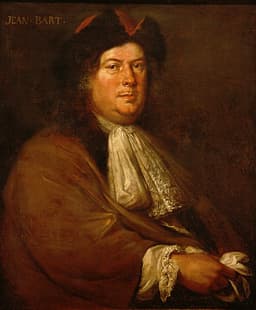
Jean Bart
General · Modern
49.9Total

Manuel Bulnes
General · Modern
56.3Total
Basic Information
Born
1650
1799
Died
1702
1866
Era
Modern
Modern
Nationality
France
Chile
Occupation
General
General
Civilization
Western
Western
Score Comparison
Military (10%)
52.5
50.0
Political (20%)
36.5
68.0
Influence (20%)
61.0
53.3
Legacy (20%)
47.5
47.5
Leadership (15%)
40.4
66.0
Strategy (15%)
60.0
60.0
TOTAL
49.9
56.3
Jean Bart — Complete Timeline
1690 AD
Battle of Beachy HeadWar
Jean Bart served as a privateer captain under the French admiral Tourville at the Battle of Beachy Head. The French fleet defeated the Anglo-Dutch fleet, gaining temporary control of the English Channel.
Nine Years' WarNaval BattleFrench Victory
Impact: regional
1694 AD
Battle of the TexelWar◆ Major
Jean Bart commanded a French squadron that broke through a Dutch blockade at the Battle of the Texel. He captured a large Dutch grain convoy, relieving a famine in France and demonstrating his skill as a naval commander.
Nine Years' WarNaval BattleFrench Victory
Impact: national
1695 AD
Raid on the Scottish CoastWar
Jean Bart led a raid on the Scottish coast, burning several villages and capturing ships. This raid was part of French efforts to support the Jacobite cause and disrupt English trade in the North Sea.
Nine Years' WarRaidJacobite Support
destructive
1696 AD
Capture of the English Convoy at Dogger BankWar
Jean Bart captured an English convoy off Dogger Bank, taking 25 merchant ships and their escort. This action disrupted English trade and demonstrated the effectiveness of French privateering during the Nine Years' War.
Nine Years' WarPrivateeringEnglish Loss
Impact: regional
1697 AD
Promoted to Chef d'EscadrePolitical Action◆ Major
Jean Bart was promoted to Chef d'Escadre (squadron commander) in the French navy, a high rank for a former privateer. This promotion recognized his successful service and made him a nobleman.
French NavyPromotionNobility
Impact: nationalconstructive
Manuel Bulnes — Complete Timeline
1839 AD
Battle of YungayWar
Bulnes led the Chilean army to a decisive victory over the Peru-Bolivia Confederation at Yungay. This battle ended the confederation and established Chile as the dominant power in the Pacific region.
WarChilePeru-Bolivia Confederation
Impact: regional
1841 AD
Elected President of ChilePolitical Action◆ Major
Bulnes was elected president, serving two consecutive terms until 1851. His presidency focused on consolidating Chilean territory, promoting colonization, and expanding education.
PresidencyChileConsolidation
Impact: nationalconstructive
1843 AD
Colonized the Strait of MagellanPolitical Action◆ Major
Under Bulnes' orders, Chile established a settlement at Punta Arenas on the Strait of Magellan. This action secured Chilean sovereignty over the strategic waterway and facilitated trade routes.
ColonizationChileTerritorial Expansion
Impact: regionalconstructive
This comparison has not been analyzed yet.
One-time AI generation (~1 minute). Scores and timeline are already available below.
Rankings
🥇
Manuel BulnesLeader
Mil: 50.0Pol: 68.0Inf: 53.3
56.3
🥈
Jean Bart
Mil: 52.5Pol: 36.5Inf: 61.0
49.9
+6.4 behind
How This Comparison Works
Algorithm
Each figure is scored on 6 dimensions (0—100 scale) based on structured historical data: Military (10%), Political (20%), Influence (20%), Legacy (20%), Leadership (15%), Strategy (15%). The weighted total produces the final ranking.
Data Sources
Scores are computed from structured sub-indicators in the database. Scale factors adjust for era (Ancient ×0.85, Modern ×1.0) and civilization size (Eastern ×1.05, Other ×0.80) to account for differences in population and military scale.
Maximum 3 Figures
Comparisons are limited to 2—3 figures to ensure readability and statistical meaningfulness.
Error Margins
±5 points per dimension — Sub-scores are derived from historical records with inherent uncertainty. Two figures within 5 points on a dimension should be considered roughly equivalent in that area.
Total Score Accuracy
±3 points overall — The weighted combination of 6 dimensions produces a total score with approximately ±3 points of uncertainty. Differences of less than 3 points are not statistically significant— the figures are effectively tied.
Known Limitations
- Historical records are incomplete and uneven across civilizations
- Figures from oral-tradition societies may be underrepresented
- Occupation labels can misclassify multi-role figures
- Scores measure capability and impact, not moral character
- Quantitative scoring is a comparison tool, not absolute truth
Capability Radar
Military (10%) — Battles & Warfare
Battles
55
45
Win Rate
70
55
Expansion
30
50
Political (20%) — Governance & Reform
Reform
10
55
Diplomacy
25
50
Economy
30
45
Influence (20%) — Cultural & Global Reach
Cultural
45
30
Global
30
20
Legacy (20%) — Historical Impact
Historical
40
40
Longevity
35
35
Leadership (15%) — Power & Stability
Tenure
20
60
Stability
15
55
Strategy (15%) — Tactics & Innovation
Strategy
50
50
Tactics
65
40
Reform
20
35
Similar Comparisons
Comments & Discussion
No comments yet. Be the first to share your thoughts!