Loading...
Jean Bart vs Napoleon Bonaparte
Napoleon Bonaparte leads by 21.0 pts · 2 figures compared
…
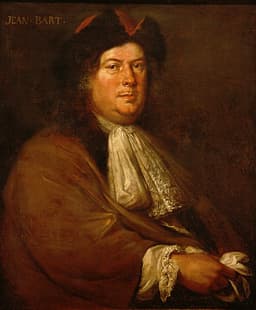
Jean Bart
General · Modern
49.9Total

Napoleon Bonaparte
General · Modern
70.9Total
Basic Information
Born
1650
1769
Died
1702
1821
Era
Modern
Modern
Nationality
France
France
Occupation
General
General
Civilization
Western
Western
Score Comparison
Military (10%)
52.5
94.0
Political (20%)
36.5
72.0
Influence (20%)
61.0
40.0
Legacy (20%)
47.5
80.0
Leadership (15%)
40.4
78.0
Strategy (15%)
60.0
90.0
TOTAL
49.9
70.9
Jean Bart — Complete Timeline
1690 AD
Battle of Beachy HeadWar
Jean Bart served as a privateer captain under the French admiral Tourville at the Battle of Beachy Head. The French fleet defeated the Anglo-Dutch fleet, gaining temporary control of the English Channel.
Nine Years' WarNaval BattleFrench Victory
Impact: regional
1694 AD
Battle of the TexelWar◆ Major
Jean Bart commanded a French squadron that broke through a Dutch blockade at the Battle of the Texel. He captured a large Dutch grain convoy, relieving a famine in France and demonstrating his skill as a naval commander.
Nine Years' WarNaval BattleFrench Victory
Impact: national
1695 AD
Raid on the Scottish CoastWar
Jean Bart led a raid on the Scottish coast, burning several villages and capturing ships. This raid was part of French efforts to support the Jacobite cause and disrupt English trade in the North Sea.
Nine Years' WarRaidJacobite Support
destructive
1696 AD
Capture of the English Convoy at Dogger BankWar
Jean Bart captured an English convoy off Dogger Bank, taking 25 merchant ships and their escort. This action disrupted English trade and demonstrated the effectiveness of French privateering during the Nine Years' War.
Nine Years' WarPrivateeringEnglish Loss
Impact: regional
1697 AD
Promoted to Chef d'EscadrePolitical Action◆ Major
Jean Bart was promoted to Chef d'Escadre (squadron commander) in the French navy, a high rank for a former privateer. This promotion recognized his successful service and made him a nobleman.
French NavyPromotionNobility
Impact: nationalconstructive
Napoleon Bonaparte — Complete Timeline
1799 AD
Coup of 18 BrumaireOther◆ Major
Napoleon Bonaparte, with support from his brother Lucien and key political figures, overthrew the Directory in a bloodless coup. He established the Consulate with himself as First Consul, effectively becoming the ruler of France. This event ended the French Revolution's most unstable period.
French RevolutionCoupRise to Power
Impact: regional
1804 AD
Promulgation of the Napoleonic CodeOther◆ Major
Napoleon enacted the Civil Code of the French, known as the Napoleonic Code, a comprehensive set of laws that replaced the fragmented feudal legal systems. The code established legal equality, protected property rights, and secularized law. It became the basis for legal systems in many European and world countries.
Legal ReformNapoleonic CodeCivil Law
Impact: globalconstructive
1805 AD
Battle of AusterlitzWar◆ Major
Napoleon's Grande Arm
Napoleonic WarsBattleDecisive Victory
Impact: global
1812 AD
Invasion of RussiaWar◆ Major
Napoleon led the Grande Arm
Napoleonic WarsInvasionDisaster
Impact: globaldestructive
1815 AD
Battle of WaterlooWar◆ Major
Napoleon's French army was defeated by the combined forces of the Duke of Wellington's Anglo-Allied army and Gebhard Leberecht von Bl
Napoleonic WarsBattleFinal Defeat
Impact: globaldestructive
Expert Analysis
jean-bart-vs-napoleon-bonaparte
# The Corsican and the Corsair
On a gray September morning in 1694, a French squadron slipped through a Dutch blockade off the coast of the Netherlands, capturing a vast grain convoy that would save Paris from famine. The man who commanded that daring raid was Jean Bart, a rough-hewn privateer from Dunkirk who had risen from common seaman to admiral. Just over a century later, another Frenchman of modest origins would conquer half of Europe before meeting his own dramatic downfall. Napoleon Bonaparte and Jean Bart both emerged from the same nation, yet their paths could hardly have diverged more sharply—one became the architect of an empire, the other a hero of the sea whose name still graces French warships. What drove these two men, and why did their fates differ so profoundly?
Origins
Napoleon was born in 1769 on the island of Corsica, a territory that had only recently become French. His family belonged to the minor nobility, but they were poor and spoke Italian at home. Young Napoleon felt like an outsider at French military academies, mocked for his accent and his small stature. This sense of being an underdog would fuel his ambition for the rest of his life. He absorbed the Enlightenment ideals of Rousseau and Voltaire, but also the harsh realities of military discipline and the chaos of revolution.
Jean Bart, born in 1650, came from a very different world. His father was a fisherman and privateer captain in Dunkirk, then a privateering stronghold. The sea was in Bart's blood—he went to sea as a cabin boy at age twelve, learning navigation, gunnery, and the brutal trade of naval warfare on the decks of small, fast ships. He never attended a military academy or read philosophy. His education was the North Sea gales and the sight of enemy merchant hulls on the horizon. Where Napoleon was shaped by books and ambition, Bart was shaped by salt spray and survival.
Rise to Power
Napoleon's ascent was meteoric and political. In 1793, at age twenty-four, he drove British forces out of the port of Toulon with a brilliant use of artillery. This victory made him a general at an age when most officers were still lieutenants. By 1796, he commanded the Army of Italy, where he defeated larger Austrian forces in a series of lightning campaigns. Each victory brought him not just territory, but political capital. When he returned to Paris in 1799, he seized power in a coup d'état, becoming First Consul. By 1804, he crowned himself Emperor of the French.
Jean Bart's rise was slower and less dramatic, but no less remarkable for a man of his class. He began as a simple privateer, raiding Dutch and English shipping during the wars of Louis XIV. His big break came in 1690 at the Battle of Beachy Head, where he served under Admiral Tourville. Though the battle itself was a French victory, Bart distinguished himself as a capable captain. Over the next few years, he proved his worth not through political maneuvering, but through relentless success at sea. In 1694 came his masterpiece: breaking the Dutch blockade of Dunkirk and capturing a grain convoy that fed Paris. The king promoted him to Chef d'Escadre in 1697, a high rank for a former privateer. Bart never sought political power—he sought prize money and glory, and found both.
Leadership & Governance
Napoleon was a genius of war and administration. He reorganized France's legal system into the Napoleonic Code, which influenced civil law across Europe and the world. He created a centralized bureaucracy, reformed education, and negotiated the Concordat with the Pope to stabilize the Church's role in France. On the battlefield, his speed, deception, and use of massed artillery shattered enemy armies from Austerlitz in 1805 to Jena in 1806. His political score of 75 reflects his effectiveness as a ruler, but also his fatal hubris—he placed his brothers on thrones, ignored the realities of guerrilla warfare in Spain, and invaded Russia in 1812, a decision that cost him his empire.
Jean Bart was never a ruler. He was a commander of ships, not nations. His leadership was personal and direct—he led from the quarterdeck, sharing the dangers of his men. His military score of 65.4 and strategy score of 59.4 suggest he was competent rather than brilliant in conventional terms, but his specialty was commerce raiding, not fleet battles. He understood that disrupting enemy trade could be as effective as sinking warships. His political score of 57.5 reflects his limited role: he could influence the king's favor, but never the course of policy. Yet his leadership score of 44.7 seems unfairly low—he held together crews of hardened privateers, men who would follow no one they did not respect.
Triumph & Tragedy
Napoleon's greatest triumph was Austerlitz in 1805, where he crushed the combined armies of Russia and Austria in a single day of perfect maneuver. His greatest tragedy was the invasion of Russia in 1812, where he lost over 400,000 men to winter, disease, and Russian scorched-earth tactics. He was exiled to Elba in 1814, returned for a hundred days, and met final defeat at Waterloo in 1815. He died in 1821 on the remote island of Saint Helena, a prisoner of the British.
Jean Bart's triumph came in 1694 at the Battle of the Texel, where he broke the blockade and captured that vital grain convoy. His tragedy was less dramatic but no less real: he died in 1702 at age fifty-two, likely from illness contracted during his raids. He never saw the peace his efforts helped secure, and his privateering victories, however brilliant, could not change the strategic balance of Louis XIV's wars. He died a hero, but a hero of a limited kind.
Character & Destiny
Napoleon's character was a study in contradictions. He was brilliant and tireless, but also arrogant and paranoid. He believed in meritocracy but surrounded himself with sycophants. His ambition was boundless, and it destroyed him. He once said, "Impossible is a word to be found only in the dictionary of fools." That confidence drove him to conquer Europe, but also to invade Russia. His total score of 82.4 reflects a figure of immense capability undone by his own flaws.
Jean Bart was simpler: tough, loyal, and direct. He was known for his generosity to captured prisoners and his fierce independence. He never aspired to an empire—he wanted to serve his king and his city of Dunkirk. His total score of 61.6 reflects a man of solid achievement but limited scope. Yet in his own way, he was more successful than Napoleon: he died at home, honored and free, not in exile.
Legacy
Napoleon's legacy is immense. The Napoleonic Code, the modern French bureaucracy, the metric system's spread, and the very idea of the career open to talent all bear his mark. He is remembered as both a liberator and a tyrant, a military genius and a cautionary tale about overreach. His influence score of 82 and legacy score of 78 show a figure who reshaped the world.
Jean Bart's legacy is smaller but more specific. He became a folk hero in France, especially in Dunkirk, where his statue stands. French warships have been named after him, and his name is synonymous with daring and seamanship. His influence score of 74.4 and legacy score of 65.3 reflect a man who did not change the world, but who embodied a certain ideal of French courage and independence.
Conclusion
Napoleon and Jean Bart both rose from modest beginnings to serve France with extraordinary skill. One sought to rule the world and lost everything; the other sought only to do his duty and died a hero. Their stories remind us that greatness comes in many forms, and that the measure of a life is not always found in the scale of ambition, but in the integrity of the path chosen. Napoleon conquered an empire and lost it; Jean Bart conquered the sea and kept it. In the end, perhaps the Corsair knew something the Corsican never learned: that the truest victory is not in ruling others, but in mastering oneself.
Rankings
🥇
Napoleon BonaparteLeader
Mil: 94.0Pol: 72.0Inf: 40.0
70.9
🥈
Jean Bart
Mil: 52.5Pol: 36.5Inf: 61.0
49.9
+21.0 behind
How This Comparison Works
Algorithm
Each figure is scored on 6 dimensions (0—100 scale) based on structured historical data: Military (10%), Political (20%), Influence (20%), Legacy (20%), Leadership (15%), Strategy (15%). The weighted total produces the final ranking.
Data Sources
Scores are computed from structured sub-indicators in the database. Scale factors adjust for era (Ancient ×0.85, Modern ×1.0) and civilization size (Eastern ×1.05, Other ×0.80) to account for differences in population and military scale.
Maximum 3 Figures
Comparisons are limited to 2—3 figures to ensure readability and statistical meaningfulness.
Error Margins
±5 points per dimension — Sub-scores are derived from historical records with inherent uncertainty. Two figures within 5 points on a dimension should be considered roughly equivalent in that area.
Total Score Accuracy
±3 points overall — The weighted combination of 6 dimensions produces a total score with approximately ±3 points of uncertainty. Differences of less than 3 points are not statistically significant— the figures are effectively tied.
Known Limitations
- Historical records are incomplete and uneven across civilizations
- Figures from oral-tradition societies may be underrepresented
- Occupation labels can misclassify multi-role figures
- Scores measure capability and impact, not moral character
- Quantitative scoring is a comparison tool, not absolute truth
Capability Radar
Military (10%) — Battles & Warfare
Battles
55
95
Win Rate
70
90
Expansion
30
95
Political (20%) — Governance & Reform
Reform
10
95
Diplomacy
25
80
Economy
30
85
Influence (20%) — Cultural & Global Reach
Cultural
45
85
Global
30
90
Legacy (20%) — Historical Impact
Historical
40
95
Longevity
35
90
Leadership (15%) — Power & Stability
Tenure
20
85
Stability
15
70
Strategy (15%) — Tactics & Innovation
Strategy
50
95
Tactics
65
98
Reform
20
92
Similar Comparisons
Comments & Discussion
No comments yet. Be the first to share your thoughts!