Loading...
Jean Bart vs Julius Caesar
Julius Caesar leads by 32.9 pts · 2 figures compared
…
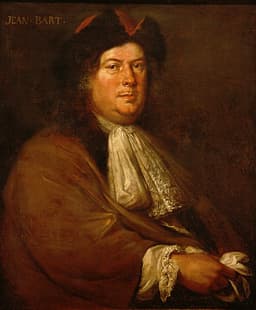
Jean Bart
General · Modern
49.9Total

Julius Caesar
General · Ancient
82.8Total
Basic Information
Born
1650
-100
Died
1702
-44
Era
Modern
Ancient
Nationality
France
Roman Republic
Occupation
General
General
Civilization
Western
Western
Score Comparison
Military (10%)
52.5
88.0
Political (20%)
36.5
78.0
Influence (20%)
61.0
85.0
Legacy (20%)
47.5
82.0
Leadership (15%)
40.4
80.0
Strategy (15%)
60.0
85.0
TOTAL
49.9
82.8
Jean Bart — Complete Timeline
1690 AD
Battle of Beachy HeadWar
Jean Bart served as a privateer captain under the French admiral Tourville at the Battle of Beachy Head. The French fleet defeated the Anglo-Dutch fleet, gaining temporary control of the English Channel.
Nine Years' WarNaval BattleFrench Victory
Impact: regional
1694 AD
Battle of the TexelWar◆ Major
Jean Bart commanded a French squadron that broke through a Dutch blockade at the Battle of the Texel. He captured a large Dutch grain convoy, relieving a famine in France and demonstrating his skill as a naval commander.
Nine Years' WarNaval BattleFrench Victory
Impact: national
1695 AD
Raid on the Scottish CoastWar
Jean Bart led a raid on the Scottish coast, burning several villages and capturing ships. This raid was part of French efforts to support the Jacobite cause and disrupt English trade in the North Sea.
Nine Years' WarRaidJacobite Support
destructive
1696 AD
Capture of the English Convoy at Dogger BankWar
Jean Bart captured an English convoy off Dogger Bank, taking 25 merchant ships and their escort. This action disrupted English trade and demonstrated the effectiveness of French privateering during the Nine Years' War.
Nine Years' WarPrivateeringEnglish Loss
Impact: regional
1697 AD
Promoted to Chef d'EscadrePolitical Action◆ Major
Jean Bart was promoted to Chef d'Escadre (squadron commander) in the French navy, a high rank for a former privateer. This promotion recognized his successful service and made him a nobleman.
French NavyPromotionNobility
Impact: nationalconstructive
Julius Caesar — Complete Timeline
58 BC
Gallic WarsWar◆ Major
Caesar, as proconsul of Gaul, launched a series of campaigns that conquered all of Gaul (modern France, Belgium, and parts of Switzerland). He fought numerous battles, including against the Helvetii, the Belgae, and the Gallic chieftain Vercingetorix. The wars brought immense wealth and a loyal army to Caesar.
Gallic WarsConquestRoman Expansion
Impact: regional
49 BC
Crossing the RubiconPolitical Action◆ Major
Caesar led Legio XIII across the Rubicon River into Italy, defying the Roman Senate's order to disband his army. This act triggered a civil war against Pompey and the Optimates, ultimately leading to Caesar's dictatorship and the end of the Roman Republic.
Roman Civil WarEnd of RepublicPower Struggle
Impact: global
48 BC
Battle of PharsalusWar◆ Major
Caesar's outnumbered army defeated the larger forces of Pompey the Great at Pharsalus in Greece. Caesar's tactical use of a reserve line to counter Pompey's cavalry charge proved decisive. Pompey fled to Egypt, where he was assassinated, leaving Caesar as the undisputed master of the Roman world.
Roman Civil WarBattleDecisive Victory
Impact: regional
44 BC
Appointment as Dictator for LifePolitical Action◆ Major
The Roman Senate appointed Caesar dictator perpetuo (dictator for life), granting him unprecedented personal power. This move concentrated military, legislative, and judicial authority in one person, effectively ending the Roman Republic's traditional system of checks and balances and alarming many senators.
DictatorshipEnd of RepublicPower Consolidation
Impact: regionaldestructive
Assassination on the Ides of MarchPolitical Action◆ Major
A group of Roman senators, led by Marcus Junius Brutus and Gaius Cassius Longinus, stabbed Caesar to death at a meeting of the Senate in the Theatre of Pompey. The assassination was intended to restore the Republic, but instead triggered another civil war that led to the rise of the Roman Empire.
AssassinationRoman PoliticsEnd of Republic
Impact: globaldestructive
Expert Analysis
jean-bart-vs-julius-caesar
### The General and the Privateer: Two Paths to Glory
On a spring day in 44 BCE, the most powerful man in the Roman world lay bleeding at the foot of a statue of his rival, Pompey. Sixty senators, men he had pardoned and promoted, had just stabbed him twenty-three times. Across the centuries and the Channel, on a cold October morning in 1694, a different scene unfolded: a burly, scarred sailor from Dunkirk, Jean Bart, smashed through a Dutch blockade off the coast of Holland, capturing a hundred ships laden with grain that would save Paris from famine. One man died at the pinnacle of his ambition; the other lived to become a folk hero. Both served their nations, both commanded men in battle, and both achieved immortality. But the paths they walked, the worlds they conquered, and the legacies they left could not have been more different. What made one a Caesar and the other a privateer?
### Origins: The Patrician and the Pirate
Julius Caesar was born into the chaos of the late Roman Republic, a world of civil wars, crumbling traditions, and ruthless ambition. His family, the Julii, claimed descent from the goddess Venus, but their political influence had waned. Young Caesar grew up in a Rome where the old senatorial aristocracy was being torn apart by populist generals like Marius and Sulla. He learned early that in a republic without rules, survival meant playing a longer, more dangerous game. His education was in rhetoric, law, and military command—the tools of a Roman statesman. He was, from the start, a creature of the state, designed to climb its greasy pole.
Jean Bart, born in 1650, came from a different world entirely. His father was a fisherman and privateer captain in Dunkirk, a port city that lived by the sea and the sword. The Barts were a family of corsairs; Jean learned to sail before he could read, and to fight before he learned to write. The France of Louis XIV was an absolute monarchy, a world where glory came from serving the Sun King, but where a commoner could rise only so far. Bart’s world was not the Senate floor but the quarterdeck, not the forum but the fog-shrouded North Sea. He was shaped by salt spray, not senatorial intrigue.
### Rise to Power: The Rubicon and the Royal Commission
Caesar’s rise was a masterpiece of political calculation. He climbed the traditional ladder of Roman offices—quaestor, aedile, praetor—but he did so with borrowed money, brilliant oratory, and a keen eye for alliances. His true power came from the command in Gaul, a province he conquered with ruthless efficiency over eight years. He built an army loyal to him, not to the Republic. When the Senate ordered him to disband his legions, he made his choice: crossing the Rubicon River into Italy in 49 BCE was an act of treason that launched a civil war. He gambled everything on his own genius and won.
Jean Bart’s rise was simpler and more brutal. He served as a privateer, a legalized pirate with a royal commission to raid enemy shipping. His career was a series of daring raids: capturing a Dutch convoy off the Texel in 1694, burning Scottish villages in 1695, and snatching an English convoy at Dogger Bank in 1696. He was not a conqueror of nations but a wrecker of commerce. His promotion to *Chef d'Escadre* (squadron commander) in 1697 was a profound honor for a former privateer, but it was a rank within a rigid hierarchy. He never commanded an army; he never changed the political order. He rose by proving his worth in battle, not by bending the state to his will.
### Leadership & Governance: The Dictator and the Admiral
Caesar governed as he conquered: with audacity, intelligence, and an iron will. As dictator of Rome, he reformed the calendar, granted citizenship to provincials, launched public works, and centralized power in his own hands. He was a military genius on the battlefield—his siege of Alesia and his victory at Pharsalus are still studied—but his political wisdom was more fragile. He pardoned his enemies, but he never understood that the Republic’s traditions could not be bent without breaking. He ruled as a king in all but name, and that cost him everything.
Jean Bart never governed. He commanded ships and squadrons, not provinces. His leadership was the tight, personal command of a captain who knew every man on his crew. He was no reformer and no politician. His “governance” was the hundred small decisions of a naval commander—when to engage, when to flee, how to keep his men alive on salted beef and desperation. He did not change France; he served it. His greatest political act was to bring food to a starving nation, a deed of logistics, not legislation.
### Triumph & Tragedy: The Ides of March and the Grain Fleet
Caesar’s greatest triumph was his conquest of Gaul, a feat that added a vast territory to the Roman world and made him the richest man in the Republic. His greatest tragedy was his failure to see that his own success had made him obsolete. The Ides of March was not just an assassination; it was the final, desperate act of a republic that could not contain its own most brilliant son. He died because he had become too powerful for the system that created him.
Jean Bart’s greatest triumph was the Battle of the Texel in 1694, where he broke the Dutch blockade and captured a grain fleet that saved France from famine. Louis XIV rewarded him with a title and a pension. His tragedy was smaller and quieter: he died of natural causes in 1702, at the age of 52, after a lifetime of hard service. There was no conspiracy, no dramatic fall. He simply faded, a hero whose time had passed.
### Character & Destiny: The Gambler and the Servant
Caesar was a gambler who believed in his own star. He was ruthless, charming, and intellectually voracious. He wrote his own history, and he made sure it was a good story. His personality—arrogant, generous, calculating—drove him to take risks that would have destroyed anyone else. He crossed the Rubicon because he could not imagine losing.
Jean Bart was a different breed. He was tough, loyal, and unpretentious. He did not write his memoirs or scheme for supreme power. He fought for his king, his city, and his crew. He was a servant of a system, not its master. His character was suited to a world of fixed hierarchies, where the highest ambition was to be the best at what you did, not to remake the world in your image.
### Legacy: The Empire and the Statue
Caesar’s legacy is the Roman Empire. His name became a title—*Kaiser*, *Tsar*—and his reforms shaped Western civilization for two millennia. He is remembered as a military genius, a political visionary, and a warning about the dangers of unchecked ambition. His death did not save the Republic; it destroyed it.
Jean Bart’s legacy is smaller but more personal. He is a national hero in France, celebrated in statues, songs, and the names of ships. He represents the courage and skill of the privateer, a figure who fought for profit and patriotism. He is remembered not as a world-changer but as a local legend, a man who did his duty brilliantly.
### Conclusion: Two Kinds of Greatness
Caesar and Jean Bart both achieved greatness, but their greatness was of different orders. Caesar played for the highest stakes—the fate of the known world—and won, then lost it all. Bart played a smaller game—the commerce war of a maritime king—and won a quieter immortality. One changed history; the other served it. One died by the dagger; the other in his bed. They remind us that history has room for both the man who would be king and the man who would be the best sailor in the fleet. Both are worth remembering, but for very different reasons.
Rankings
🥇
Julius CaesarLeader
Mil: 88.0Pol: 78.0Inf: 85.0
82.8
🥈
Jean Bart
Mil: 52.5Pol: 36.5Inf: 61.0
49.9
+32.9 behind
How This Comparison Works
Algorithm
Each figure is scored on 6 dimensions (0—100 scale) based on structured historical data: Military (10%), Political (20%), Influence (20%), Legacy (20%), Leadership (15%), Strategy (15%). The weighted total produces the final ranking.
Data Sources
Scores are computed from structured sub-indicators in the database. Scale factors adjust for era (Ancient ×0.85, Modern ×1.0) and civilization size (Eastern ×1.05, Other ×0.80) to account for differences in population and military scale.
Maximum 3 Figures
Comparisons are limited to 2—3 figures to ensure readability and statistical meaningfulness.
Error Margins
±5 points per dimension — Sub-scores are derived from historical records with inherent uncertainty. Two figures within 5 points on a dimension should be considered roughly equivalent in that area.
Total Score Accuracy
±3 points overall — The weighted combination of 6 dimensions produces a total score with approximately ±3 points of uncertainty. Differences of less than 3 points are not statistically significant— the figures are effectively tied.
Known Limitations
- Historical records are incomplete and uneven across civilizations
- Figures from oral-tradition societies may be underrepresented
- Occupation labels can misclassify multi-role figures
- Scores measure capability and impact, not moral character
- Quantitative scoring is a comparison tool, not absolute truth
Capability Radar
Military (10%) — Battles & Warfare
Battles
55
95
Win Rate
70
92
Expansion
30
97
Political (20%) — Governance & Reform
Reform
10
90
Diplomacy
25
85
Economy
30
82
Influence (20%) — Cultural & Global Reach
Cultural
45
88
Global
30
94
Legacy (20%) — Historical Impact
Historical
40
95
Longevity
35
96
Leadership (15%) — Power & Stability
Tenure
20
75
Stability
15
60
Strategy (15%) — Tactics & Innovation
Strategy
50
94
Tactics
65
96
Reform
20
88
Similar Comparisons
Comments & Discussion
No comments yet. Be the first to share your thoughts!