Loading...
Jean Bart vs Mahadji Scindia
Mahadji Scindia leads by 15.5 pts · 2 figures compared
…
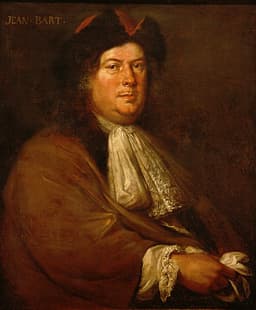
Jean Bart
General · Modern
49.9Total
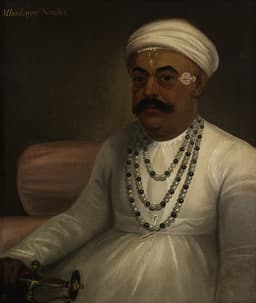
Mahadji Scindia
General · Modern
65.4Total
Basic Information
Born
1650
1730
Died
1702
1794
Era
Modern
Modern
Nationality
France
India
Occupation
General
General
Civilization
Western
Indian
Score Comparison
Military (10%)
52.5
85.0
Political (20%)
36.5
78.0
Influence (20%)
61.0
56.7
Legacy (20%)
47.5
52.0
Leadership (15%)
40.4
72.0
Strategy (15%)
60.0
72.0
TOTAL
49.9
65.4
Jean Bart — Complete Timeline
1690 AD
Battle of Beachy HeadWar
Jean Bart served as a privateer captain under the French admiral Tourville at the Battle of Beachy Head. The French fleet defeated the Anglo-Dutch fleet, gaining temporary control of the English Channel.
Nine Years' WarNaval BattleFrench Victory
Impact: regional
1694 AD
Battle of the TexelWar◆ Major
Jean Bart commanded a French squadron that broke through a Dutch blockade at the Battle of the Texel. He captured a large Dutch grain convoy, relieving a famine in France and demonstrating his skill as a naval commander.
Nine Years' WarNaval BattleFrench Victory
Impact: national
1695 AD
Raid on the Scottish CoastWar
Jean Bart led a raid on the Scottish coast, burning several villages and capturing ships. This raid was part of French efforts to support the Jacobite cause and disrupt English trade in the North Sea.
Nine Years' WarRaidJacobite Support
destructive
1696 AD
Capture of the English Convoy at Dogger BankWar
Jean Bart captured an English convoy off Dogger Bank, taking 25 merchant ships and their escort. This action disrupted English trade and demonstrated the effectiveness of French privateering during the Nine Years' War.
Nine Years' WarPrivateeringEnglish Loss
Impact: regional
1697 AD
Promoted to Chef d'EscadrePolitical Action◆ Major
Jean Bart was promoted to Chef d'Escadre (squadron commander) in the French navy, a high rank for a former privateer. This promotion recognized his successful service and made him a nobleman.
French NavyPromotionNobility
Impact: nationalconstructive
Mahadji Scindia — Complete Timeline
1768 AD
Became Regent of GwaliorPolitical Action◆ Major
Mahadji Scindia assumed the regency of Gwalior after the death of his predecessor. He consolidated power and expanded the Scindia domain through military campaigns and alliances.
SuccessionGwaliorScindia Dynasty
Impact: regionalconstructive
1771 AD
Battle of DelhiWar◆ Major
Mahadji Scindia led Maratha forces to capture Delhi from the Rohilla Afghans. He restored the Mughal Emperor Shah Alam II to the throne, becoming the de facto power behind the Mughal court.
Maratha-Afghan WarsDelhiMughal Restoration
Impact: national
1784 AD
Appointed Mughal RegentPolitical Action
Mahadji Scindia was appointed as the regent (Vakil-i-Mutlaq) of the Mughal Empire by Shah Alam II. This gave him control over Mughal administration and military, making him the most powerful figure in northern India.
Mughal EmpireRegencyScindia
Impact: nationalconstructive
1787 AD
Battle of LalsotWar
Mahadji Scindia fought against the Rajput coalition of Jaipur and Jodhpur at Lalsot. The battle ended inconclusively, but it weakened Rajput resistance to Maratha expansion.
Maratha-Rajput WarsBattleRajasthan
Impact: regional
1790 AD
Battle of PatanWar◆ Major
Mahadji Scindia defeated the Rajput forces of Jaipur at the Battle of Patan. The victory forced Jaipur to accept Maratha suzerainty and pay tribute.
Maratha-Rajput WarsBattleJaipur
Impact: regional
Battle of MertaWar◆ Major
Mahadji Scindia defeated the Rajput forces of Jodhpur at the Battle of Merta. This victory extended Maratha control over Marwar and established Scindia as the dominant power in Rajasthan.
Maratha-Rajput WarsBattleJodhpur
Impact: regional
Expert Analysis
Origins
Jean Bart was born on October 21, 1650, in Dunkirk, a port city then part of the Spanish Netherlands but later French. His father, Cornil Bart, was a privateer captain, and his family had a long maritime tradition. Bart began his naval career as a cabin boy, later serving in the Dutch navy under Admiral de Ruyter, gaining experience that would serve him well. He returned to France and became a privateer, operating out of Dunkirk.
Mahadji Scindia was born around 1727 in the Maratha Empire, into the Scindia family, a prominent Maratha clan. His father, Ranoji Scindia, was a general under the Peshwa. Mahadji received military training and administration experience from a young age. He rose through the ranks, serving under the Peshwa and later carving his own path.
Rise to Power
Jean Bart's rise began during the Franco-Dutch War. In 1674, he was commissioned as a lieutenant in the French navy. His big break came in 1676 when he captured a Dutch convoy, gaining recognition. In 1683, he was promoted to captain. His most famous exploit was in 1694 at the Battle of the Texel, where he broke a Dutch blockade and captured a grain convoy, relieving famine in Paris. This earned him promotion to Chef d'Escadre in 1697, a high rank for a former privateer.
Mahadji Scindia's rise was marked by the decline of the Maratha Empire after the Third Battle of Panipat in 1761. He took control of the Scindia faction and allied with the Mughal Emperor Shah Alam II. In 1771, he led the Maratha capture of Delhi, restoring the emperor and becoming the Mughal regent (Vakil-i-Mutlaq). This gave him control over Mughal administration and vast territories. He consolidated power through military campaigns and diplomacy.
Leadership & Governance
Jean Bart was a daring and charismatic leader who inspired loyalty among his crews. He was known for his aggressive tactics and ability to outmaneuver larger enemy forces. As a privateer, he operated with a mix of state support and independent action. His leadership style was direct and hands-on, often leading from the front. In governance, he had little involvement, as his role was primarily military.
Mahadji Scindia was a shrewd politician and military strategist. He modernized his army with European training and artillery, creating a disciplined force. As regent, he effectively controlled the Mughal court, installing his own officials and collecting revenue. He used a combination of force and diplomacy to expand his territory, imposing tribute on Rajput states like Jaipur and Jodhpur. His governance was pragmatic, focusing on stability and extraction of resources.
Triumph & Tragedy
Jean Bart's greatest triumph was the Battle of the Texel in 1694, where he captured a Dutch grain convoy, saving Paris from famine. This cemented his reputation. He also captured an English convoy at Dogger Bank in 1695. His tragedy came in 1697 when he was captured by the English but later exchanged. He died in 1702 from natural causes, his career ending without major defeat.
Mahadji Scindia's triumphs include the Battle of Delhi (1771) restoring the Mughal emperor, and victories at Patan (1790) and Merta (1790) over Rajput kingdoms. He expanded Maratha influence to the north. His tragedy was the decline of the Maratha Empire after his death in 1794; his successors failed to maintain control, leading to British conquest. He also faced internal Maratha rivalries, notably with the Peshwa.
Character & Destiny
Jean Bart was bold, resourceful, and fearless, typical of privateers. He was also proud and independent, often clashing with naval authorities. His character suited the high-risk, high-reward world of privateering. His destiny was tied to French naval power; he succeeded in disrupting enemy commerce but never commanded a major fleet. His scores reflect this: Military 52.5, Strategy 60.0.
Mahadji Scindia was ambitious, patient, and politically astute. He was a master of realpolitik, using the Mughal emperor as a figurehead. His character allowed him to navigate complex Indian politics. His destiny was to revive Maratha power temporarily, but his death led to fragmentation. His scores: Military 85.0, Political 78.0, Leadership 72.0, Strategy 72.0.
Legacy
Jean Bart is remembered as a national hero in France, particularly in Dunkirk. His name adorns ships and streets. He symbolizes French privateering prowess. However, his impact was limited; he did not change naval warfare or strategy. Legacy score: 47.5.
Mahadji Scindia left a lasting legacy in Indian history. He restored Mughal authority briefly and expanded Maratha influence. The Scindia dynasty continued in Gwalior until independence. His military innovations influenced later Indian armies. Legacy score: 52.0. Influence score: 56.7.
Conclusion
Mahadji Scindia had greater impact than Jean Bart. His military score of 85.0 dwarfs Bart's 52.5, and his political score of 78.0 far exceeds Bart's 36.5. Total scores: 65.4 vs 49.9. Scindia shaped the political landscape of 18th-century India, while Bart's achievements were tactical and temporary. Scindia's legacy as a regent and modernizer endures, whereas Bart's is mostly symbolic. The 15.5-point gap is justified.
Rankings
🥇
Mahadji ScindiaLeader
Mil: 85.0Pol: 78.0Inf: 56.7
65.4
🥈
Jean Bart
Mil: 52.5Pol: 36.5Inf: 61.0
49.9
+15.5 behind
How This Comparison Works
Algorithm
Each figure is scored on 6 dimensions (0—100 scale) based on structured historical data: Military (10%), Political (20%), Influence (20%), Legacy (20%), Leadership (15%), Strategy (15%). The weighted total produces the final ranking.
Data Sources
Scores are computed from structured sub-indicators in the database. Scale factors adjust for era (Ancient ×0.85, Modern ×1.0) and civilization size (Eastern ×1.05, Other ×0.80) to account for differences in population and military scale.
Maximum 3 Figures
Comparisons are limited to 2—3 figures to ensure readability and statistical meaningfulness.
Error Margins
±5 points per dimension — Sub-scores are derived from historical records with inherent uncertainty. Two figures within 5 points on a dimension should be considered roughly equivalent in that area.
Total Score Accuracy
±3 points overall — The weighted combination of 6 dimensions produces a total score with approximately ±3 points of uncertainty. Differences of less than 3 points are not statistically significant— the figures are effectively tied.
Known Limitations
- Historical records are incomplete and uneven across civilizations
- Figures from oral-tradition societies may be underrepresented
- Occupation labels can misclassify multi-role figures
- Scores measure capability and impact, not moral character
- Quantitative scoring is a comparison tool, not absolute truth
Capability Radar
Military (10%) — Battles & Warfare
Battles
55
85
Win Rate
70
80
Expansion
30
80
Political (20%) — Governance & Reform
Reform
10
70
Diplomacy
25
90
Economy
30
70
Influence (20%) — Cultural & Global Reach
Cultural
45
60
Global
30
55
Legacy (20%) — Historical Impact
Historical
40
75
Longevity
35
60
Leadership (15%) — Power & Stability
Tenure
20
85
Stability
15
65
Strategy (15%) — Tactics & Innovation
Strategy
50
90
Tactics
65
85
Reform
20
75
Similar Comparisons
Comments & Discussion
No comments yet. Be the first to share your thoughts!