Loading...
Jahangir vs Savang Vatthana
Jahangir leads by 11.2 pts · 2 figures compared
…
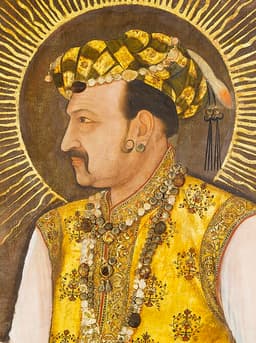
Jahangir
Emperor · Modern
52.9Total

Savang Vatthana
Emperor · Modern
41.7Total
Basic Information
Born
1569
1907
Died
1627
1978
Era
Modern
Modern
Nationality
Mughal Empire
Laos
Occupation
Emperor
Emperor
Civilization
Indian
Eastern
Score Comparison
Military (10%)
38.3
53.6
Political (20%)
43.7
27.9
Influence (20%)
59.0
47.1
Legacy (20%)
46.7
34.2
Leadership (15%)
74.0
37.4
Strategy (15%)
50.0
62.6
TOTAL
52.9
41.7
Jahangir — Complete Timeline
1606 AD
Execution of Guru Arjan DevPolitical Action◆ Major
Jahangir ordered the execution of Guru Arjan Dev, the fifth Sikh guru, for supporting the rebellion of his son Khusrau. Guru Arjan Dev was tortured and died in Mughal custody. This event marked a turning point in Sikh-Mughal relations, leading to the militarization of the Sikh community.
ExecutionSikhismReligious Conflict
Impact: regionaldestructive
Rebellion of Prince KhusrauPolitical Action
Jahangir's eldest son, Prince Khusrau, rebelled against his father shortly after Jahangir's accession. Khusrau gathered an army and marched on Lahore. Jahangir's forces defeated the rebellion, and Khusrau was captured. He was later blinded and imprisoned, dying in 1622.
RebellionSuccessionKhusrau
Impact: nationaltragic
1611 AD
Marriage to Nur JahanPolitical Action◆ Major
Jahangir married Mehr-un-Nissa, who was given the title Nur Jahan. She became his most influential wife and effectively co-ruled the empire. Nur Jahan controlled court appointments, issued decrees, and managed the empire's finances. Her influence marked a period of significant female political power in the Mughal court.
MarriageNur JahanCourt Politics
Impact: national
1612 AD
Granting of Trade Rights to the English East India CompanyPolitical Action◆ Major
Jahangir granted the English East India Company permission to establish a trading post at Surat. This was the first formal English foothold in India. The company later expanded its influence, eventually becoming the dominant colonial power in the subcontinent.
TradeEast India CompanyColonialism
Impact: global
Savang Vatthana — Complete Timeline
1959 AD
Accession to the Throne of LaosPolitical Action◆ Major
Savang Vatthana became king of Laos following the death of his father Sisavang Vong. He inherited a kingdom already embroiled in civil war between the royal government, neutralists, and the communist Pathet Lao. His reign was marked by political instability and foreign intervention.
CoronationCivil WarMonarchy
Impact: national
1973 AD
Signing of the Vientiane AgreementPolitical Action◆ Major
Savang Vatthana endorsed the Vientiane Agreement, a ceasefire accord between the royal government and the Pathet Lao. The agreement established a coalition government and temporarily halted fighting in the Laotian Civil War, but failed to resolve the underlying political conflict.
CeasefireCoalitionCivil War
Impact: nationalconstructive
1975 AD
Abdication and Communist TakeoverPolitical Action
Following the Pathet Lao's military victory, Savang Vatthana abdicated the throne on December 2, 1975. The Lao People's Democratic Republic was proclaimed, ending 600 years of Lao monarchy. The king was appointed a 'private citizen' and 'adviser' to the new government.
AbdicationCommunist RevolutionEnd of Monarchy
Impact: nationaltragic
1978 AD
Death in Re-education CampPolitical Action◆ Major
Savang Vatthana, along with his family, was sent to a communist re-education camp in Houaphan Province. He died there in 1978 under unclear circumstances, likely from malnutrition and harsh conditions. His death was not officially acknowledged by the Lao government for decades.
Re-education CampDeathCommunist Repression
Impact: nationaltragic
Expert Analysis
Origins
Jahangir was born in 1569 to Emperor Akbar and a Rajput princess, Mariam-uz-Zamani. He was educated in Persian, Arabic, and military arts, and grew up in the opulent Mughal court. His early life was marked by rebellion against his father, which shaped his later insecurities.
Savang Vatthana was born in 1907 to King Sisavang Vong of Luang Prabang, then a French protectorate. He was educated in France and at the École Nationale de la France d'Outre-Mer. He inherited a kingdom torn by colonial rule and emerging communist insurgency.
Rise to Power
Jahangir ascended the throne in 1605 after Akbar's death, but faced immediate rebellion from his son Khusrau in 1606. He crushed the revolt, executing Guru Arjan Dev for supporting Khusrau. His marriage to Nur Jahan in 1611 consolidated his power as she became co-ruler.
Savang Vatthana became king in 1959 upon his father's death. He inherited a civil war between the Royal Lao Government and the Pathet Lao. He sought neutrality but was caught in the Cold War, with U.S. funding his government while North Vietnam supported the communists.
Leadership & Governance
Jahangir's leadership score of 74.0 reflects his ability to maintain Mughal stability through delegation. He allowed Nur Jahan to effectively govern, issuing farmans and managing court factions. He also granted the English East India Company trading rights in 1613, opening India to European influence. However, his reliance on his wife and his addiction to opium and wine weakened his authority.
Savang Vatthana's leadership score of 37.4 indicates his limited control. He endorsed the 1973 Vientiane Agreement that created a coalition government, but the Pathet Lao soon dominated. He failed to modernize the monarchy or build popular support, relying on French and American backing that collapsed after 1975.
Triumph & Tragedy
Jahangir's triumphs include a stable empire, patronage of the arts (Mughal painting flourished), and the construction of Shalimar Gardens. His tragedy was the execution of Guru Arjan Dev, which alienated Sikhs and sparked long-term conflict. His political score of 43.7 reflects his inability to prevent court intrigues and the rise of his son Shah Jahan's rebellion.
Savang Vatthana's reign saw the Vientiane Agreement as a brief triumph, but it failed to stop the Pathet Lao. His tragedy was his abdication in 1975 and death in a re-education camp in 1978, ending the 600-year monarchy. His legacy score of 34.2 reflects the disappearance of the Lao monarchy.
Character & Destiny
Jahangir was cultured but cruel, with a love for justice (he set up a Chain of Justice) but also a temper. His addiction and delegation to Nur Jahan set a precedent for weak central rule. His strategy score of 50.0 shows a mixed record: he expanded the empire but failed to secure succession.
Savang Vatthana was a passive, well-meaning figure caught in forces beyond his control. He lacked the military or political acumen to navigate the Cold War. His strategy score of 62.6 is higher than his political score, indicating he made tactical choices (like the Vientiane Agreement) but without long-term success.
Legacy
Jahangir's legacy is mixed: he is remembered for artistic patronage and the English East India Company's foothold, which eventually led to British colonization. His influence score of 59.0 reflects his impact on Mughal culture and the Sikh conflict. The execution of Guru Arjan Dev is a pivotal event in Sikh history.
Savang Vatthana's legacy is minimal: he is the last king of a forgotten monarchy. Laos became a communist state, and the royal family's fate is a footnote. His influence score of 47.1 is largely due to his symbolic role.
Conclusion
Jahangir had greater impact. His total score of 52.9 compared to Savang Vatthana's 41.7 reflects his role in shaping Mughal India and the subcontinent's trajectory. While Savang Vatthana's reign ended a dynasty, Jahangir's decisions—granting English trade rights, executing Guru Arjan—had centuries-long consequences. Jahangir's leadership score of 74.0 against Savang's 37.4 underscores his ability to govern, even with flaws. In the balance of history, Jahangir's influence outweighs that of a king who was a victim of larger forces.
Rankings
🥇
JahangirLeader
Mil: 38.3Pol: 43.7Inf: 59.0
52.9
🥈
Savang Vatthana
Mil: 53.6Pol: 27.9Inf: 47.1
41.7
+11.2 behind
How This Comparison Works
Algorithm
Each figure is scored on 6 dimensions (0—100 scale) based on structured historical data: Military (10%), Political (20%), Influence (20%), Legacy (20%), Leadership (15%), Strategy (15%). The weighted total produces the final ranking.
Data Sources
Scores are computed from structured sub-indicators in the database. Scale factors adjust for era (Ancient ×0.85, Modern ×1.0) and civilization size (Eastern ×1.05, Other ×0.80) to account for differences in population and military scale.
Maximum 3 Figures
Comparisons are limited to 2—3 figures to ensure readability and statistical meaningfulness.
Error Margins
±5 points per dimension — Sub-scores are derived from historical records with inherent uncertainty. Two figures within 5 points on a dimension should be considered roughly equivalent in that area.
Total Score Accuracy
±3 points overall — The weighted combination of 6 dimensions produces a total score with approximately ±3 points of uncertainty. Differences of less than 3 points are not statistically significant— the figures are effectively tied.
Known Limitations
- Historical records are incomplete and uneven across civilizations
- Figures from oral-tradition societies may be underrepresented
- Occupation labels can misclassify multi-role figures
- Scores measure capability and impact, not moral character
- Quantitative scoring is a comparison tool, not absolute truth
Capability Radar
Military (10%) — Battles & Warfare
Battles
45
55
Win Rate
40
54
Expansion
25
58
Political (20%) — Governance & Reform
Reform
30
10
Diplomacy
40
15
Economy
35
10
Influence (20%) — Cultural & Global Reach
Cultural
60
15
Global
35
5
Legacy (20%) — Historical Impact
Historical
50
10
Longevity
40
5
Leadership (15%) — Power & Stability
Tenure
55
19
Stability
30
5
Strategy (15%) — Tactics & Innovation
Strategy
30
60
Tactics
35
64
Reform
20
65
Similar Comparisons
Comments & Discussion
No comments yet. Be the first to share your thoughts!