Loading...
Charles II of Spain vs Savang Vatthana
Charles II of Spain leads by 3.2 pts · 2 figures compared
…
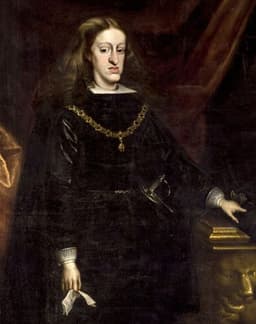
Charles II of Spain
Emperor · Modern
44.9Total

Savang Vatthana
Emperor · Modern
41.7Total
Basic Information
Born
1661
1907
Died
1700
1978
Era
Modern
Modern
Nationality
Spain
Laos
Occupation
Emperor
Emperor
Civilization
Western
Eastern
Score Comparison
Military (10%)
15.0
53.6
Political (20%)
26.4
27.9
Influence (20%)
53.3
47.1
Legacy (20%)
52.0
34.2
Leadership (15%)
48.4
37.4
Strategy (15%)
58.4
62.6
TOTAL
44.9
41.7
Charles II of Spain — Complete Timeline
1661 AD
Suffered from Severe Physical and Mental DisabilitiesOther◆ Major
Charles II was born with numerous health problems due to Habsburg inbreeding, including a deformed jaw, epilepsy, and intellectual disabilities. He was unable to walk until age eight and was considered unfit to rule, leading to a regency throughout his life.
InbreedingDisabilityHabsburg Dynasty
Impact: nationaltragic
1665 AD
Became King of SpainPolitical Action
Charles II inherited the Spanish throne at age four upon the death of his father Philip IV. His reign was marked by severe physical and mental disabilities due to generations of inbreeding, leading to a regency government.
SuccessionHabsburg DynastyRegency
Impact: global
1697 AD
Signed the Treaty of RyswickPolitical Action
Charles II's government signed the Treaty of Ryswick, ending the Nine Years' War with France. Spain ceded territories in the Caribbean and Europe to France, but the treaty temporarily stabilized relations before the succession crisis.
TreatyNine Years' WarDiplomacy
Impact: regional
1700 AD
Death Without Heir Triggered War of Spanish SuccessionPolitical Action
Charles II died without an heir, leaving his throne to Philip of Anjou (grandson of Louis XIV) in his will. This sparked the War of Spanish Succession (1701-1714) as European powers contested the Bourbon succession to the Spanish throne.
Succession CrisisWar of Spanish SuccessionBourbon Dynasty
Impact: global
Savang Vatthana — Complete Timeline
1959 AD
Accession to the Throne of LaosPolitical Action◆ Major
Savang Vatthana became king of Laos following the death of his father Sisavang Vong. He inherited a kingdom already embroiled in civil war between the royal government, neutralists, and the communist Pathet Lao. His reign was marked by political instability and foreign intervention.
CoronationCivil WarMonarchy
Impact: national
1973 AD
Signing of the Vientiane AgreementPolitical Action◆ Major
Savang Vatthana endorsed the Vientiane Agreement, a ceasefire accord between the royal government and the Pathet Lao. The agreement established a coalition government and temporarily halted fighting in the Laotian Civil War, but failed to resolve the underlying political conflict.
CeasefireCoalitionCivil War
Impact: nationalconstructive
1975 AD
Abdication and Communist TakeoverPolitical Action
Following the Pathet Lao's military victory, Savang Vatthana abdicated the throne on December 2, 1975. The Lao People's Democratic Republic was proclaimed, ending 600 years of Lao monarchy. The king was appointed a 'private citizen' and 'adviser' to the new government.
AbdicationCommunist RevolutionEnd of Monarchy
Impact: nationaltragic
1978 AD
Death in Re-education CampPolitical Action◆ Major
Savang Vatthana, along with his family, was sent to a communist re-education camp in Houaphan Province. He died there in 1978 under unclear circumstances, likely from malnutrition and harsh conditions. His death was not officially acknowledged by the Lao government for decades.
Re-education CampDeathCommunist Repression
Impact: nationaltragic
Expert Analysis
Origins
**Charles II of Spain** was born on November 6, 1661, in Madrid, the only surviving son of King Philip IV and Mariana of Austria. The Habsburg dynasty's practice of intermarriage had left him with severe genetic defects. He was born with a deformed jaw, suffered from epilepsy, and had intellectual disabilities. His mother served as regent until he reached majority.
**Savang Vatthana** was born on November 13, 1907, in Luang Prabang, Laos, to King Sisavang Vong and Queen Kham-Oun. He was educated in France, attending the Lycée Condorcet and later the École des Sciences Politiques. He returned to Laos and served as crown prince, gaining administrative experience under French colonial rule.
Rise to Power
Charles II ascended the throne at age four upon his father's death in 1665. His mother, Mariana of Austria, acted as regent until 1675. The Spanish empire was vast but declining. Charles's physical and mental disabilities prevented him from ruling effectively, leaving control to his mother and a series of favorites, most notably John Joseph of Austria, his illegitimate half-brother, who led a coup in 1677.
Savang Vatthana became king in 1959 after his father's death. He inherited a kingdom deeply divided by the Laotian Civil War between the royal government, neutralists, and the communist Pathet Lao. As a constitutional monarch, he had limited political power but served as a symbolic unifying figure. He attempted to navigate the Cold War pressures, seeking neutrality while relying on U.S. aid.
Leadership & Governance
Charles II's reign was characterized by weak governance. The Spanish monarchy functioned through a series of regents and ministers. Economic decline, military defeats, and administrative chaos marked his rule. The Treaty of Ryswick in 1697 ended the Nine Years' War, forcing Spain to cede territories to France. Charles himself was incapable of making decisions; his will, manipulated by court factions, ultimately sparked a war.
Savang Vatthana's leadership was constrained by the civil war and foreign intervention. He endorsed the 1973 Vientiane Agreement, which established a coalition government with the Pathet Lao. However, the agreement was fragile. His strategy score of 62.6 reflects his attempts to preserve the monarchy through diplomacy, but his political score of 27.9 indicates his inability to prevent the communist takeover.
Triumph & Tragedy
Charles II's greatest triumph was perhaps surviving to adulthood and maintaining the Spanish Empire's integrity during his reign, despite his disabilities. However, his greatest failure was his inability to produce an heir. His death without a child led to the War of Spanish Succession (1701-1714), which devastated Europe and resulted in the loss of Spanish territories in Italy and the Netherlands. His military score of 15.0 reflects the decline of Spanish power.
Savang Vatthana's triumph was his peaceful abdication on December 2, 1975, which avoided a bloodbath in Vientiane. However, his tragedy was his subsequent death in a communist re-education camp in 1978, along with his family. The Pathet Lao reneged on promises of a coalition. His legacy score of 34.2 reflects the monarchy's complete dissolution.
Character & Destiny
Charles II was described as kind and pious but intellectually disabled. His physical ailments, including a prognathic jaw that prevented chewing, made him a tragic figure. His character was shaped by his dependency on others. His destiny was sealed by genetics: the Habsburg inbreeding that caused his sterility and illnesses. Historians note that his reign was a slow decline, and his death was a release.
Savang Vatthana was seen as a cultured, educated man who tried to modernize Laos. He was cautious and diplomatic, but his decision to remain in Laos after the communist takeover proved fatal. He trusted the Pathet Lao's promises of a safe retirement. His character—loyal to his people and unwilling to flee—led to his tragic end. His leadership score of 37.4 reflects his limited ability to inspire change.
Legacy
Charles II's legacy is the end of the Spanish Habsburg dynasty and the War of Spanish Succession, which reshaped European power balances. The Treaty of Utrecht (1713) established the Bourbon dynasty in Spain and marked the rise of British and French dominance. His name became synonymous with inbreeding and decline. His influence score of 53.3 reflects the war's impact.
Savang Vatthana is remembered as the last king of Laos, a symbol of a lost era. His death in a camp is a cautionary tale about the fate of monarchs under communist regimes. The monarchy was abolished, and Laos became a one-party state. His legacy is largely national, with little global impact. His total score of 41.7 is lower than Charles II's 44.9.
Conclusion
Charles II of Spain had a greater historical impact than Savang Vatthana. Despite his disabilities, his death triggered a major European war that reshaped the continent. Savang Vatthana's reign ended quietly, and his influence was limited to Laos. The score gap of 3.2 points reflects this difference. Charles II's legacy, though negative, was far-reaching, while Savang Vatthana's remains a footnote in Cold War history.
Rankings
🥇
Charles II of SpainLeader
Mil: 15.0Pol: 26.4Inf: 53.3
44.9
🥈
Savang Vatthana
Mil: 53.6Pol: 27.9Inf: 47.1
41.7
+3.2 behind
How This Comparison Works
Algorithm
Each figure is scored on 6 dimensions (0—100 scale) based on structured historical data: Military (10%), Political (20%), Influence (20%), Legacy (20%), Leadership (15%), Strategy (15%). The weighted total produces the final ranking.
Data Sources
Scores are computed from structured sub-indicators in the database. Scale factors adjust for era (Ancient ×0.85, Modern ×1.0) and civilization size (Eastern ×1.05, Other ×0.80) to account for differences in population and military scale.
Maximum 3 Figures
Comparisons are limited to 2—3 figures to ensure readability and statistical meaningfulness.
Error Margins
±5 points per dimension — Sub-scores are derived from historical records with inherent uncertainty. Two figures within 5 points on a dimension should be considered roughly equivalent in that area.
Total Score Accuracy
±3 points overall — The weighted combination of 6 dimensions produces a total score with approximately ±3 points of uncertainty. Differences of less than 3 points are not statistically significant— the figures are effectively tied.
Known Limitations
- Historical records are incomplete and uneven across civilizations
- Figures from oral-tradition societies may be underrepresented
- Occupation labels can misclassify multi-role figures
- Scores measure capability and impact, not moral character
- Quantitative scoring is a comparison tool, not absolute truth
Capability Radar
Military (10%) — Battles & Warfare
Battles
37
55
Win Rate
41
54
Expansion
45
58
Political (20%) — Governance & Reform
Reform
5
10
Diplomacy
10
15
Economy
5
10
Influence (20%) — Cultural & Global Reach
Cultural
10
15
Global
40
5
Legacy (20%) — Historical Impact
Historical
60
10
Longevity
50
5
Leadership (15%) — Power & Stability
Tenure
35
19
Stability
5
5
Strategy (15%) — Tactics & Innovation
Strategy
45
60
Tactics
50
64
Reform
49
65
Similar Comparisons
Comments & Discussion
No comments yet. Be the first to share your thoughts!