Loading...
Hideki Tojo vs Lon Nol
Hideki Tojo leads by 12.4 pts · 2 figures compared
…
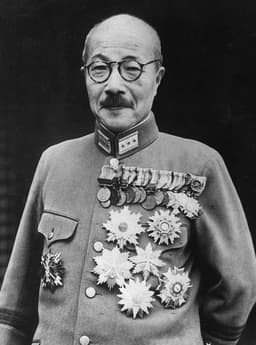
Hideki Tojo
General · Modern
53.9Total
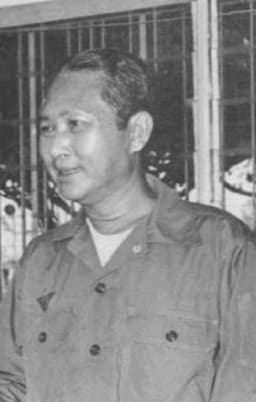
Lon Nol
General · Modern
41.5Total
Basic Information
Born
1884
1913
Died
1948
1985
Era
Modern
Modern
Nationality
Japan
Cambodia
Occupation
General
General
Civilization
Eastern
Eastern
Score Comparison
Military (10%)
70.0
25.9
Political (20%)
48.0
30.8
Influence (20%)
55.0
47.9
Legacy (20%)
50.0
38.3
Leadership (15%)
53.2
61.1
Strategy (15%)
55.0
35.7
TOTAL
53.9
41.5
Hideki Tojo — Complete Timeline
1941 AD
Attack on Pearl HarborWar
As Prime Minister, Hideki Tojo authorized the attack on the US naval base at Pearl Harbor, Hawaii. The surprise attack brought the United States into World War II. Tojo's decision was based on the belief that war with the US was inevitable due to resource embargoes and diplomatic failures.
World War IIPearl HarborUS-Japan War
Impact: globaldestructive
Appointment as Prime MinisterPolitical Action◆ Major
Hideki Tojo was appointed Prime Minister of Japan, replacing Fumimaro Konoe. He retained his position as Army Minister and later took on other portfolios, consolidating power. His appointment marked the ascendancy of the military faction in the Japanese government and the shift towards total war.
Prime MinisterMilitary GovernmentWorld War II
Impact: national
1942 AD
Fall of SingaporeWar◆ Major
Under Tojo's leadership, Japanese forces captured Singapore from the British in a swift campaign. The fall of Singapore was one of the worst British military defeats in history. It demonstrated Japanese military prowess and led to the occupation of a key strategic location in Southeast Asia.
World War IISingaporeJapanese Victory
Impact: global
1948 AD
Execution by the International Military Tribunal for the Far EastPolitical Action◆ Major
Hideki Tojo was found guilty of war crimes by the International Military Tribunal for the Far East and sentenced to death. He was executed by hanging on December 23, 1948. His trial and execution symbolized the Allied effort to hold Japanese leaders accountable for wartime atrocities.
War CrimesExecutionTokyo Trials
Impact: globaltragic
Lon Nol — Complete Timeline
1970 AD
Coup against Norodom SihanoukPolitical Action
Lon Nol led a military coup that overthrew King Sihanouk while he was abroad. He established the Khmer Republic, ending the monarchy and aligning Cambodia with the United States during the Vietnam War.
CoupKhmer RepublicUS alliance
Impact: nationaldestructive
Declaration of the Khmer RepublicPolitical Action◆ Major
Lon Nol officially proclaimed the Khmer Republic, abolishing the monarchy. He became president and implemented a pro-American, anti-communist regime, which led to civil war with the Khmer Rouge and North Vietnamese forces.
RepublicRegime changeCivil War
Impact: national
1975 AD
Fall of Phnom PenhWar
Lon Nol's government collapsed as Khmer Rouge forces captured Phnom Penh. He fled into exile in the United States, ending the Khmer Republic and leading to the establishment of Democratic Kampuchea under Pol Pot.
Khmer Rouge victoryExileRegime collapse
Impact: nationaltragic
Expert Analysis
Hideki Tojo vs Lon Nol
# The Weight of Command
On a December morning in 1941, Hideki Tojo sat in Tokyo and gave the order that would bring the United States into a Pacific war. Three decades later, in April 1975, Lon Nol boarded a plane from Phnom Penh and fled his collapsing capital, leaving behind a country that would soon disappear into one of the twentieth century's darkest nightmares. Both men were generals who became political leaders in times of crisis. Both believed they were saving their nations. Yet one ended on a gallows, the other in obscurity in Hawaii. The question is not simply who was worse, but why their paths diverged so dramatically—and what that tells us about the relationship between character, circumstance, and catastrophe.
Origins
Hideki Tojo was born in 1884 into a military family in Tokyo, the son of an army officer who had fought in the Boshin War. He grew up in the shadow of Japan's rapid modernization, a nation that had transformed itself from feudal isolation to imperial power in a single lifetime. Tojo attended the Imperial Japanese Army Academy and later the Army War College, emerging as a rigid, efficient, and utterly loyal product of the system. He was not brilliant, but he was relentless—a man who believed in discipline, hierarchy, and the divine destiny of Japan.
Lon Nol, born in 1913 in Prey Veng Province, came from a different world. Cambodia was a French protectorate, a quiet backwater in Southeast Asia. His father was a minor official, and Lon Nol grew up fluent in French, educated in colonial schools. He joined the civil service, then the army, rising through the ranks of a military that existed more to maintain order than to fight wars. Where Tojo was forged in the fire of imperial ambition, Lon Nol was shaped by the slow decay of French Indochina and the sudden chaos of independence.
Rise to Power
Tojo's ascent was methodical. He served as a military attaché in Germany, commanded troops in Manchuria, and by 1937 was chief of staff of the Kwantung Army. He was a hawk within a military that had already seized control of Japanese foreign policy. When Prime Minister Fumimaro Konoe resigned in October 1941 over disagreements about war with the United States, Tojo was the natural successor—the army's man, the embodiment of militarist resolve. He took power not through a coup, but through the system that the military had already captured.
Lon Nol's rise was more improvisational. After Cambodia gained independence from France in 1953, King Norodom Sihanouk dominated politics. Lon Nol served as a loyal general and prime minister, but by 1970, Sihanouk's balancing act between the United States, North Vietnam, and domestic communists had become untenable. While Sihanouk was abroad, Lon Nol staged a coup—bloodless, swift, and backed by the army and the United States. He declared the Khmer Republic, abolished the monarchy, and took power as a man who believed he could save Cambodia from communism.
Leadership & Governance
As prime minister, Tojo ruled Japan with an iron grip. He combined the roles of prime minister, army minister, and later chief of the general staff, concentrating power in a way that left little room for dissent. His leadership was defined by the war itself: the attack on Pearl Harbor in December 1941, the stunning capture of Singapore in February 1942, and then the long, grinding attrition that followed. Tojo was not a strategic genius—his military score of 68.4 reflects mediocrity—but he was a competent administrator who kept the war machine running until it began to collapse. His political score of 65.0 suggests a man who ruled by fear and control, not by persuasion or vision.
Lon Nol, by contrast, was a leader whose political score of 74.3 outshone his military one of 44.6. He understood politics better than war. He declared martial law, suppressed dissent, and aligned Cambodia firmly with the United States. But he could not control the country. The Khmer Rouge, initially a small insurgency, grew as the war in Vietnam bled into Cambodia. Lon Nol's army, despite American aid, was corrupt, demoralized, and unable to defend the countryside. He was a politician in general's uniform, not a soldier who became a statesman.
Triumph & Tragedy
Tojo's greatest moment was also his greatest tragedy. The attack on Pearl Harbor achieved tactical surprise and crippled the U.S. Pacific Fleet. For six months, Japan swept across Southeast Asia, and Tojo was at the height of his power. But the attack ensured American entry into the war, and with it, Japan's eventual destruction. By 1944, Saipan had fallen, Tojo had resigned, and Japan was burning. He attempted suicide in 1945, failed, and was arrested. In 1948, the International Military Tribunal for the Far East sentenced him to death. He was hanged, a symbol of militarism's ruin.
Lon Nol's tragedy was that he never had a true triumph. The coup of 1970 was his moment, but it unleashed a civil war that he could not win. By 1975, the Khmer Rouge surrounded Phnom Penh. Lon Nol fled, and the city fell. Within four years, a quarter of Cambodia's population would be dead. Lon Nol died in 1985 in California, an exile forgotten by the world.
Character & Destiny
Tojo was a man of certainty. He believed in Japan's mission, in the inevitability of war, in the strength of the military. That certainty drove him to make decisions that cost millions of lives. He was not a monster in the sense of personal cruelty—he was a bureaucrat of destruction, a man who followed the logic of his system to its ultimate conclusion.
Lon Nol was a man of ambition without conviction. He overthrew Sihanouk to save Cambodia, but he had no plan beyond that. He relied on American support, then watched it evaporate. He was a general who could not command, a president who could not govern. His tragedy was not that he was evil, but that he was inadequate.
Legacy
Tojo is remembered as a war criminal, his name synonymous with Japanese aggression. In Japan, he is a figure of shame and, for a fringe, of misguided nostalgia. His legacy score of 68.3 reflects this ambiguous memory.
Lon Nol is barely remembered at all. His legacy score of 53.6 is the lowest among these figures, and rightly so. He is a footnote in a larger tragedy, the man who opened the door for the Khmer Rouge and then fled.
Conclusion
Both men were products of their eras, but their eras were not the same. Tojo inherited a Japan that had already chosen war; he was the executor of a national suicide. Lon Nol inherited a Cambodia that had chosen neutrality; he tore it apart. One was a fanatic, the other a failure. In the end, the difference between them is the difference between a man who believed in his cause and a man who believed only in himself. History judges both harshly, but for different reasons—and that judgment, like the men themselves, is a mirror held up to the terrible choices of the twentieth century.
Rankings
🥇
Hideki TojoLeader
Mil: 70.0Pol: 48.0Inf: 55.0
53.9
🥈
Lon Nol
Mil: 25.9Pol: 30.8Inf: 47.9
41.5
+12.4 behind
How This Comparison Works
Algorithm
Each figure is scored on 6 dimensions (0—100 scale) based on structured historical data: Military (10%), Political (20%), Influence (20%), Legacy (20%), Leadership (15%), Strategy (15%). The weighted total produces the final ranking.
Data Sources
Scores are computed from structured sub-indicators in the database. Scale factors adjust for era (Ancient ×0.85, Modern ×1.0) and civilization size (Eastern ×1.05, Other ×0.80) to account for differences in population and military scale.
Maximum 3 Figures
Comparisons are limited to 2—3 figures to ensure readability and statistical meaningfulness.
Error Margins
±5 points per dimension — Sub-scores are derived from historical records with inherent uncertainty. Two figures within 5 points on a dimension should be considered roughly equivalent in that area.
Total Score Accuracy
±3 points overall — The weighted combination of 6 dimensions produces a total score with approximately ±3 points of uncertainty. Differences of less than 3 points are not statistically significant— the figures are effectively tied.
Known Limitations
- Historical records are incomplete and uneven across civilizations
- Figures from oral-tradition societies may be underrepresented
- Occupation labels can misclassify multi-role figures
- Scores measure capability and impact, not moral character
- Quantitative scoring is a comparison tool, not absolute truth
Capability Radar
Military (10%) — Battles & Warfare
Battles
65
15
Win Rate
40
10
Expansion
70
5
Political (20%) — Governance & Reform
Reform
30
10
Diplomacy
35
15
Economy
25
5
Influence (20%) — Cultural & Global Reach
Cultural
30
5
Global
55
10
Legacy (20%) — Historical Impact
Historical
55
15
Longevity
40
5
Leadership (15%) — Power & Stability
Tenure
60
40
Stability
20
5
Strategy (15%) — Tactics & Innovation
Strategy
50
15
Tactics
55
20
Reform
45
10
Similar Comparisons
Comments & Discussion
赤色余烬6/16/2026
波尔布特能成功,多亏了朗诺先把柬埔寨掏空了。他1970年推翻西哈努克后,疯狂屠杀越南裔平民,结果把越共游击队直接逼成了红色高棉盟友。数据上看,他五年统治让国家GDP暴跌70%,而自己却在1975年4月坐着美国飞机逃到夏威夷,带走了国库最后五百万美元。比起东条英机那种体系化的罪恶,朗诺更像是把钥匙交给魔鬼的门卫。
泥泞反思者6/16/2026
别急着比谁更恶,先看历史语境。东条掌权时日本已是列强,工业实力碾压亚洲对手,他的战略选择虽残忍但有逻辑;朗诺的柬埔寨却是农业国,1970年人均GDP才120美元,面对的是北越正规军和本土叛乱的双重绞杀。东条是被审判处刑,朗诺却安然死在夏威夷——这不只关于个人罪行,更是战后秩序的双标:赢家写历史,输家进坟墓。
Historian9456/16/2026
Tojo wasn't some madman; he was the perfect bureaucrat of death. He micromanaged Unit 731's logistics while sipping tea, signing off on biological warfare tests that killed hundreds of thousands. Meanwhile, Lon Nol was a delusional drunk who thought he could win a war by praying, literally airlifting a giant Buddha statue to the front lines. Tojo was evil by system; Lon Nol was tragic by incompetence.
Historian3616/16/2026
Lon Nol's 1974 "Operation Total Victory" was the most tragically misnamed campaign in modern history. He committed 80% of his army to retake one small town, leaving Phnom Penh undefended. That's not strategy; that's suicide. Tojo at least had the Pearl Harbor attack—flawed, yes, but a coherent military operation. These aren't two evils on the same scale. One was a competent architect of catastrophe; the other was a man who couldn't even manage his own collapse.
Chronicler26186/16/2026
Stop romanticizing the Tokyo Trials. Tojo's execution was political theater—the U.S. needed a scapegoat for a war they helped escalate by cutting off Japan's oil. Lon Nol's exile was equally cynical: Kissinger used him as a pawn, then abandoned him when Pol Pot won. Neither man was a mastermind; they were both symptoms of larger imperial cycles. Calling one "worse" is like arguing which hurricane did more damage—it misses the point that storms don't exist in a vacuum.