Loading...
Henry I Duke of Guise vs K. M. Cariappa
Henry I Duke of Guise leads by 12.0 pts · 2 figures compared
…
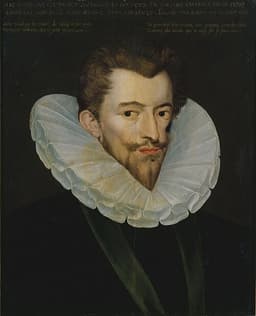
Henry I Duke of Guise
General · Modern
68.8Total

K. M. Cariappa
General · Modern
56.8Total
Basic Information
Born
1550
1899
Died
1588
1993
Era
Modern
Modern
Nationality
France
India
Occupation
General
General
Civilization
Western
Indian
Score Comparison
Military (10%)
70.0
38.3
Political (20%)
72.0
68.0
Influence (20%)
82.0
55.0
Legacy (20%)
52.0
50.0
Leadership (15%)
80.0
70.0
Strategy (15%)
55.0
60.0
TOTAL
68.8
56.8
Henry I Duke of Guise — Complete Timeline
1576 AD
Formation of the Catholic LeaguePolitical Action◆ Major
Henry I, Duke of Guise, helped found the Catholic League, a militant Catholic faction opposed to Huguenot concessions. The League aimed to protect Catholicism in France and became a powerful political and military force during the Wars of Religion.
Catholic LeagueReligious ConflictPolitical Faction
Impact: national
1588 AD
Day of the BarricadesPolitical Action
Henry I, Duke of Guise, led a popular uprising in Paris against King Henry III. The city's Catholic population erected barricades, forcing the king to flee. This event demonstrated the League's power and led to the king's submission to the League's demands.
UprisingCatholic LeaguePower Struggle
Impact: nationaldestructive
Assassination at BloisOther◆ Major
Henry I, Duke of Guise, was assassinated on the orders of King Henry III at the Ch
AssassinationCatholic LeagueWars of Religion
Impact: nationaltragic
K. M. Cariappa — Complete Timeline
1945 AD
Awarded Order of the British Empire (OBE)Cultural
Cariappa was awarded the Order of the British Empire (OBE) for his services during World War II. He served in the Burma Campaign and other theaters, commanding troops.
AwardWorld War IIMilitary
Impact: national
1947 AD
Led Indian Forces in the 1947-48 Kashmir WarWar◆ Major
As a senior commander, Cariappa played a key role in the military operations during the first Indo-Pakistani war over Kashmir. He coordinated Indian forces to repel tribal invaders and secure the state's accession to India.
Kashmir WarMilitary Operations1947
Impact: regional
1949 AD
Appointed First Indian Commander-in-Chief of Indian ArmyPolitical Action◆ Major
K. M. Cariappa was appointed as the first Indian Commander-in-Chief of the Indian Army, succeeding General Sir Roy Bucher. This marked the Indianization of the army's top leadership after independence.
ArmyIndianizationLeadership
Impact: nationalconstructive
1953 AD
Served as High Commissioner to AustraliaPolitical Action
After retiring from the army, Cariappa served as India's High Commissioner to Australia. He focused on diplomatic relations and trade, representing India in the Commonwealth.
DiplomacyHigh CommissionerAustralia
Impact: national
Expert Analysis
Origins
Henry I, Duke of Guise (born 1550), was the son of Francis, Duke of Guise, a prominent Catholic military leader. Raised in the heart of French aristocratic power, he was steeped in the politics of the Catholic Reformation and the fierce religious conflicts dividing France. His family, the House of Guise, was a leading force among ultra-Catholic nobles, and Henry inherited both their wealth and their enmity toward Protestant Huguenots. His education focused on military command and court intrigue, preparing him for a life of political and religious warfare.
K. M. Cariappa (born 1899) came from a modest Kodava family in Coorg, India. He was among the first Indians to attend the Royal Military College, Sandhurst, after World War I, an opportunity that shaped his career. His early life was marked by British colonial rule, and he served in the British Indian Army, gaining experience in various campaigns, including World War II in Burma. His background was one of navigating colonial structures while building a path for Indian military leadership.
Rise to Power
Henry I rose to prominence during the French Wars of Religion. In 1576, he helped form the Catholic League, a militant faction dedicated to suppressing Protestantism and opposing any royal concessions to Huguenots. His leadership and charisma made him the de facto leader of the League. A turning point came in 1588 with the Day of the Barricades in Paris, where he orchestrated a popular uprising that forced King Henry III to flee. This event cemented his power as the kingmaker of France, controlling the capital and dictating terms to the monarchy.
Cariappa's rise was more gradual but equally significant. He served with distinction in World War II, earning the Order of the British Empire (OBE) for his service in the Burma Campaign. After India's independence in 1947, he was appointed as the first Indian Commander-in-Chief of the Indian Army, succeeding General Sir Roy Bucher. This appointment marked a crucial step in the Indianization of the military, a process he championed. His key test came during the 1947-48 Kashmir War, where he coordinated Indian forces against Pakistani tribal invaders, securing a ceasefire line that held for decades.
Leadership & Governance
Henry I led through personal magnetism and ruthless political maneuvering. He governed Paris and the League's territories with an iron hand, using religious fervor to mobilize the masses. His leadership style was confrontational: he openly defied the king and sought to control the succession. However, he lacked strategic patience and often acted impulsively, such as when he accepted a truce with Henry III in 1588 without securing lasting guarantees. His governance was characterized by short-term gains over long-term stability.
Cariappa's leadership was institutional and consensus-building. As Commander-in-Chief, he focused on integrating the diverse components of the Indian Army, ensuring a smooth transition from British to Indian command. He emphasized discipline, professionalism, and secularism in the military. His strategy in the Kashmir conflict was cautious: he prioritized holding key positions and avoiding overextension, which contrasted with more aggressive commanders. His political score of 68.0 reflects his ability to navigate the complex post-independence political landscape, while his military score of 38.3 indicates limited direct combat command.
Triumph & Tragedy
Henry I's greatest triumph was the Day of the Barricades (1588), where he effectively seized control of Paris and forced King Henry III to capitulate. He also successfully defended the Catholic cause against Huguenot advances. However, his tragic flaw was overconfidence. He underestimated the king's desperation and was assassinated at Blois in 1588, just months after his peak. His death triggered a civil war that ultimately ended the Valois dynasty and brought Henry IV to power, a Protestant-turned-Catholic who implemented the Edict of Nantes. Henry I's legacy is thus one of short-lived success but long-term defeat for the ultra-Catholic cause.
Cariappa's triumph was overseeing the Indian Army's first major conflict as an independent nation. The 1947-48 Kashmir War ended with India controlling two-thirds of the disputed region, a strategic victory. He also successfully led the Indianization of the officer corps. However, his later role as High Commissioner to Australia (1953-1956) was less impactful. A tragedy was that his contributions are often overshadowed by later military leaders like Sam Manekshaw. His legacy score of 50.0 reflects a solid but not transformative impact.
Character & Destiny
Henry I was charismatic, ambitious, and impulsive. His character drove him to challenge royal authority, but also led to his downfall. He trusted his popularity and the League's strength too much, ignoring the political necessity of compromise. Historians often describe him as a brilliant tactician but poor strategist, reflected in his strategy score of 55.0. His destiny was sealed by his inability to secure his position against a vengeful king.
Cariappa was methodical, disciplined, and diplomatic. He embodied the ideal of a professional soldier who served the state, not a political faction. His character suited the transition from colonial to independent India, where stability was paramount. However, his caution may have limited his military achievements; his military score of 38.3 is lower than Henry I's 70.0. His destiny was to be a foundational figure rather than a battlefield hero.
Legacy
Henry I's legacy is tied to the Catholic League and the Wars of Religion. He intensified religious conflict in France, but his death allowed for the eventual reconciliation under Henry IV. His influence score of 82.0 reflects his role in shaping the period, but his legacy score of 52.0 shows that his impact was ultimately negative or short-lived. The League he led collapsed, and his family's power waned.
Cariappa's legacy is more enduring. He is remembered as the first Indian Commander-in-Chief, a symbol of national pride and military professionalism. His work in Indianizing the army laid the groundwork for a cohesive force. His influence score of 55.0 and legacy score of 50.0 indicate a steady but not monumental impact. He is a respected figure in Indian military history, but not a global icon.
Conclusion
Henry I Duke of Guise scored higher overall (68.8 vs 56.8) due to his greater influence and leadership in a pivotal era. However, Cariappa's impact was more constructive and lasting in building a national institution. Taking a clear stance: Henry I had greater immediate impact on European history, but Cariappa's contribution to India's stability is more positive. In terms of historical significance, Henry I's actions shaped the course of French history, while Cariappa's role was foundational for Indian military independence. Thus, Henry I's influence was greater, but Cariappa's legacy is more admirable.
Rankings
🥇
Henry I Duke of GuiseLeader
Mil: 70.0Pol: 72.0Inf: 82.0
68.8
🥈
K. M. Cariappa
Mil: 38.3Pol: 68.0Inf: 55.0
56.8
+12.0 behind
How This Comparison Works
Algorithm
Each figure is scored on 6 dimensions (0—100 scale) based on structured historical data: Military (10%), Political (20%), Influence (20%), Legacy (20%), Leadership (15%), Strategy (15%). The weighted total produces the final ranking.
Data Sources
Scores are computed from structured sub-indicators in the database. Scale factors adjust for era (Ancient ×0.85, Modern ×1.0) and civilization size (Eastern ×1.05, Other ×0.80) to account for differences in population and military scale.
Maximum 3 Figures
Comparisons are limited to 2—3 figures to ensure readability and statistical meaningfulness.
Error Margins
±5 points per dimension — Sub-scores are derived from historical records with inherent uncertainty. Two figures within 5 points on a dimension should be considered roughly equivalent in that area.
Total Score Accuracy
±3 points overall — The weighted combination of 6 dimensions produces a total score with approximately ±3 points of uncertainty. Differences of less than 3 points are not statistically significant— the figures are effectively tied.
Known Limitations
- Historical records are incomplete and uneven across civilizations
- Figures from oral-tradition societies may be underrepresented
- Occupation labels can misclassify multi-role figures
- Scores measure capability and impact, not moral character
- Quantitative scoring is a comparison tool, not absolute truth
Capability Radar
Military (10%) — Battles & Warfare
Battles
65
30
Win Rate
60
40
Expansion
50
20
Political (20%) — Governance & Reform
Reform
60
50
Diplomacy
70
50
Economy
45
30
Influence (20%) — Cultural & Global Reach
Cultural
55
40
Global
45
45
Legacy (20%) — Historical Impact
Historical
60
55
Longevity
50
40
Leadership (15%) — Power & Stability
Tenure
65
55
Stability
30
60
Strategy (15%) — Tactics & Innovation
Strategy
75
40
Tactics
70
35
Reform
55
60
Similar Comparisons
Comments & Discussion
No comments yet. Be the first to share your thoughts!