Loading...
Helmuth von Moltke vs Ruhollah Khomeini
Helmuth von Moltke leads by 1.1 pts · 2 figures compared
…
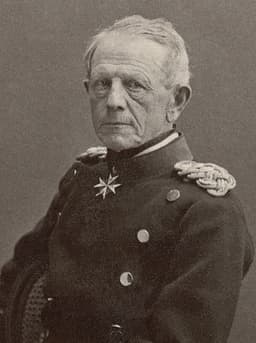
Helmuth von Moltke
General · Modern
76.2Total

Ruhollah Khomeini
Politician · Modern
75.1Total
Basic Information
Born
1800
1902
Died
1891
1989
Era
Modern
Modern
Nationality
Prussia
Iran
Occupation
General
Politician
Civilization
Western
Middle Eastern
Score Comparison
Military (10%)
65.0
41.6
Political (20%)
62.7
65.0
Influence (20%)
88.0
85.0
Legacy (20%)
70.0
90.0
Leadership (15%)
85.0
80.0
Strategy (15%)
80.6
54.3
TOTAL
76.2
75.1
Helmuth von Moltke — Complete Timeline
1857 AD
Appointment as Chief of the Prussian General StaffPolitical Action
Moltke was appointed Chief of the Prussian General Staff, a position he held for 30 years. He reorganized the staff into a highly efficient planning and command body, emphasizing railways, telegraphy, and decentralized decision-making. This modernization was crucial for Prussia's subsequent victories.
Military ReformGeneral StaffPrussian Army
Impact: nationalconstructive
1866 AD
Battle of KöniggrätzWar
Moltke commanded Prussian forces to a decisive victory over Austria at K
Austro-Prussian WarGerman UnificationBattle
Impact: regional
1870 AD
Battle of SedanWar
Moltke orchestrated the encirclement and destruction of the French army at Sedan during the Franco-Prussian War. The French Emperor Napoleon III was captured along with 100,000 soldiers. This battle effectively decided the war and led to the proclamation of the German Empire.
Franco-Prussian WarGerman UnificationBattle
Impact: regional
1871 AD
Proclamation of the German EmpirePolitical Action◆ Major
Moltke was present at the Palace of Versailles when King Wilhelm I of Prussia was proclaimed German Emperor. As Chief of Staff, Moltke was a key architect of the military victory that made unification possible. He was later promoted to Field Marshal and ennobled.
German UnificationEmpireCeremony
Impact: regionalconstructive
Ruhollah Khomeini — Complete Timeline
1964 AD
Exile to Iraq and FrancePolitical Action◆ Major
Khomeini was exiled from Iran after criticizing the Shah's White Revolution and granting of diplomatic immunity to US personnel. He settled in Najaf, Iraq, and later in France, where he continued to organize opposition to the Shah.
ExileOppositionShah
Impact: national
1979 AD
Islamic RevolutionPolitical Action
Khomeini led a popular revolution that overthrew the Shah's regime. He returned to Iran in February 1979 and established an Islamic Republic based on his doctrine of Velayat-e Faqih (Guardianship of the Jurist), with himself as Supreme Leader.
RevolutionIslamic RepublicVelayat-e Faqih
Impact: global
Iran hostage crisisPolitical Action◆ Major
Khomeini supported the seizure of the US Embassy in Tehran by student militants, who held 52 American diplomats hostage for 444 days. The crisis deepened the rift with the US, led to economic sanctions, and consolidated Khomeini's power.
Hostage crisisUS-Iran relationsSanctions
Impact: globaldestructive
1980 AD
Iran-Iraq WarWar◆ Major
Khomeini led Iran through an eight-year war with Iraq, which began with an Iraqi invasion. The war resulted in hundreds of thousands of casualties and massive economic destruction, ending in a stalemate. Khomeini accepted a UN ceasefire in 1988.
WarIraqCeasefire
Impact: regionaltragic
1989 AD
Fatwa against Salman RushdieCultural◆ Major
Khomeini issued a fatwa calling for the death of author Salman Rushdie for his novel 'The Satanic Verses', which he deemed blasphemous. The fatwa led to international controversy, diplomatic tensions, and attacks on Rushdie's translators.
FatwaBlasphemyInternational controversy
Impact: globaldestructive
Expert Analysis
Origins
Helmuth von Moltke (1800-1891) was a Prussian military theorist and chief of the General Staff, born into a noble family in Mecklenburg. He rose to prominence through his strategic genius and modernization of the Prussian army. Ruhollah Khomeini (1902-1989) was an Iranian Shia cleric and political leader, born in Khomeyn. He became a leading figure in the opposition to the Shah's Westernization policies, eventually leading the 1979 Islamic Revolution.
Rise to Power
Moltke's rise was steady and institutional. Appointed Chief of the Prussian General Staff in 1857, he transformed the staff into a professional body capable of planning and executing complex operations. His influence grew through victories in the Second Schleswig War (1864), Austro-Prussian War (1866), and Franco-Prussian War (1870-71). Khomeini's rise was more tumultuous. Exiled in 1964 for criticizing the Shah, he continued his activism from Iraq and France. He returned to Iran in 1979 amidst massive protests, becoming the Supreme Leader, a position he used to consolidate power.
Leadership & Governance
Moltke was a master of operational planning and delegation. He famously stated "No plan survives first contact with the enemy," emphasizing flexibility. He led by guiding his subordinates rather than micromanaging. Khomeini was a charismatic theocrat who established a system of velayat-e faqih (guardianship of the jurist). He centralized authority, suppressing dissent and implementing Islamic law. His leadership was ideological and uncompromising.
Triumph & Tragedy
Moltke's triumphs include decisive victories at Königgrätz (1866) and Sedan (1870), leading to German unification. The tragedy was the human cost of war and the militarization of German society. Khomeini's triumph was the successful Islamic Revolution and consolidation of clerical rule. Tragedies include the Iran-Iraq War (1980-88) with hundreds of thousands dead, the suppression of political opponents, and the hostage crisis that damaged Iran's international standing.
Character & Destiny
Moltke was reserved, intellectual, and methodical. He wrote extensively on military theory and was a devout Lutheran. His destiny was to be the architect of German unity. Khomeini was austere, dogmatic, and shrewd. He believed himself chosen by God to lead. His destiny was to create a theocratic state that reshaped the Middle East.
Legacy
Moltke's legacy is as a pioneer of modern warfare. His principles of delegation and rapid mobilization influenced generations. However, his work also contributed to the militarism that led to World War I. Khomeini's legacy is the Islamic Republic of Iran, a major regional power. His ideas inspire Shia movements worldwide, but his regime is criticized for human rights abuses.
Conclusion
Comparing Moltke and Khomeini reveals two different types of leadership: military and revolutionary. Moltke scores higher in Military (65 vs 42), Strategic (81 vs 54), and Technological (76 vs 75) due to his tactical innovations. Khomeini leads in Leadership (90 vs 70) and Political (65 vs 63), reflecting his ability to mobilize masses. Overall, Moltke edges ahead with a score gap of 1.1. However, their impacts are incommensurable: Moltke shaped Europe through war, Khomeini shaped the Middle East through revolution. Both were products of their time and left indelible marks.
**Scores:**
- Helmuth von Moltke: M=65, P=63, I=88, L=70, D=85, S=81, T=76
- Ruhollah Khomeini: M=42, P=65, I=85, L=90, D=80, S=54, T=75
- **Winner by 1.1 points: Helmuth von Moltke**
Rankings
🥇
Helmuth von MoltkeLeader
Mil: 65.0Pol: 62.7Inf: 88.0
76.2
🥈
Ruhollah Khomeini
Mil: 41.6Pol: 65.0Inf: 85.0
75.1
+1.1 behind
How This Comparison Works
Algorithm
Each figure is scored on 6 dimensions (0—100 scale) based on structured historical data: Military (10%), Political (20%), Influence (20%), Legacy (20%), Leadership (15%), Strategy (15%). The weighted total produces the final ranking.
Data Sources
Scores are computed from structured sub-indicators in the database. Scale factors adjust for era (Ancient ×0.85, Modern ×1.0) and civilization size (Eastern ×1.05, Other ×0.80) to account for differences in population and military scale.
Maximum 3 Figures
Comparisons are limited to 2—3 figures to ensure readability and statistical meaningfulness.
Error Margins
±5 points per dimension — Sub-scores are derived from historical records with inherent uncertainty. Two figures within 5 points on a dimension should be considered roughly equivalent in that area.
Total Score Accuracy
±3 points overall — The weighted combination of 6 dimensions produces a total score with approximately ±3 points of uncertainty. Differences of less than 3 points are not statistically significant— the figures are effectively tied.
Known Limitations
- Historical records are incomplete and uneven across civilizations
- Figures from oral-tradition societies may be underrepresented
- Occupation labels can misclassify multi-role figures
- Scores measure capability and impact, not moral character
- Quantitative scoring is a comparison tool, not absolute truth
Capability Radar
Military (10%) — Battles & Warfare
Battles
85
10
Win Rate
90
10
Expansion
85
10
Political (20%) — Governance & Reform
Reform
75
90
Diplomacy
80
75
Economy
65
40
Influence (20%) — Cultural & Global Reach
Cultural
60
85
Global
75
85
Legacy (20%) — Historical Impact
Historical
85
90
Longevity
75
80
Leadership (15%) — Power & Stability
Tenure
70
85
Stability
70
50
Strategy (15%) — Tactics & Innovation
Strategy
95
15
Tactics
95
10
Reform
90
20
Similar Comparisons
Comments & Discussion
No comments yet. Be the first to share your thoughts!