Loading...
Hastings Banda vs Lala Lajpat Rai
Lala Lajpat Rai leads by 7.9 pts · 2 figures compared
…
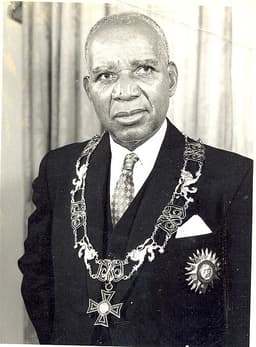
Hastings Banda
Politician · Modern
49.3Total

Lala Lajpat Rai
Politician · Modern
57.2Total
Basic Information
Born
1898
1865
Died
1997
1928
Era
Modern
Modern
Nationality
Malawi
India
Occupation
Politician
Politician
Civilization
Other
Indian
Score Comparison
Military (10%)
13.4
36.4
Political (20%)
48.0
68.0
Influence (20%)
54.9
60.0
Legacy (20%)
45.0
52.0
Leadership (15%)
74.0
62.2
Strategy (15%)
47.0
60.0
TOTAL
49.3
57.2
Hastings Banda — Complete Timeline
1958 AD
Returned to Malawi and led independence movementPolitical Action◆ Major
Banda returned to Nyasaland after decades abroad and assumed leadership of the Nyasaland African Congress. He led the push for independence from British colonial rule, becoming the central figure in the nationalist movement.
IndependenceNationalismDecolonization
Impact: nationalconstructive
1963 AD
Became first Prime Minister of independent MalawiPolitical Action
Following constitutional changes and elections, Banda became Prime Minister of self-governing Nyasaland. On July 6, 1964, Malawi achieved full independence from Britain, with Banda as its first Prime Minister.
IndependenceGovernment Formation
Impact: nationalconstructive
1966 AD
Declared Malawi a one-party statePolitical Action◆ Major
Banda declared Malawi a republic and himself President. He consolidated power by making the Malawi Congress Party the sole legal party, banning all opposition and establishing an authoritarian regime that lasted for three decades.
AuthoritarianismOne-Party StateRepression
Impact: nationaldestructive
1967 AD
Established diplomatic relations with apartheid South AfricaPolitical Action◆ Major
Banda became the first African leader to establish formal diplomatic relations with apartheid South Africa. This controversial decision provided Malawi with economic aid and trade benefits but drew sharp criticism from other African nations.
Foreign PolicyApartheidDiplomacy
Impact: regional
1994 AD
Lost power in multi-party electionsPolitical Action◆ Major
After decades of authoritarian rule, Banda was defeated in Malawi's first multi-party elections since independence. Bakili Muluzi of the United Democratic Front won the presidency, ending Banda's 31-year rule.
ElectionTransitionDemocracy
Impact: national
Lala Lajpat Rai — Complete Timeline
1928 AD
Protest against Simon CommissionPolitical Action◆ Major
Lala Lajpat Rai led a protest in Lahore against the Simon Commission, which had no Indian members. He was struck by a lathi (baton) charge by British police, sustaining injuries that led to his death.
Indian Independence MovementProtestSimon Commission
Impact: nationaltragic
Death from lathi charge injuriesOther◆ Major
Lala Lajpat Rai died from injuries sustained during the lathi charge at the Simon Commission protest. His death sparked outrage and led to the assassination of police officer Saunders by revolutionaries.
Indian Independence MovementDeathMartyr
Impact: nationaltragic
Expert Analysis
Origins
Hastings Banda was born around 1898 in Kasungu, Nyasaland (now Malawi), to Chewa farmers. Orphaned early, he received mission education and walked to South Africa in 1915, working in mines. He later studied in the US (Wilberforce Academy, Indiana University, Meharry Medical College) and Scotland (University of Edinburgh), qualifying as a doctor in 1941. Banda practiced medicine in England and Ghana, staying abroad for nearly 40 years.
Lala Lajpat Rai was born on January 28, 1865, in Dhudike, Punjab (now India), to a Hindu family. His father was a teacher. Rai studied law at Government College, Lahore, and practiced in Hissar and Lahore. He became involved in nationalist activities early, joining the Indian National Congress in 1888. Rai was a founding member of the Hindu reformist Arya Samaj movement.
Rise to Power
Banda's rise began in 1958 when he returned to Nyasaland at the invitation of the Nyasaland African Congress (NAC). He took over the NAC, which became the Malawi Congress Party (MCP). After the 1959 State of Emergency, Banda was imprisoned but emerged as the undisputed leader. In 1961 elections, the MCP won all seats. Banda became Prime Minister of self-governing Nyasaland on February 1, 1963, and led Malawi to independence on July 6, 1964. His political score of 48.0 reflects his effective but authoritarian consolidation.
Lajpat Rai rose through the Congress and Hindu reform movements. He was a key figure in the Swadeshi movement after the 1905 partition of Bengal. He founded the Indian Home Rule League in the US in 1914 and returned to India in 1919. Rai was elected President of the Indian National Congress in 1920. His political score of 68.0 indicates his organizational and oratory skills. He led protests against the Rowlatt Act and later the Simon Commission in 1928.
Leadership & Governance
Banda ruled Malawi as a one-party state from 1966 to 1994. He centralized power, banned opposition, and controlled the judiciary. His leadership score of 74.0 reflects his firm control, but his strategy score of 47.0 shows limited adaptability. Banda established diplomatic relations with apartheid South Africa in 1967, a pragmatic move that brought aid but damaged his reputation. He promoted a conservative social agenda, including dress codes and censorship.
Lajpat Rai never held formal governmental power. His leadership was through mass movements and writings. He advocated for Swaraj (self-rule) and criticized moderate Congress leaders. Rai's strategy score of 60.0 reflects his ability to mobilize public opinion. He founded the Servants of the People Society in 1921 to train social workers. His leadership was more moral than administrative.
Triumph & Tragedy
Banda's greatest triumph was leading Malawi to independence peacefully. He built infrastructure, expanded education, and maintained stability. However, his authoritarian rule led to human rights abuses, including detentions and forced labor. His greatest failure was the 1964 Cabinet Crisis, where he forced out talented ministers, and his isolationist policies that stunted economic growth. His legacy score of 45.0 reflects mixed outcomes.
Lajpat Rai's triumph was his role in the independence movement. He inspired many through his writings and protests. His death from lathi blows during the Simon Commission protest on October 30, 1928, made him a martyr. The tragedy is that he did not live to see independence. His influence score of 60.0 shows his enduring impact on Indian nationalism.
Character & Destiny
Banda was authoritarian, meticulous, and suspicious of dissent. His long absence abroad made him an outsider, yet he commanded loyalty. His character led him to suppress opposition, which ultimately caused his downfall. In 1994, he lost multi-party elections, scoring a military 13.4 and political 48.0. He died in 1997, largely forgotten.
Lajpat Rai was passionate, scholarly, and courageous. His character drove him to lead protests despite risks. His destiny was to become a symbol of sacrifice. His death galvanized the independence movement, and his assassin, Bhagat Singh, became a revolutionary icon.
Legacy
Banda's legacy is complex. He is credited with unifying Malawi but criticized for autocracy. His policies left Malawi poor and underdeveloped. The MCP still exists but with diminished influence. His influence score of 54.9 and legacy 45.0 reflect a mixed record. In contrast, Lajpat Rai's legacy is celebrated in India. His statues, institutions, and the Lala Lajpat Rai University in Hisar honor him. His martyrdom is remembered annually.
Conclusion
Lala Lajpat Rai had greater impact overall, scoring 57.2 compared to Banda's 49.3. While Banda achieved independence for Malawi, his authoritarianism and collaboration with apartheid South Africa tarnished his legacy. Rai's moral leadership and sacrifice inspired millions and accelerated India's freedom struggle. His influence endures in India's democratic ethos, while Banda's legacy is confined to Malawi's history. The data supports this: Rai scored higher in political (68.0 vs 48.0), influence (60.0 vs 54.9), and strategy (60.0 vs 47.0). Banda's higher leadership score (74.0 vs 62.2) reflects his control, not necessarily positive leadership. In the broader context of history, Rai's contribution to the cause of freedom and democracy outweighs Banda's flawed nation-building.
Rankings
🥇
Lala Lajpat RaiLeader
Mil: 36.4Pol: 68.0Inf: 60.0
57.2
🥈
Hastings Banda
Mil: 13.4Pol: 48.0Inf: 54.9
49.3
+7.9 behind
How This Comparison Works
Algorithm
Each figure is scored on 6 dimensions (0—100 scale) based on structured historical data: Military (10%), Political (20%), Influence (20%), Legacy (20%), Leadership (15%), Strategy (15%). The weighted total produces the final ranking.
Data Sources
Scores are computed from structured sub-indicators in the database. Scale factors adjust for era (Ancient ×0.85, Modern ×1.0) and civilization size (Eastern ×1.05, Other ×0.80) to account for differences in population and military scale.
Maximum 3 Figures
Comparisons are limited to 2—3 figures to ensure readability and statistical meaningfulness.
Error Margins
±5 points per dimension — Sub-scores are derived from historical records with inherent uncertainty. Two figures within 5 points on a dimension should be considered roughly equivalent in that area.
Total Score Accuracy
±3 points overall — The weighted combination of 6 dimensions produces a total score with approximately ±3 points of uncertainty. Differences of less than 3 points are not statistically significant— the figures are effectively tied.
Known Limitations
- Historical records are incomplete and uneven across civilizations
- Figures from oral-tradition societies may be underrepresented
- Occupation labels can misclassify multi-role figures
- Scores measure capability and impact, not moral character
- Quantitative scoring is a comparison tool, not absolute truth
Capability Radar
Military (10%) — Battles & Warfare
Battles
27
43
Win Rate
29
48
Expansion
31
50
Political (20%) — Governance & Reform
Reform
50
60
Diplomacy
40
50
Economy
30
30
Influence (20%) — Cultural & Global Reach
Cultural
40
55
Global
30
45
Legacy (20%) — Historical Impact
Historical
50
60
Longevity
30
50
Leadership (15%) — Power & Stability
Tenure
70
40
Stability
20
20
Strategy (15%) — Tactics & Innovation
Strategy
36
52
Tactics
36
54
Reform
42
58
Similar Comparisons
Comments & Discussion
No comments yet. Be the first to share your thoughts!