Loading...
Guan Yu vs Huang Gai
Guan Yu leads by 9.0 pts · 2 figures compared
…
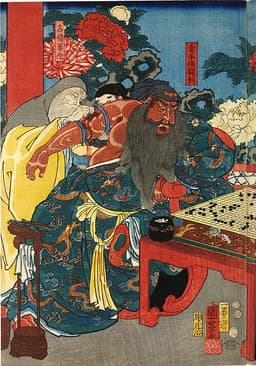
Guan Yu
General · Ancient
57.6Total

Huang Gai
General · Ancient
48.6Total
Basic Information
Born
160
145
Died
220
210
Era
Ancient
Ancient
Nationality
China
China
Occupation
General
General
Civilization
Eastern
Eastern
Score Comparison
Military (10%)
61.7
50.0
Political (20%)
35.0
35.0
Influence (20%)
72.0
53.3
Legacy (20%)
68.0
49.2
Leadership (15%)
40.9
40.9
Strategy (15%)
50.0
66.3
TOTAL
57.6
48.6
Guan Yu — Complete Timeline
200 AD
Battle of BomaWar
Guan Yu, serving under Cao Cao, killed the enemy general Yan Liang in battle at Boma. This act demonstrated his martial prowess and loyalty to Cao Cao at the time. The victory helped Cao Cao's forces in the campaign against Yuan Shao.
Three KingdomsBattleMartial Skill
Impact: regional
Departure from Cao Cao to Rejoin Liu BeiPolitical Action◆ Major
After learning of Liu Bei's whereabouts, Guan Yu left Cao Cao's service, crossing five passes and killing six generals to rejoin his sworn brother. This act of loyalty became legendary, symbolizing unwavering commitment to one's oath.
LoyaltyOathThree Kingdoms
Impact: regional
219 AD
Battle of FanchengWar◆ Major
Guan Yu led a campaign against Cao Cao's forces at Fancheng. He achieved initial success, flooding the city, but was ultimately defeated by reinforcements led by Xu Huang. This battle marked the turning point in his military career.
Three KingdomsSiegeTurning Point
Impact: regional
220 AD
Capture and Execution by Sun Quan's ForcesWar◆ Major
After the defeat at Fancheng, Guan Yu retreated but was ambushed and captured by Sun Quan's general L
ExecutionThree KingdomsRevenge
Impact: regionaltragic
Huang Gai — Complete Timeline
208 AD
Battle of Red CliffsWar
Huang Gai proposed and executed the fire attack against Cao Cao's fleet at Red Cliffs. His ships, loaded with combustibles, set fire to the enemy fleet, leading to a decisive Wu victory.
Three KingdomsBattleFire Attack
Impact: global
209 AD
Battle of JianglingWar◆ Major
After Red Cliffs, Huang Gai participated in the siege of Jiangling against Cao Ren. He was wounded in battle but continued to fight, contributing to the eventual Wu capture of the city.
Three KingdomsSiegeJiangling
Impact: regional
210 AD
Appointment as Administrator of WulingPolitical Action
Huang Gai was appointed Administrator of Wuling Commandery. He implemented policies to pacify the local tribes and improve governance, stabilizing the region for Wu.
WuAppointmentAdministration
Impact: regionalconstructive
Expert Analysis
Origins
Guan Yu (160–220), from Xie County in Hedong (modern Yuncheng, Shanxi), emerged from humble beginnings as a refugee fleeing the chaos of the late Han dynasty. He met Liu Bei and Zhang Fei in Zhuo Commandery and formed a sworn brotherhood that would define his life. Guan Yu's early years are shrouded in legend, but he was known for his physical strength and sense of justice. Huang Gai, born in Lingling (modern Yongzhou, Hunan), came from a less prominent family. He served under the Sun family from early on, distinguishing himself as a capable commander in the turbulent years leading up to the Three Kingdoms period. His formative experiences included pacifying local rebellions, which honed his tactical acumen.
Rise to Power
Guan Yu's rise was tied to Liu Bei's fortunes. He followed Liu Bei through years of wandering, serving under various lords. His pivotal moment came when he temporarily served Cao Cao during Liu Bei's defeat. At the Battle of Boma (200), Guan Yu killed Yan Liang, a top general of Yuan Shao, demonstrating his martial prowess. He then famously left Cao Cao's service to rejoin Liu Bei, crossing five passes and killing six generals—a journey that cemented his reputation for loyalty. Huang Gai's rise was steadier. He fought in numerous campaigns under Sun Jian and Sun Ce, but his defining moment came at the Battle of Red Cliffs (208). As a veteran commander, he proposed the fire attack that crippled Cao Cao's fleet, turning the tide of the battle. This single act elevated him from a capable officer to a key figure in Wu's victory.
Leadership & Governance
Guan Yu's leadership was characterized by personal bravery and strict honor. He governed Jing Province with a heavy hand, often alienating local officials and allies. His arrogance toward Sun Quan's envoys and refusal of marriage alliances contributed to his downfall. In contrast, Huang Gai proved a pragmatic administrator. As Administrator of Wuling, he pacified local tribes through a mix of military force and conciliatory policies, stabilizing the region. He was known for his fairness and ability to inspire loyalty among his troops. Guan Yu's leadership style scored 40.9, while Huang Gai's was similarly rated at 40.9, but Huang Gai's strategic acumen (66.3) far exceeded Guan Yu's (50.0).
Triumph & Tragedy
Guan Yu's greatest triumph was his campaign at Fancheng (219), where he flooded the city and forced Cao Cao to consider relocating the capital. His capture of Yu Jin and execution of Pang De showcased his military capabilities. However, his tragedy was equally monumental: overconfident and isolated, he was betrayed by Sun Quan's forces, captured, and executed in 220. His death led to the loss of Jing Province and triggered a chain of events that culminated in Liu Bei's disastrous invasion of Wu. Huang Gai's triumph was the fire attack at Red Cliffs, a masterstroke that required careful planning and courage. He personally led the fire ships, suffering wounds but achieving a decisive victory. His tragedy was less dramatic: he was wounded at Jiangling and later died in office, but his legacy was not tarnished by catastrophic failure. Huang Gai's military score of 50.0 reflects his solid but not exceptional record, while Guan Yu's 61.7 highlights his higher impact in individual battles.
Character & Destiny
Guan Yu's character was defined by extreme loyalty and pride. He viewed himself as the embodiment of honor, which made him inflexible. His refusal to acknowledge Sun Quan's power and his harsh treatment of subordinates like Mi Fang and Shi Ren led directly to his betrayal. Huang Gai was more adaptable, willing to use deceit (the fire attack) and diplomacy to achieve goals. His character allowed him to thrive within Sun Quan's court, where he was respected but not feared. Historical assessments note that Guan Yu's deification as Guandi, the God of War, stems from his symbolic loyalty rather than his strategic brilliance. Huang Gai, while not deified, is remembered as a reliable and innovative commander.
Legacy
Guan Yu's legacy is immense. He was posthumously elevated to the status of a god in Chinese folk religion, with temples across East Asia. His image as a symbol of loyalty and righteousness permeates literature, opera, and popular culture. The Romance of the Three Kingdoms immortalized his exploits, making him a household name. Huang Gai's legacy is more modest but historically significant. The fire attack at Red Cliffs is studied as a classic example of using the environment in warfare. He is remembered as a key contributor to the establishment of Eastern Wu. In terms of influence, Guan Yu scores 72.0 to Huang Gai's 53.3, reflecting his broader cultural impact. Legacy scores are 68.0 vs 49.2.
Conclusion
Guan Yu had greater overall impact, driven by his posthumous deification and symbolic power, which far surpass Huang Gai's concrete but limited achievements. Guan Yu's total score of 57.6 against Huang Gai's 48.6 underscores this. While Huang Gai's strategic insight at Red Cliffs was pivotal, Guan Yu's story resonates across millennia as a moral exemplar. His military prowess (61.7) and influence (72.0) outweigh Huang Gai's strategic rating (66.3). In the contest between loyalty and cleverness, Guan Yu's legend wins.
Rankings
🥇
Guan YuLeader
Mil: 61.7Pol: 35.0Inf: 72.0
57.6
🥈
Huang Gai
Mil: 50.0Pol: 35.0Inf: 53.3
48.6
+9.0 behind
How This Comparison Works
Algorithm
Each figure is scored on 6 dimensions (0—100 scale) based on structured historical data: Military (10%), Political (20%), Influence (20%), Legacy (20%), Leadership (15%), Strategy (15%). The weighted total produces the final ranking.
Data Sources
Scores are computed from structured sub-indicators in the database. Scale factors adjust for era (Ancient ×0.85, Modern ×1.0) and civilization size (Eastern ×1.05, Other ×0.80) to account for differences in population and military scale.
Maximum 3 Figures
Comparisons are limited to 2—3 figures to ensure readability and statistical meaningfulness.
Error Margins
±5 points per dimension — Sub-scores are derived from historical records with inherent uncertainty. Two figures within 5 points on a dimension should be considered roughly equivalent in that area.
Total Score Accuracy
±3 points overall — The weighted combination of 6 dimensions produces a total score with approximately ±3 points of uncertainty. Differences of less than 3 points are not statistically significant— the figures are effectively tied.
Known Limitations
- Historical records are incomplete and uneven across civilizations
- Figures from oral-tradition societies may be underrepresented
- Occupation labels can misclassify multi-role figures
- Scores measure capability and impact, not moral character
- Quantitative scoring is a comparison tool, not absolute truth
Capability Radar
Military (10%) — Battles & Warfare
Battles
65
45
Win Rate
55
40
Expansion
45
25
Political (20%) — Governance & Reform
Reform
10
10
Diplomacy
25
35
Economy
15
15
Influence (20%) — Cultural & Global Reach
Cultural
85
40
Global
70
30
Legacy (20%) — Historical Impact
Historical
80
55
Longevity
90
50
Leadership (15%) — Power & Stability
Tenure
30
30
Stability
20
20
Strategy (15%) — Tactics & Innovation
Strategy
50
55
Tactics
70
70
Reform
10
20
Similar Comparisons
Comments & Discussion
No comments yet. Be the first to share your thoughts!