Loading...
Guan Yu vs Julius Caesar
Julius Caesar leads by 25.2 pts · 2 figures compared
…
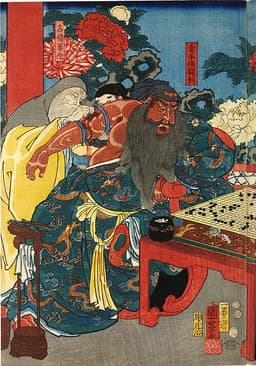
Guan Yu
General · Ancient
57.6Total

Julius Caesar
General · Ancient
82.8Total
Basic Information
Born
160
-100
Died
220
-44
Era
Ancient
Ancient
Nationality
China
Roman Republic
Occupation
General
General
Civilization
Eastern
Western
Score Comparison
Military (10%)
61.7
88.0
Political (20%)
35.0
78.0
Influence (20%)
72.0
85.0
Legacy (20%)
68.0
82.0
Leadership (15%)
40.9
80.0
Strategy (15%)
50.0
85.0
TOTAL
57.6
82.8
Guan Yu — Complete Timeline
200 AD
Battle of BomaWar
Guan Yu, serving under Cao Cao, killed the enemy general Yan Liang in battle at Boma. This act demonstrated his martial prowess and loyalty to Cao Cao at the time. The victory helped Cao Cao's forces in the campaign against Yuan Shao.
Three KingdomsBattleMartial Skill
Impact: regional
Departure from Cao Cao to Rejoin Liu BeiPolitical Action◆ Major
After learning of Liu Bei's whereabouts, Guan Yu left Cao Cao's service, crossing five passes and killing six generals to rejoin his sworn brother. This act of loyalty became legendary, symbolizing unwavering commitment to one's oath.
LoyaltyOathThree Kingdoms
Impact: regional
219 AD
Battle of FanchengWar◆ Major
Guan Yu led a campaign against Cao Cao's forces at Fancheng. He achieved initial success, flooding the city, but was ultimately defeated by reinforcements led by Xu Huang. This battle marked the turning point in his military career.
Three KingdomsSiegeTurning Point
Impact: regional
220 AD
Capture and Execution by Sun Quan's ForcesWar◆ Major
After the defeat at Fancheng, Guan Yu retreated but was ambushed and captured by Sun Quan's general L
ExecutionThree KingdomsRevenge
Impact: regionaltragic
Julius Caesar — Complete Timeline
58 BC
Gallic WarsWar◆ Major
Caesar, as proconsul of Gaul, launched a series of campaigns that conquered all of Gaul (modern France, Belgium, and parts of Switzerland). He fought numerous battles, including against the Helvetii, the Belgae, and the Gallic chieftain Vercingetorix. The wars brought immense wealth and a loyal army to Caesar.
Gallic WarsConquestRoman Expansion
Impact: regional
49 BC
Crossing the RubiconPolitical Action◆ Major
Caesar led Legio XIII across the Rubicon River into Italy, defying the Roman Senate's order to disband his army. This act triggered a civil war against Pompey and the Optimates, ultimately leading to Caesar's dictatorship and the end of the Roman Republic.
Roman Civil WarEnd of RepublicPower Struggle
Impact: global
48 BC
Battle of PharsalusWar◆ Major
Caesar's outnumbered army defeated the larger forces of Pompey the Great at Pharsalus in Greece. Caesar's tactical use of a reserve line to counter Pompey's cavalry charge proved decisive. Pompey fled to Egypt, where he was assassinated, leaving Caesar as the undisputed master of the Roman world.
Roman Civil WarBattleDecisive Victory
Impact: regional
44 BC
Appointment as Dictator for LifePolitical Action◆ Major
The Roman Senate appointed Caesar dictator perpetuo (dictator for life), granting him unprecedented personal power. This move concentrated military, legislative, and judicial authority in one person, effectively ending the Roman Republic's traditional system of checks and balances and alarming many senators.
DictatorshipEnd of RepublicPower Consolidation
Impact: regionaldestructive
Assassination on the Ides of MarchPolitical Action◆ Major
A group of Roman senators, led by Marcus Junius Brutus and Gaius Cassius Longinus, stabbed Caesar to death at a meeting of the Senate in the Theatre of Pompey. The assassination was intended to restore the Republic, but instead triggered another civil war that led to the rise of the Roman Empire.
AssassinationRoman PoliticsEnd of Republic
Impact: globaldestructive
Expert Analysis
guan-yu-vs-julius-caesar
# The General and the God
On a March morning in 44 BCE, Julius Caesar walked into the Senate chamber, ignoring a soothsayer’s warning and a friend’s desperate note pressed into his hand. Moments later, twenty-three dagger strokes ended his life and changed the course of Western history. Nearly four centuries later and half a world away, another general faced his end with equal fatalism: Guan Yu, betrayed by allies, captured in an ambush, and executed without trial. One became the father of an empire; the other became a god. What separates a mortal conqueror from an immortal legend? The answer lies not in their swords, but in the worlds they sought to conquer.
Origins
Caesar was born into the patrician Julian clan, an ancient but politically marginal family in a Republic already rotting from within. His uncle Marius had been a populist reformer, his father died when Caesar was sixteen, and the young nobleman inherited a world of civil war, debt, and ambition. Rome in the first century BCE was a machine of conquest powered by slave labor, its Senate paralyzed by factional greed, its legions loyal to generals, not laws. Caesar learned early that survival meant playing politics as a blood sport.
Guan Yu emerged from a very different China. The Eastern Han dynasty was collapsing under peasant rebellions and warlord infighting, but the moral framework of Confucianism still held—loyalty, righteousness, and brotherhood were not abstractions but codes that defined a man’s worth. Little is known of Guan Yu’s early life; he was a fugitive who fled a murder charge before meeting Liu Bei and Zhang Fei in a peach orchard, where the three swore an oath of brotherhood that would bind them for life. Where Caesar inherited a name, Guan Yu inherited a promise.
Rise to Power
Caesar’s path was calculated brilliance. He climbed the Roman political ladder with ruthless precision: military tribune, quaestor in Spain, aedile who bankrupted himself on gladiatorial games, pontifex maximus, and finally consul in 59 BCE. Each step was financed by borrowed money and secured by alliances—first with Crassus and Pompey in the First Triumvirate, then by the conquest of Gaul from 58 to 50 BCE. The Gallic Wars were not merely a campaign; they were a self-funded empire-building project that gave Caesar an army personally loyal to him, a fortune in plunder, and a legend of invincibility.
Guan Yu’s rise was a story of service, not self-advancement. He fought for Liu Bei not to build a new order but to restore the Han dynasty. His first great deed came at the Battle of Boma in 200 CE, where he served under the warlord Cao Cao—an enemy of his sworn brother—and killed the enemy general Yan Liang in a single charge. Cao Cao rewarded him lavishly, hoping to keep him. But Guan Yu, upon learning Liu Bei was alive, famously declared: “I know that Lord Cao treats me well, but I have received the kindness of General Liu and sworn to die with him. I cannot stay.” He then departed, crossing five passes and killing six generals to return to his brother’s side. This was not ambition; it was devotion.
Leadership & Governance
Caesar governed as a revolutionary. As dictator, he reformed the calendar, granted citizenship to provincials, initiated public works, and centralized power in ways that made the Republic a monarchy in all but name. His military genius lay in speed and audacity—crossing the Rubicon in 49 BCE, besieging Alesia, defeating Pompey at Pharsalus. But his political wisdom was flawed: he pardoned enemies who would later kill him, and he accepted the title “dictator for life” as if Romans would tolerate a king. His strategy won wars; his arrogance lost the peace.
Guan Yu’s leadership was that of a warrior, not a statesman. His military score of 62.0 reflects competence, not brilliance: he won at Fancheng in 219 CE by flooding the city, but he failed to secure his supply lines, alienated allies like Sun Quan, and ultimately lost both the campaign and his life. His political score of 43.5 tells a deeper story—he was proud, quick to insult, and incapable of the diplomacy that might have saved him. When Sun Quan proposed a marriage alliance, Guan Yu dismissed the envoy with the words: “My daughter is a tiger’s daughter; how could she marry a dog’s son?” That insult cost him everything.
Triumph & Tragedy
Caesar’s triumph was absolute: he conquered Gaul, defeated his rivals, and stood alone atop the Roman world. His tragedy was that he could not stop. In February 44 BCE, he was declared dictator for life. One month later, he was dead. His last words—if Plutarch is to be believed—were not a grand speech but a shocked recognition: “Et tu, Brute?” The man he had pardoned led the assassins.
Guan Yu’s triumph was brief and bitter. At Fancheng, he seemed invincible, his floodwaters drowning Cao Cao’s army. But then the trap closed. Sun Quan’s general Lü Meng struck from behind, capturing Jing Province while Guan Yu’s army melted away. Fleeing with only a few dozen men, he was ambushed, captured, and executed in 220 CE. He died not on a battlefield but in a prisoner’s shack, betrayed by the very allies he had scorned.
Character & Destiny
Caesar’s character was a study in controlled fire. He was charming, generous, and intellectually voracious—he wrote war commentaries that remain classics of Latin prose. But he was also ruthless, vain, and pathologically unable to share power. His destiny was to destroy the Republic to save it, and in doing so, to create the Empire he would not live to rule.
Guan Yu’s character was simpler and sterner. He was loyal to a fault, proud to a vice, and righteous to the point of self-destruction. His destiny was not to conquer but to embody—to become the symbol of brotherhood that later generations needed more than any kingdom. Where Caesar changed the world through action, Guan Yu changed it through myth.
Legacy
Caesar’s legacy is the Roman Empire itself—every emperor from Augustus to Constantine ruled in his shadow. His name became a title: Kaiser, Tsar. His reforms outlived him, his writings survive, and his assassination is perhaps the most famous political murder in history. But he is remembered as a man, flawed and mortal.
Guan Yu’s legacy is stranger and more profound. In 1100 CE, nearly a millennium after his death, he was formally deified as Guandi, the God of War and Loyalty. Temples rose across China; merchants, soldiers, and even criminals prayed to him. His red face and long beard became iconic. He is not a historical figure to be studied but a divine presence to be worshipped. Caesar conquered the world; Guan Yu was absorbed into the soul of a civilization.
Conclusion
Stand before Caesar’s statue in Rome, and you see a conqueror—calculating, brilliant, doomed. Stand before Guan Yu’s temple in any Chinese city, and you see a god—eternal, righteous, serene. One changed history through power; the other through symbol. The difference is not in their achievements, for Caesar achieved far more in measurable terms. It is in what their cultures needed. Rome needed a founder; China needed a saint. And so Caesar, for all his glory, remains a corpse in the Senate. Guan Yu, for all his failures, lives forever.
Rankings
🥇
Julius CaesarLeader
Mil: 88.0Pol: 78.0Inf: 85.0
82.8
🥈
Guan Yu
Mil: 61.7Pol: 35.0Inf: 72.0
57.6
+25.2 behind
How This Comparison Works
Algorithm
Each figure is scored on 6 dimensions (0—100 scale) based on structured historical data: Military (10%), Political (20%), Influence (20%), Legacy (20%), Leadership (15%), Strategy (15%). The weighted total produces the final ranking.
Data Sources
Scores are computed from structured sub-indicators in the database. Scale factors adjust for era (Ancient ×0.85, Modern ×1.0) and civilization size (Eastern ×1.05, Other ×0.80) to account for differences in population and military scale.
Maximum 3 Figures
Comparisons are limited to 2—3 figures to ensure readability and statistical meaningfulness.
Error Margins
±5 points per dimension — Sub-scores are derived from historical records with inherent uncertainty. Two figures within 5 points on a dimension should be considered roughly equivalent in that area.
Total Score Accuracy
±3 points overall — The weighted combination of 6 dimensions produces a total score with approximately ±3 points of uncertainty. Differences of less than 3 points are not statistically significant— the figures are effectively tied.
Known Limitations
- Historical records are incomplete and uneven across civilizations
- Figures from oral-tradition societies may be underrepresented
- Occupation labels can misclassify multi-role figures
- Scores measure capability and impact, not moral character
- Quantitative scoring is a comparison tool, not absolute truth
Capability Radar
Military (10%) — Battles & Warfare
Battles
65
95
Win Rate
55
92
Expansion
45
97
Political (20%) — Governance & Reform
Reform
10
90
Diplomacy
25
85
Economy
15
82
Influence (20%) — Cultural & Global Reach
Cultural
85
88
Global
70
94
Legacy (20%) — Historical Impact
Historical
80
95
Longevity
90
96
Leadership (15%) — Power & Stability
Tenure
30
75
Stability
20
60
Strategy (15%) — Tactics & Innovation
Strategy
50
94
Tactics
70
96
Reform
10
88
Similar Comparisons
Comments & Discussion
No comments yet. Be the first to share your thoughts!