Loading...
Al-Muthanna ibn Haritha vs Guan Yu
Guan Yu leads by 10.7 pts · 2 figures compared
…

Al-Muthanna ibn Haritha
General · Ancient
46.9Total
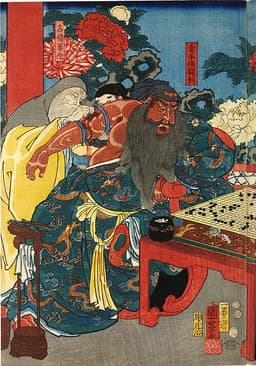
Guan Yu
General · Ancient
57.6Total
Basic Information
Born
-570
160
Died
—
220
Era
Ancient
Ancient
Nationality
Rashidun Caliphate
China
Occupation
General
General
Civilization
Middle Eastern
Eastern
Score Comparison
Military (10%)
63.3
61.7
Political (20%)
33.6
35.0
Influence (20%)
52.5
72.0
Legacy (20%)
44.2
68.0
Leadership (15%)
35.4
40.9
Strategy (15%)
60.0
50.0
TOTAL
46.9
57.6
Al-Muthanna ibn Haritha — Complete Timeline
633 AD
Led raids into Sasanian IraqWar◆ Major
Al-Muthanna ibn Haritha, as a tribal chief, initiated the first Muslim military campaigns into Sasanian Iraq. He led successful raids against Persian garrisons, paving the way for the larger Muslim conquest of Iraq.
Military CampaignConquestSasanian Empire
Impact: regional
634 AD
Battle of the BridgeWar◆ Major
Al-Muthanna commanded the Muslim forces at the Battle of the Bridge against the Sasanian army. The Muslims suffered a heavy defeat, and al-Muthanna was wounded. This setback temporarily halted the Muslim advance into Iraq.
BattleDefeatSasanian Empire
Impact: regionaldestructive
635 AD
Victory at the Battle of BuwaibWar◆ Major
Al-Muthanna rallied the Muslim forces after the defeat at the Bridge and won a decisive victory at the Battle of Buwaib against the Sasanians. This victory restored Muslim momentum and led to the eventual conquest of Iraq.
BattleVictorySasanian Empire
Impact: regional
Guan Yu — Complete Timeline
200 AD
Battle of BomaWar
Guan Yu, serving under Cao Cao, killed the enemy general Yan Liang in battle at Boma. This act demonstrated his martial prowess and loyalty to Cao Cao at the time. The victory helped Cao Cao's forces in the campaign against Yuan Shao.
Three KingdomsBattleMartial Skill
Impact: regional
Departure from Cao Cao to Rejoin Liu BeiPolitical Action◆ Major
After learning of Liu Bei's whereabouts, Guan Yu left Cao Cao's service, crossing five passes and killing six generals to rejoin his sworn brother. This act of loyalty became legendary, symbolizing unwavering commitment to one's oath.
LoyaltyOathThree Kingdoms
Impact: regional
219 AD
Battle of FanchengWar◆ Major
Guan Yu led a campaign against Cao Cao's forces at Fancheng. He achieved initial success, flooding the city, but was ultimately defeated by reinforcements led by Xu Huang. This battle marked the turning point in his military career.
Three KingdomsSiegeTurning Point
Impact: regional
220 AD
Capture and Execution by Sun Quan's ForcesWar◆ Major
After the defeat at Fancheng, Guan Yu retreated but was ambushed and captured by Sun Quan's general L
ExecutionThree KingdomsRevenge
Impact: regionaltragic
Expert Analysis
Origins
Al-Muthanna ibn Haritha was born around 570 CE in the Banu Shayban tribe, a powerful Bedouin confederation in northeastern Arabia. His father was a tribal chief, and Al-Muthanna inherited leadership after his father's death. He was a contemporary of the Prophet Muhammad but likely never converted during Muhammad's lifetime. His early life was marked by tribal warfare and raids (ghazw) common among Bedouin, honing his military skills.
Guan Yu (160–220 CE) was born in Xie County, Hedong Commandery (modern Yuncheng, Shanxi). His family was of modest means, and he fled his hometown after killing a local bully. He became a fugitive, eventually meeting Liu Bei and Zhang Fei in Zhuo Commandery around 184 CE. The three swore brotherhood in the Peach Garden Oath, pledging to restore the Han dynasty. Guan Yu's early life was shaped by the chaos of the Yellow Turban Rebellion and the decline of Han central authority.
Rise to Power
Al-Muthanna rose to prominence after the death of Muhammad in 632 CE. During the Ridda Wars, he led his tribe against the apostate forces and later submitted to the first caliph, Abu Bakr. Recognizing his military skill, Abu Bakr appointed him to lead raids into Sasanian Iraq. In 633 CE, Al-Muthanna launched the first Muslim incursions into Persian territory, capturing the frontier town of Ubulla. His successes prompted Caliph Umar to send a larger army under Khalid ibn al-Walid, but after Khalid's transfer to Syria, Al-Muthanna became the primary commander in Iraq.
Guan Yu rose to power as a key general under Liu Bei. After the Battle of Red Cliffs (208 CE), Liu Bei gained control of Jing Province, and Guan Yu was appointed as its governor. His reputation grew from his early exploits, such as killing Yan Liang at the Battle of Boma (200 CE) while serving Cao Cao. Guan Yu's loyalty was cemented when he left Cao Cao's service to rejoin Liu Bei, crossing five passes and killing six generals—a tale that became legendary. By 219 CE, Guan Yu was one of Liu Bei's most trusted commanders, holding the strategic Jing Province.
Leadership & Governance
Al-Muthanna's leadership style was that of a tribal chief: personal charisma, direct command, and reliance on loyalty of his warriors. He governed conquered territories through local agreements, often allowing Persian nobles to retain authority in exchange for tribute. His governance was limited by his nomadic background; he lacked administrative infrastructure and relied on Medina for direction. After his death, his forces were integrated into the regular Muslim army under Sa'd ibn Abi Waqqas.
Guan Yu's leadership was characterized by strict codes of honor and personal pride. As governor of Jing Province, he maintained order but alienated allies through arrogance. He dismissed Sun Quan's marriage proposal for his daughter, insulting the Wu ruler. He also treated his subordinates harshly, which led to defections during crisis. His governance was effective in maintaining Liu Bei's claim, but his lack of diplomacy ultimately cost him the province. In contrast to Al-Muthanna's collaborative tribal approach, Guan Yu's inflexible honor system created enemies.
Triumph & Tragedy
Al-Muthanna's greatest triumph was the victory at the Battle of Buwaib (634 CE). After the disastrous Battle of the Bridge, where he was wounded, he regrouped the Muslim forces and won a decisive battle against the Sasanian army under Mihran. This victory restored Muslim morale and paved the way for the conquest of Iraq. His tragedy was his death from wounds sustained at Buwaib, dying before seeing the full conquest of Ctesiphon. He scored 63.3 in military and 60.0 in strategy, reflecting his tactical skill but limited strategic scope.
Guan Yu's greatest triumph was the Battle of Fancheng (219 CE), where he besieged Cao Cao's forces and used flooding to devastating effect, capturing the city. His tragedy was the loss of Jing Province due to betrayal and overconfidence. Sun Quan's forces under Lü Meng attacked from behind, and Guan Yu was captured and executed in 220 CE. His death led to Liu Bei's disastrous invasion of Wu. Guan Yu scored 61.7 in military and 50.0 in strategy, showing his prowess but strategic flaws.
Character & Destiny
Al-Muthanna was pragmatic and adaptable. He switched allegiance from the apostate movement to the caliphate when it suited his tribe's interests. His character—bold but cautious in defeat—allowed him to recover from the Bridge disaster. His destiny was cut short by wounds, but he laid the foundation for the Arab conquest of Iraq. Historians assess him as a capable tribal leader who operated within the limits of his resources.
Guan Yu was proud, loyal, and inflexible. His unwavering loyalty to Liu Bei was admirable but led to poor political decisions. His contempt for Sun Quan and his own subordinates created vulnerabilities. His character—overconfident and dismissive—directly caused his downfall. In Chinese history, he is revered as a symbol of loyalty (yi), but his historical record shows a general whose flaws matched his strengths. He scored 40.9 in leadership and 35.0 in political, indicating weaknesses in coalition-building.
Legacy
Al-Muthanna's legacy is as the initiator of the Muslim conquest of Iraq. His raids opened the door for the Arab armies that later defeated the Sasanian Empire. He is remembered in Islamic historiography as a pioneer but is overshadowed by figures like Khalid ibn al-Walid. His score of 44.2 in legacy reflects his limited long-term recognition. However, his military actions directly led to the spread of Islam in the region.
Guan Yu's legacy is immense. He was deified as Guandi, the God of War, and is worshipped in Chinese folk religion, Buddhism, and Taoism. Temples dedicated to him exist across East Asia. His story is immortalized in the novel 'Romance of the Three Kingdoms'. His score of 68.0 in legacy is among the highest for ancient generals. His cultural impact far exceeds his historical military achievements.
Conclusion
While Al-Muthanna ibn Haritha was a pivotal figure in early Islamic expansion, Guan Yu's greater total score (57.6 vs 46.9) and his transformation into a deity demonstrate a more profound and enduring impact. Guan Yu's influence spans millennia and cultures, shaping not only military history but also religious and moral frameworks. Al-Muthanna's contributions were crucial but localized to a specific historical era. Therefore, Guan Yu had greater overall impact, both historically and culturally.
Rankings
🥇
Guan YuLeader
Mil: 61.7Pol: 35.0Inf: 72.0
57.6
🥈
Al-Muthanna ibn Haritha
Mil: 63.3Pol: 33.6Inf: 52.5
46.9
+10.7 behind
How This Comparison Works
Algorithm
Each figure is scored on 6 dimensions (0—100 scale) based on structured historical data: Military (10%), Political (20%), Influence (20%), Legacy (20%), Leadership (15%), Strategy (15%). The weighted total produces the final ranking.
Data Sources
Scores are computed from structured sub-indicators in the database. Scale factors adjust for era (Ancient ×0.85, Modern ×1.0) and civilization size (Eastern ×1.05, Other ×0.80) to account for differences in population and military scale.
Maximum 3 Figures
Comparisons are limited to 2—3 figures to ensure readability and statistical meaningfulness.
Error Margins
±5 points per dimension — Sub-scores are derived from historical records with inherent uncertainty. Two figures within 5 points on a dimension should be considered roughly equivalent in that area.
Total Score Accuracy
±3 points overall — The weighted combination of 6 dimensions produces a total score with approximately ±3 points of uncertainty. Differences of less than 3 points are not statistically significant— the figures are effectively tied.
Known Limitations
- Historical records are incomplete and uneven across civilizations
- Figures from oral-tradition societies may be underrepresented
- Occupation labels can misclassify multi-role figures
- Scores measure capability and impact, not moral character
- Quantitative scoring is a comparison tool, not absolute truth
Capability Radar
Military (10%) — Battles & Warfare
Battles
45
65
Win Rate
50
55
Expansion
55
45
Political (20%) — Governance & Reform
Reform
15
10
Diplomacy
35
25
Economy
20
15
Influence (20%) — Cultural & Global Reach
Cultural
30
85
Global
25
70
Legacy (20%) — Historical Impact
Historical
40
80
Longevity
35
90
Leadership (15%) — Power & Stability
Tenure
30
30
Stability
25
20
Strategy (15%) — Tactics & Innovation
Strategy
45
50
Tactics
40
70
Reform
20
10
Similar Comparisons
Comments & Discussion
No comments yet. Be the first to share your thoughts!