Loading...
Godfrey of Bouillon vs Tokugawa Ieyasu
Tokugawa Ieyasu leads by 29.6 pts · 2 figures compared
…
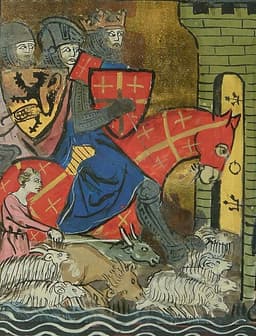
Godfrey of Bouillon
General · Medieval
52.2Total
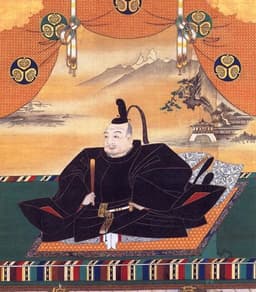
Tokugawa Ieyasu
General · Modern
81.8Total
Basic Information
Born
1060
1543
Died
1100
1616
Era
Medieval
Modern
Nationality
Jerusalem
Japan
Occupation
General
General
Civilization
Western
Eastern
Score Comparison
Military (10%)
60.0
78.0
Political (20%)
37.9
82.0
Influence (20%)
55.7
88.0
Legacy (20%)
47.5
75.0
Leadership (15%)
54.2
85.0
Strategy (15%)
66.3
82.0
TOTAL
52.2
81.8
Godfrey of Bouillon — Complete Timeline
1096 AD
Leadership of the First CrusadeWar◆ Major
Godfrey of Bouillon was a key leader of the First Crusade, commanding an army from Lorraine. He participated in the Siege of Nicaea, the Battle of Dorylaeum, and the Siege of Antioch, and was instrumental in the capture of Jerusalem in 1099.
CrusadeFirst CrusadeJerusalem
Impact: global
1099 AD
Capture of JerusalemWar
Godfrey led the successful assault on Jerusalem on July 15, 1099, ending Muslim rule. The capture was followed by a massacre of the city's Jewish and Muslim inhabitants. Godfrey was elected as the first ruler of the Kingdom of Jerusalem.
CrusadeJerusalemMassacre
Impact: globaldestructive
Battle of AscalonWar◆ Major
Godfrey led the Crusader army to victory against a Fatimid Egyptian force at Ascalon, securing the new kingdom's southern border. The victory prevented an immediate Muslim reconquest of Jerusalem.
BattleCrusader KingdomFatimids
Impact: regional
Election as Advocate of the Holy SepulchrePolitical Action◆ Major
After the capture of Jerusalem, Godfrey was elected as the ruler of the kingdom, but he refused the title of king, instead taking the title Advocatus Sancti Sepulchri (Advocate of the Holy Sepulchre). This established the Crusader state.
Crusader KingdomJerusalemTitle
Impact: regional
1100 AD
Death and SuccessionPolitical Action◆ Major
Godfrey died in 1100, possibly from illness or a wound. His brother Baldwin I succeeded him as the first king of Jerusalem. Godfrey's death left the kingdom in a precarious position, but Baldwin's leadership expanded it.
DeathSuccessionCrusader Kingdom
Impact: regionaltragic
Tokugawa Ieyasu — Complete Timeline
1600 AD
Battle of SekigaharaWar
Tokugawa Ieyasu led the Eastern Army to victory over Ishida Mitsunari's Western Army at Sekigahara. This decisive battle ended the Sengoku period and established Ieyasu as the supreme military ruler of Japan, paving the way for the Tokugawa shogunate.
Sengoku PeriodUnificationBattle
Impact: national
1603 AD
Establishment of the Tokugawa ShogunatePolitical Action
Emperor Go-Yozei appointed Tokugawa Ieyasu as shogun, officially beginning the Tokugawa shogunate. Ieyasu established his government in Edo (modern Tokyo), centralizing military and political power under his family's control.
ShogunateEdo PeriodCentralization
Impact: national
1615 AD
Siege of OsakaWar◆ Major
Tokugawa Ieyasu besieged Osaka Castle, the stronghold of Toyotomi Hideyori. The castle fell, and Hideyori committed suicide. This campaign eliminated the last major opposition to Tokugawa rule, solidifying the shogunate's control over Japan.
Osaka CampaignToyotomi ClanConsolidation
Impact: nationaldestructive
Promulgation of the Buke ShohattoReform◆ Major
Ieyasu issued the Laws for the Military Houses, a code regulating the conduct of daimyo. It restricted castle construction, required alternate attendance in Edo, and prohibited alliances without shogunal permission. This law helped control the feudal lords.
Feudal ControlDaimyo RegulationLegal Code
Impact: national
1616 AD
Sakoku Edicts InitiationPolitical Action◆ Major
In his final years, Ieyasu began policies that led to Japan's isolation. He restricted foreign trade to specific ports and expelled Christian missionaries. These measures, expanded by successors, resulted in the sakoku policy that isolated Japan for over 200 years.
IsolationismForeign PolicyChristianity
Impact: national
Expert Analysis
Tokugawa Ieyasu vs Godfrey of Bouillon
# The Unifier and the Crusader: Two Paths to Power, Two Ends of Legacy
On a summer morning in 1600, at a fog-shrouded valley called Sekigahara, Tokugawa Ieyasu watched his cannons open fire on fellow Japanese samurai. On a July afternoon in 1099, Godfrey of Bouillon scaled the walls of Jerusalem, his sword wet with the blood of Muslims and Jews alike. Both men won decisive victories that made them rulers. But one founded a dynasty that would last 250 years, while the other built a kingdom that crumbled within a century. Why did their fates diverge so dramatically?
Origins
Tokugawa Ieyasu was born in 1543 into a minor samurai family in Mikawa Province, during Japan's Sengoku period—a century of civil war where warlords fought for supremacy. His childhood was a hostage's nightmare: sent as a pawn to rival clans at age four, he learned early that trust was a weapon and patience a shield. Japan's chaos taught him that power came not from glory but from endurance.
Godfrey of Bouillon, born around 1060 in the French region of Lorraine, came from aristocratic stock with direct ties to Charlemagne's legacy. Europe was emerging from the Dark Ages, and the Church was calling for holy war. Godfrey grew up in a world where piety and violence intertwined, where a knight's duty was to fight for Christendom. His era offered crusade as the ultimate path to redemption and renown.
Rise to Power
Ieyasu's rise was a masterclass in survival. He allied with Oda Nobunaga, the first great unifier, and later with Toyotomi Hideyoshi, the second. Each alliance was a calculated step. He watched Nobunaga fall to betrayal, then outmaneuvered Hideyoshi's successors. The turning point came in 1600 at Sekigahara, where Ieyasu led the Eastern Army against Ishida Mitsunari's Western forces. The battle was a gamble—some of his own generals wavered—but Ieyasu's pre-battle alliances and defections secured victory. He had not just won a war; he had eliminated nearly every rival.
Godfrey's path was more direct. In 1096, he sold his lands to fund his army for the First Crusade, a leader among equals. His military record was solid but not spectacular: he survived the brutal siege of Antioch and marched on Jerusalem. The turning point came on July 15, 1099, when Crusaders breached the city walls. Godfrey led the assault, and the subsequent massacre—thousands dead in the streets—cemented his reputation. He was elected ruler, but refused the title of king, calling himself "Advocate of the Holy Sepulchre." It was a gesture of humility that masked a fatal weakness: he had no claim to legitimacy beyond conquest.
Leadership & Governance
Here the two men could not have been more different. Ieyasu was a political architect. After becoming shogun in 1603, he systematically dismantled the feudal chaos that had defined Japan. In 1615, he issued the Buke Shohatto, or Laws for the Military Houses, which restricted castle construction, controlled daimyo marriages, and required lords to spend every other year in Edo—a policy that drained their resources and prevented rebellion. He also began the Sakoku edicts, isolating Japan from foreign influence. His rule was about control: centralized, bureaucratic, and relentless.
Godfrey, by contrast, had no time for governance. His kingdom was a narrow strip of coastal land, surrounded by hostile Muslim powers. His greatest military achievement after Jerusalem was the Battle of Ascalon later in 1099, where he defeated a Fatimid Egyptian army. But he never built institutions. He never created a bureaucracy or a legal code. His rule depended on personal loyalty from fellow Crusaders, many of whom returned to Europe after their vows were fulfilled. When Godfrey died in 1100—perhaps from typhoid, perhaps from a wound—his kingdom had no stable succession. His brother Baldwin I took the crown, but the foundation was sand.
Triumph & Tragedy
Ieyasu's triumph was Sekigahara, a battle that ended centuries of war. His tragedy came in 1615 at the Siege of Osaka, where he crushed Toyotomi Hideyori, the son of his former lord. Hideyori committed suicide, and with him died the last hope of the Toyotomi clan. Ieyasu had destroyed his old master's line—a necessary cruelty, but one that haunted his legacy.
Godfrey's triumph was Jerusalem itself, a city sacred to three faiths. His tragedy was that he could not hold it. Within a generation, the Crusader states were in constant retreat. By 1187, Saladin would recapture Jerusalem. Godfrey's kingdom became a cautionary tale: conquest without governance is merely violence.
Character & Destiny
Ieyasu was patient, calculating, and ruthlessly pragmatic. He was known for his saying, "Life is like a long journey with a heavy load. Let thy step be slow and steady." He never acted in haste, never trusted fully, and never forgot a slight. His personality shaped a destiny of endurance: he outlived his enemies, outmaneuvered his allies, and built a system that could survive without him.
Godfrey was a knight of faith, driven by conviction rather than calculation. He refused the crown not out of modesty but out of a medieval worldview where kingship required divine sanction. His personality shaped a destiny of glory and brevity: he achieved the impossible, then died before he could secure it.
Legacy
Tokugawa Ieyasu's legacy is the Edo period—250 years of peace, cultural flowering, and isolation. He is remembered as one of Japan's three great unifiers, the one who finished the work Nobunaga began and Hideyoshi advanced. His shogunate fell only in 1868, when Commodore Perry's black ships forced Japan open. Today, his shrine at Nikko is a UNESCO World Heritage site, and his face still appears on Japanese currency.
Godfrey of Bouillon's legacy is more ambiguous. He is celebrated in Crusader mythology as the ideal Christian knight, yet his kingdom was a failure. His name appears in Dante's *Paradiso*, but modern historians see him as a symbol of religious violence. His legacy is a reminder that glory and sustainability are rarely the same thing.
Conclusion
What drove these two men to such different outcomes? Ieyasu understood that power is a system, not a moment. He built institutions that outlasted him. Godfrey understood that power is a symbol, not a structure. He captured a city but could not capture a future. In the end, the unifier of Japan and the crusader of Jerusalem both sought to remake their worlds. One succeeded because he thought in centuries; the other failed because he thought in battles. Their stories remain, centuries later, a lesson in what it truly means to rule.
Rankings
🥇
Tokugawa IeyasuLeader
Mil: 78.0Pol: 82.0Inf: 88.0
81.8
🥈
Godfrey of Bouillon
Mil: 60.0Pol: 37.9Inf: 55.7
52.2
+29.6 behind
How This Comparison Works
Algorithm
Each figure is scored on 6 dimensions (0—100 scale) based on structured historical data: Military (10%), Political (20%), Influence (20%), Legacy (20%), Leadership (15%), Strategy (15%). The weighted total produces the final ranking.
Data Sources
Scores are computed from structured sub-indicators in the database. Scale factors adjust for era (Ancient ×0.85, Modern ×1.0) and civilization size (Eastern ×1.05, Other ×0.80) to account for differences in population and military scale.
Maximum 3 Figures
Comparisons are limited to 2—3 figures to ensure readability and statistical meaningfulness.
Error Margins
±5 points per dimension — Sub-scores are derived from historical records with inherent uncertainty. Two figures within 5 points on a dimension should be considered roughly equivalent in that area.
Total Score Accuracy
±3 points overall — The weighted combination of 6 dimensions produces a total score with approximately ±3 points of uncertainty. Differences of less than 3 points are not statistically significant— the figures are effectively tied.
Known Limitations
- Historical records are incomplete and uneven across civilizations
- Figures from oral-tradition societies may be underrepresented
- Occupation labels can misclassify multi-role figures
- Scores measure capability and impact, not moral character
- Quantitative scoring is a comparison tool, not absolute truth
Capability Radar
Military (10%) — Battles & Warfare
Battles
65
85
Win Rate
60
90
Expansion
55
75
Political (20%) — Governance & Reform
Reform
25
90
Diplomacy
40
85
Economy
20
88
Influence (20%) — Cultural & Global Reach
Cultural
55
85
Global
50
70
Legacy (20%) — Historical Impact
Historical
60
90
Longevity
55
95
Leadership (15%) — Power & Stability
Tenure
30
95
Stability
25
95
Strategy (15%) — Tactics & Innovation
Strategy
60
92
Tactics
55
88
Reform
30
80
Similar Comparisons
Comments & Discussion
城墙上的计算器6/16/2026
说统一?德川家康不过是个精致的投机者。关原之战前夜,他早算准了小早川秀秋的叛变,用几十年布局换一场顺风局——这哪是兵法,分明是账房先生的功夫。而戈弗雷是真刀真枪爬上耶路撒冷城墙的人,1099年7月那个下午,他的信仰比任何计算都锋利。统一不是靠忍耐,是靠血性。
SwordScribe6/16/2026
As a classicist, I see two men shaped by their epics. Godfrey embodies the "chanson de geste"—a holy warrior whose deeds were mythologized within decades, celebrated in the *History of the Expedition to Jerusalem*. Ieyasu, however, is more akin to the pragmatic hero of a chronicle like *Tokugawa Jikki*—a patient strategist who built legitimacy through peace. One fought for God and glory; the other for a dynasty that outlasted his bones. The former is a legend; the latter, a foundation.
塔楼上的人6/16/2026
数据能说明一切:德川家康死后,德川幕府统治了日本265年,天皇成了摆设。戈弗雷的耶路撒冷王国撑了不到90年,而且从他弟弟鲍德温一世开始,王权就摇摇欲坠。别扯什么信仰高尚,结果就是硬道理。家康传承的务实政治把战国乱世压成了秩序,戈弗雷的圣战梦却被萨拉丁一把火点燃。历史从不奖励天真。
BattlefieldSurgeon6/16/2026
Military historian here, and I’ll take endurance over glory any day. Godfrey’s siege of Jerusalem in 1099 was a bloody three-week gamble—he won, but he lost half his army to desertion and plague. Ieyasu’s genius was logistical: at Sekigahara, he turned a rain-soaked battlefield into a trap, using arquebus volleys and terrain to fracture the Western Army without risking annihilation. One Christian knight’s victory was a flashpoint; the unifier’s was a system.
墨迹未干的史官6/16/2026
你们都在夸他俩的刀,我却看到笔。德川家康花了二十年写《武家诸法度》,把武士的刀鞘钉上锁;戈弗雷留下的只有一首拉丁赞美诗和几块“圣墓守护者”的空头衔。家康的遗产是制度,写在纸上,延续三百年;戈弗雷的遗产是传说,刻在教堂里,被下一个十字军随手擦掉。历史记得会写字的人,而不是只会挥剑的骑士。