Loading...
Giuseppe Garibaldi vs Julius Caesar
Julius Caesar leads by 27.8 pts · 2 figures compared
…
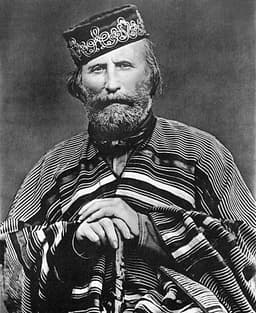
Giuseppe Garibaldi
General · Modern
55.0Total

Julius Caesar
General · Ancient
82.8Total
Basic Information
Born
1807
-100
Died
1882
-44
Era
Modern
Ancient
Nationality
Italy
Roman Republic
Occupation
General
General
Civilization
Western
Western
Score Comparison
Military (10%)
61.7
88.0
Political (20%)
54.7
78.0
Influence (20%)
40.0
85.0
Legacy (20%)
68.0
82.0
Leadership (15%)
54.2
80.0
Strategy (15%)
55.0
85.0
TOTAL
55.0
82.8
Giuseppe Garibaldi — Complete Timeline
1849 AD
Defense of the Roman RepublicWar◆ Major
Garibaldi commanded the defense of the short-lived Roman Republic against French forces sent to restore papal rule. Despite heroic resistance, the republic fell, and Garibaldi led a retreat through central Italy.
Italian UnificationRoman RepublicDefense
Impact: regionaltragic
1860 AD
Expedition of the ThousandWar
Garibaldi led a volunteer force of about 1,000 men to conquer Sicily and Naples. His campaign overthrew the Bourbon monarchy and unified southern Italy with the Kingdom of Sardinia.
Italian UnificationExpeditionVolunteers
Impact: nationalconstructive
Battle of CalatafimiWar◆ Major
Garibaldi's Redshirts defeated a larger Bourbon army at Calatafimi in Sicily. The victory boosted morale and demonstrated the effectiveness of his volunteers, opening the way to Palermo.
Italian UnificationBattleSicily
Impact: regional
Battle of VolturnusWar◆ Major
Garibaldi's forces defeated the Neapolitan army at the Volturno River. The victory secured his conquest of Naples and forced King Francis II into exile, completing the unification of southern Italy.
Italian UnificationBattleNaples
Impact: regional
Cession of Sicily and Naples to Victor Emmanuel IIPolitical Action
After conquering southern Italy, Garibaldi voluntarily handed over his conquests to King Victor Emmanuel II of Sardinia. This act unified Italy under the monarchy and avoided civil war.
Italian UnificationCessionMonarchy
Impact: nationalconstructive
Julius Caesar — Complete Timeline
58 BC
Gallic WarsWar◆ Major
Caesar, as proconsul of Gaul, launched a series of campaigns that conquered all of Gaul (modern France, Belgium, and parts of Switzerland). He fought numerous battles, including against the Helvetii, the Belgae, and the Gallic chieftain Vercingetorix. The wars brought immense wealth and a loyal army to Caesar.
Gallic WarsConquestRoman Expansion
Impact: regional
49 BC
Crossing the RubiconPolitical Action◆ Major
Caesar led Legio XIII across the Rubicon River into Italy, defying the Roman Senate's order to disband his army. This act triggered a civil war against Pompey and the Optimates, ultimately leading to Caesar's dictatorship and the end of the Roman Republic.
Roman Civil WarEnd of RepublicPower Struggle
Impact: global
48 BC
Battle of PharsalusWar◆ Major
Caesar's outnumbered army defeated the larger forces of Pompey the Great at Pharsalus in Greece. Caesar's tactical use of a reserve line to counter Pompey's cavalry charge proved decisive. Pompey fled to Egypt, where he was assassinated, leaving Caesar as the undisputed master of the Roman world.
Roman Civil WarBattleDecisive Victory
Impact: regional
44 BC
Appointment as Dictator for LifePolitical Action◆ Major
The Roman Senate appointed Caesar dictator perpetuo (dictator for life), granting him unprecedented personal power. This move concentrated military, legislative, and judicial authority in one person, effectively ending the Roman Republic's traditional system of checks and balances and alarming many senators.
DictatorshipEnd of RepublicPower Consolidation
Impact: regionaldestructive
Assassination on the Ides of MarchPolitical Action◆ Major
A group of Roman senators, led by Marcus Junius Brutus and Gaius Cassius Longinus, stabbed Caesar to death at a meeting of the Senate in the Theatre of Pompey. The assassination was intended to restore the Republic, but instead triggered another civil war that led to the rise of the Roman Empire.
AssassinationRoman PoliticsEnd of Republic
Impact: globaldestructive
Expert Analysis
giuseppe-garibaldi-vs-julius-caesar
# The Conqueror and the Liberator
On a January morning in 49 BCE, Julius Caesar stood at the banks of the Rubicon River, a small stream that marked the boundary between his province and Italy proper. To cross with his army was treason, a declaration of civil war. He hesitated, then uttered a phrase that would echo through millennia: *“Alea iacta est”*—the die is cast. Eighteen centuries later, in May 1860, another man stood on a wharf in Genoa, watching a thousand volunteers board two steamships. Giuseppe Garibaldi, a rugged figure in a red shirt and poncho, was about to launch the most audacious gamble of the Italian Risorgimento. Both men defied empires and remade nations. But where Caesar sought to crown himself, Garibaldi knelt before a king. Their lives, separated by nearly two thousand years, tell a story of how ambition and selflessness, when placed in the crucible of history, yield profoundly different outcomes.
Origins
Julius Caesar was born into the patrician Julian clan, a family of ancient lineage but modest political clout in the late Roman Republic. His youth was marked by the violent upheavals of the Marian and Sullan civil wars, which taught him that power flowed from the sword, not the Senate. He learned early to balance aristocratic pride with populist charm, borrowing fortunes to fund spectacles for the Roman mob. His era was one of decay: a republic rotting from oligarchic greed, where ambitious generals could carve out personal empires.
Giuseppe Garibaldi, born in 1807 in Nice, then part of the French Empire, came from a family of coastal traders and sailors. His world was fragmented Italy, a “geographical expression” of competing states, Austrian dominance, and papal obscurantism. If Caesar was the product of a dying republic, Garibaldi was the child of a nation not yet born. He was shaped by the Romantic nationalism sweeping Europe, by the secret societies of the Carbonari, and by the example of revolutionaries like Mazzini. While Caesar learned statecraft in the Forum, Garibaldi learned guerrilla warfare in the jungles of South America.
Rise to Power
Caesar’s ascent was a masterclass in political engineering. He climbed the *cursus honorum*—quaestor, aedile, praetor—while forging the First Triumvirate with Pompey and Crassus. His consulship in 59 BCE was marked by land reforms and ruthless tactics. But the true springboard was Gaul. From 58 to 50 BCE, Caesar conquered a territory larger than Italy, amassing a veteran army and legendary wealth. His *Commentaries* turned military dispatches into political propaganda. When the Senate ordered him to disband his army, he chose war.
Garibaldi’s rise was more erratic, more romantic. Exiled after a failed insurrection in 1834, he fled to South America, where he became a naval commander for the breakaway republic of Rio Grande do Sul. He met his lover, Anita, in battle. He fought in Uruguay’s civil war, leading the Italian Legion in red shirts—a uniform that would become iconic. When revolution erupted in Italy in 1848, he returned, only to see the First War of Independence collapse. In 1849, he defended the Roman Republic against French, Austrian, and Neapolitan armies with desperate brilliance. After its fall, he led a harrowing retreat across central Italy, his pregnant wife dying in his arms. He spent another decade in exile, a wandering hero waiting for his moment.
Leadership & Governance
Caesar governed as a revolutionary traditionalist. As dictator, he reformed the calendar, extended citizenship to provincials, redistributed land to veterans, and launched public works. But his rule was autocratic. He centralized power, packed the Senate with his supporters, and accepted the title “dictator for life.” His military genius—speed, logistics, and the discipline of his legions—was matched by a political genius for clemency. He pardoned former enemies, but the gesture felt like condescension. His reforms were rational, efficient, and deeply resented by the old aristocracy.
Garibaldi governed as a liberator, never a ruler. After conquering Sicily in 1860, he issued decrees abolishing feudal dues and distributing land, but he had no interest in permanent power. At the Battle of Calatafimi, his thousand Redshirts defeated a Bourbon army twice their size through sheer will. At Volturnus, he held off a counterattack long enough for Piedmontese forces to arrive. Yet his greatest act was not military but political: at a meeting in Teano in October 1860, he handed over Sicily and Naples to King Victor Emmanuel II, saluting him as “King of Italy.” He refused titles, money, or land. “I obey,” he said, and returned to his farm on the island of Caprera.
Triumph & Tragedy
Caesar’s triumph was absolute. He conquered Gaul, defeated his rival Pompey at Pharsalus, crushed the remains of the optimates in Africa and Spain, and returned to Rome as master of the Mediterranean. His tragedy came on the Ides of March, 44 BCE, when sixty senators stabbed him to death in the Pompeian Theatre. He fell at the feet of a statue of his old enemy, bleeding from twenty-three wounds. The conspiracy succeeded in killing the man but failed to save the republic; his adopted heir, Octavian, would become Augustus, the first emperor.
Garibaldi’s triumph was the unification of Italy, a dream he had pursued for thirty years. But his tragedy was the incompleteness of that dream. Rome and Venice remained outside the new kingdom until later wars. The south he liberated was soon governed by northern bureaucrats who ignored its poverty. Garibaldi himself was wounded in the leg at the Battle of Aspromonte in 1862, shot by Italian troops while trying to march on Rome. He spent his final decades as a farmer, a critic of the monarchy he had served, and a symbol of lost revolutionary ideals.
Character & Destiny
Caesar was audacious, calculating, and supremely confident. He believed in his own star, his *felicitas*—the luck of the gods. He slept with queens, pardoned enemies, and rewrote the law. His flaw was not ambition but the inability to imagine that others did not share his vision. He saw the republic as a machine that needed a single operator; he could not see that his operation was its death.
Garibaldi was selfless, impulsive, and magnetic. He fought not for power but for a cause. He refused crowns, wealth, and titles. His flaw was a kind of political innocence: he believed that a united Italy would automatically be a free and just one. He handed his conquests to a monarchy that would soon suppress the very freedoms he had fought for. Where Caesar’s tragedy was his success, Garibaldi’s tragedy was his success—given to others.
Legacy
Caesar’s legacy is the Roman Empire and the very concept of a dictator as a figure who transforms a state. His name became a title: Kaiser, Tsar. He is studied in every military academy, quoted in every political debate. But he is also a warning: the man who saves the republic may be the one who destroys it.
Garibaldi’s legacy is Italian unity and the ideal of the people’s general. Statues of him on horseback grace every Italian piazza. His Redshirts inspired guerrilla fighters from Cuba to Ireland. He is remembered not as a ruler but as a liberator, a man who could have been a king but chose to be a citizen.
Conclusion
Caesar crossed the Rubicon to seize power; Garibaldi crossed the Strait of Messina to give it away. One built an empire on his own ambition; the other built a nation on his own humility. Both changed the world, but they changed it in opposite ways. Caesar’s story is about the seduction of absolute power, Garibaldi’s about the power of absolute selflessness. In the end, the conqueror was murdered by his peers, and the liberator died in bed, surrounded by his family and his dreams. History, perhaps, has a sense of justice—but it is never a simple one.
Rankings
🥇
Julius CaesarLeader
Mil: 88.0Pol: 78.0Inf: 85.0
82.8
🥈
Giuseppe Garibaldi
Mil: 61.7Pol: 54.7Inf: 40.0
55.0
+27.8 behind
How This Comparison Works
Algorithm
Each figure is scored on 6 dimensions (0—100 scale) based on structured historical data: Military (10%), Political (20%), Influence (20%), Legacy (20%), Leadership (15%), Strategy (15%). The weighted total produces the final ranking.
Data Sources
Scores are computed from structured sub-indicators in the database. Scale factors adjust for era (Ancient ×0.85, Modern ×1.0) and civilization size (Eastern ×1.05, Other ×0.80) to account for differences in population and military scale.
Maximum 3 Figures
Comparisons are limited to 2—3 figures to ensure readability and statistical meaningfulness.
Error Margins
±5 points per dimension — Sub-scores are derived from historical records with inherent uncertainty. Two figures within 5 points on a dimension should be considered roughly equivalent in that area.
Total Score Accuracy
±3 points overall — The weighted combination of 6 dimensions produces a total score with approximately ±3 points of uncertainty. Differences of less than 3 points are not statistically significant— the figures are effectively tied.
Known Limitations
- Historical records are incomplete and uneven across civilizations
- Figures from oral-tradition societies may be underrepresented
- Occupation labels can misclassify multi-role figures
- Scores measure capability and impact, not moral character
- Quantitative scoring is a comparison tool, not absolute truth
Capability Radar
Military (10%) — Battles & Warfare
Battles
65
95
Win Rate
70
92
Expansion
60
97
Political (20%) — Governance & Reform
Reform
40
90
Diplomacy
50
85
Economy
20
82
Influence (20%) — Cultural & Global Reach
Cultural
70
88
Global
65
94
Legacy (20%) — Historical Impact
Historical
75
95
Longevity
65
96
Leadership (15%) — Power & Stability
Tenure
30
75
Stability
25
60
Strategy (15%) — Tactics & Innovation
Strategy
60
94
Tactics
75
96
Reform
55
88
Similar Comparisons
Comments & Discussion
RUBICON-RED6/17/2026
Caesar was a glory-hungry warlord who destroyed the Republic for personal power; Garibaldi liberated a people from foreign oppression. Caesar crossed the Rubicon for himself, Garibaldi sailed from Genoa for Italy. That's the difference between a tyrant and a hero. The fact that Garibaldi refused Napoleon III's bribes and handed Sicily to King Victor Emmanuel II without a crown for himself proves it—selfless vs. selfish, no contest.
BALDY-OF-THE-NUMBERS6/17/2026
Your romanticized "liberator" narrative ignores the data: Garibaldi's Thousand succeeded only because of British naval protection and Piedmontese logistics. Caesar's Gallic Wars mobilized 60,000-100,000 troops over a decade—Garibaldi couldn't even supply his redshirts for three months without begging. Scale and sustainability matter. If you judge by conquest efficiency, Caesar wins decisively. Garibaldi's just a gifted guerrilla in a world of real empire-builders.
背锅的凯撒6/17/2026
你们就吹加里波第吧,他那点成就能跟凯撒比?凯撒一个人征服高卢,杀了百万蛮族,俘虏百万,直接改变了欧洲史走向。加里波第呢?带着一千个乌合之众去西西里,靠的是皮埃蒙特军队在后面擦屁股。说白了他就是个高级混混,凯撒才是真正的战略家。你们这些浪漫主义者就喜欢把土匪当成英雄。
经典控述者6/17/2026
加里波第从来不是什么“解放者”,他砸烂了南意大利的合法政权,让皮埃蒙特吞并了两西西里王国。当地人不想要他的统一,他靠暴力和虚假承诺强推。凯撒至少承认他是独裁者,加里波第打着自由旗号搞殖民扩张。你要是两西西里的农民,你肯定骂他是个北方侵略者,而不是什么民族英雄。
THE RED SHIRT SKEPTIC6/17/2026
Look, I respect Garibaldi's charisma, but Caesar was the better commander by any metric: logistics, discipline, siegecraft. Caesar built a bridge across the Rhine in ten days and held off Pompey's superior forces at Dyrrhachium. Garibaldi's "battles" were disorganized skirmishes—his only real victory was at Calatafimi against a Neapolitan force that barely fought. You can't compare a man who wrote *Commentarii* to a man who barely dictated memoirs. Caesar wrote history; Garibaldi stumbled throug