Loading...
This comparison has not been analyzed yet.
One-time AI generation (~1 minute). Scores and timeline are already available below.
Giuseppe Garibaldi vs Jorge Ubico Castaneda
Giuseppe Garibaldi leads by 5.2 pts · 2 figures compared
…
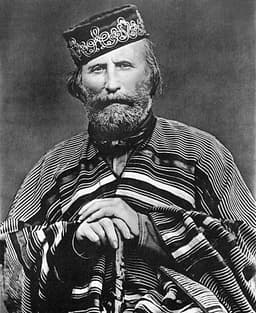
Giuseppe Garibaldi
General · Modern
55.0Total

Jorge Ubico Castaneda
General · Modern
49.8Total
Basic Information
Born
1807
1878
Died
1882
1946
Era
Modern
Modern
Nationality
Italy
Guatemala
Occupation
General
General
Civilization
Western
Western
Score Comparison
Military (10%)
61.7
25.9
Political (20%)
54.7
68.0
Influence (20%)
40.0
49.4
Legacy (20%)
68.0
39.2
Leadership (15%)
54.2
71.0
Strategy (15%)
55.0
41.7
TOTAL
55.0
49.8
Giuseppe Garibaldi — Complete Timeline
1849 AD
Defense of the Roman RepublicWar◆ Major
Garibaldi commanded the defense of the short-lived Roman Republic against French forces sent to restore papal rule. Despite heroic resistance, the republic fell, and Garibaldi led a retreat through central Italy.
Italian UnificationRoman RepublicDefense
Impact: regionaltragic
1860 AD
Expedition of the ThousandWar
Garibaldi led a volunteer force of about 1,000 men to conquer Sicily and Naples. His campaign overthrew the Bourbon monarchy and unified southern Italy with the Kingdom of Sardinia.
Italian UnificationExpeditionVolunteers
Impact: nationalconstructive
Battle of CalatafimiWar◆ Major
Garibaldi's Redshirts defeated a larger Bourbon army at Calatafimi in Sicily. The victory boosted morale and demonstrated the effectiveness of his volunteers, opening the way to Palermo.
Italian UnificationBattleSicily
Impact: regional
Battle of VolturnusWar◆ Major
Garibaldi's forces defeated the Neapolitan army at the Volturno River. The victory secured his conquest of Naples and forced King Francis II into exile, completing the unification of southern Italy.
Italian UnificationBattleNaples
Impact: regional
Cession of Sicily and Naples to Victor Emmanuel IIPolitical Action
After conquering southern Italy, Garibaldi voluntarily handed over his conquests to King Victor Emmanuel II of Sardinia. This act unified Italy under the monarchy and avoided civil war.
Italian UnificationCessionMonarchy
Impact: nationalconstructive
Jorge Ubico Castaneda — Complete Timeline
1931 AD
Seizure of Power in a CoupPolitical Action
General Ubico led a coup d'
GuatemalaCoupDictatorship
Impact: nationaldestructive
1934 AD
Implementation of Vagrancy LawsReform◆ Major
Ubico enacted vagrancy laws requiring all landless peasants to work a minimum number of days per year on plantations. This system forced indigenous Maya into virtual serfdom for large landowners.
GuatemalaLaborIndigenous
Impact: nationaldestructive
1936 AD
Granting of Concessions to United Fruit CompanyPolitical Action◆ Major
Ubico granted extensive land concessions and tax exemptions to the United Fruit Company (UFC). This strengthened UFC's economic stranglehold over Guatemala and deepened US corporate influence.
GuatemalaUnited Fruit CompanyEconomy
Impact: nationaldestructive
1944 AD
Forced Resignation and ExilePolitical Action
A general strike and popular uprising (the October Revolution) forced Ubico to resign. He fled to the United States, ending his dictatorship. The revolution led to democratic reforms.
GuatemalaRevolutionDictatorship
Impact: nationalconstructive
This comparison has not been analyzed yet.
One-time AI generation (~1 minute). Scores and timeline are already available below.
Rankings
🥇
Giuseppe GaribaldiLeader
Mil: 61.7Pol: 54.7Inf: 40.0
55.0
🥈
Jorge Ubico Castaneda
Mil: 25.9Pol: 68.0Inf: 49.4
49.8
+5.2 behind
How This Comparison Works
Algorithm
Each figure is scored on 6 dimensions (0—100 scale) based on structured historical data: Military (10%), Political (20%), Influence (20%), Legacy (20%), Leadership (15%), Strategy (15%). The weighted total produces the final ranking.
Data Sources
Scores are computed from structured sub-indicators in the database. Scale factors adjust for era (Ancient ×0.85, Modern ×1.0) and civilization size (Eastern ×1.05, Other ×0.80) to account for differences in population and military scale.
Maximum 3 Figures
Comparisons are limited to 2—3 figures to ensure readability and statistical meaningfulness.
Error Margins
±5 points per dimension — Sub-scores are derived from historical records with inherent uncertainty. Two figures within 5 points on a dimension should be considered roughly equivalent in that area.
Total Score Accuracy
±3 points overall — The weighted combination of 6 dimensions produces a total score with approximately ±3 points of uncertainty. Differences of less than 3 points are not statistically significant— the figures are effectively tied.
Known Limitations
- Historical records are incomplete and uneven across civilizations
- Figures from oral-tradition societies may be underrepresented
- Occupation labels can misclassify multi-role figures
- Scores measure capability and impact, not moral character
- Quantitative scoring is a comparison tool, not absolute truth
Capability Radar
Military (10%) — Battles & Warfare
Battles
65
10
Win Rate
70
15
Expansion
60
5
Political (20%) — Governance & Reform
Reform
40
55
Diplomacy
50
40
Economy
20
50
Influence (20%) — Cultural & Global Reach
Cultural
70
15
Global
65
10
Legacy (20%) — Historical Impact
Historical
75
25
Longevity
65
10
Leadership (15%) — Power & Stability
Tenure
30
60
Stability
25
30
Strategy (15%) — Tactics & Innovation
Strategy
60
25
Tactics
75
20
Reform
55
30
Similar Comparisons
Comments & Discussion
No comments yet. Be the first to share your thoughts!