Loading...
Fuad Chehab vs Lon Nol
Fuad Chehab leads by 8.4 pts · 2 figures compared
…
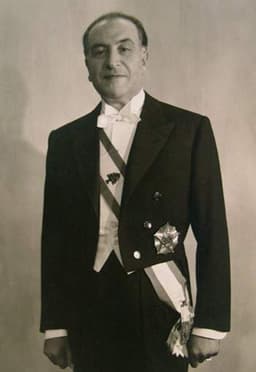
Fuad Chehab
General · Modern
49.9Total
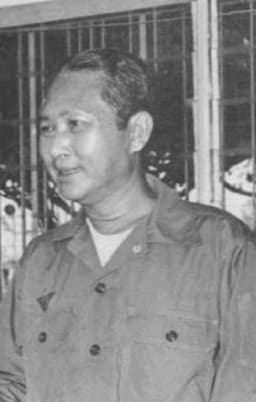
Lon Nol
General · Modern
41.5Total
Basic Information
Born
1902
1913
Died
1973
1985
Era
Modern
Modern
Nationality
Lebanon
Cambodia
Occupation
General
General
Civilization
Middle Eastern
Eastern
Score Comparison
Military (10%)
10.2
25.9
Political (20%)
70.0
30.8
Influence (20%)
54.1
47.9
Legacy (20%)
44.2
38.3
Leadership (15%)
72.0
61.1
Strategy (15%)
30.3
35.7
TOTAL
49.9
41.5
Fuad Chehab — Complete Timeline
1958 AD
Launched Chehabist reforms and modernizationReform◆ Major
President Chehab implemented a series of reforms known as Chehabism, including administrative modernization, economic planning, and strengthening state institutions. He established the Central Bank of Lebanon and the Civil Service Board.
ReformModernizationState Building
Impact: nationalconstructive
Elected President of LebanonPolitical Action◆ Major
Fuad Chehab was elected President of Lebanon on September 23, 1958, succeeding Camille Chamoun. His election ended the 1958 crisis and was supported by both Christian and Muslim factions seeking stability.
PresidencyElectionStabilization
Impact: nationalconstructive
Created the Deuxième Bureau intelligence agencyPolitical Action
Chehab expanded the role of the Deuxi
IntelligenceSecurityAuthoritarianism
Impact: national
1960 AD
Presided over the 1960s economic boomOther
Under Chehab's presidency, Lebanon experienced a period of economic growth and stability, with Beirut becoming a major financial and tourism hub. His policies attracted foreign investment and expanded the middle class.
Economic GrowthBeirutProsperity
Impact: nationalconstructive
1964 AD
Refused to amend constitution for a second termPolitical Action
Chehab declined to seek a second term as president, respecting the constitutional limit. He retired from politics in 1964, setting a precedent for peaceful transitions of power in Lebanon.
ConstitutionTerm LimitRetirement
Impact: nationalconstructive
Lon Nol — Complete Timeline
1970 AD
Coup against Norodom SihanoukPolitical Action
Lon Nol led a military coup that overthrew King Sihanouk while he was abroad. He established the Khmer Republic, ending the monarchy and aligning Cambodia with the United States during the Vietnam War.
CoupKhmer RepublicUS alliance
Impact: nationaldestructive
Declaration of the Khmer RepublicPolitical Action◆ Major
Lon Nol officially proclaimed the Khmer Republic, abolishing the monarchy. He became president and implemented a pro-American, anti-communist regime, which led to civil war with the Khmer Rouge and North Vietnamese forces.
RepublicRegime changeCivil War
Impact: national
1975 AD
Fall of Phnom PenhWar
Lon Nol's government collapsed as Khmer Rouge forces captured Phnom Penh. He fled into exile in the United States, ending the Khmer Republic and leading to the establishment of Democratic Kampuchea under Pol Pot.
Khmer Rouge victoryExileRegime collapse
Impact: nationaltragic
Expert Analysis
Fuad Chehab vs Lon Nol
# Two Generals, Two Republics
On a March morning in 1970, as Norodom Sihanouk’s plane lifted off from Phnom Penh airport, General Lon Nol set in motion a coup that would shatter Cambodia’s fragile peace. Eight thousand miles away, a decade earlier, another general named Fuad Chehab had taken a different path—accepting the presidency of Lebanon not through force, but through the ballot box, after a crisis that had threatened to tear his country apart. Both men were soldiers who became presidents. Both inherited fractured nations. Yet one built a republic that lasted barely five years and ended in genocide, while the other forged a reformist legacy that still bears his name. Why did two generals, facing similar challenges, produce such radically different outcomes?
Origins
Lon Nol was born in 1913 into a family of minor officials in Cambodia’s French colonial administration. He grew up in a world where power flowed from Paris, where the monarchy was both revered and hollow, and where the only path to prominence was through the colonial state. He entered the military young, rising through the ranks of the French-backed army, learning to command men but never to question the system that sustained him. Cambodia in his youth was a quiet backwater, a protectorate that had known little upheaval—until the winds of decolonization began to blow.
Fuad Chehab, born in 1902, was a product of a different world. Lebanon was then part of the Ottoman Empire, a mosaic of religious communities—Maronites, Sunnis, Shia, Druze, Orthodox—each with its own loyalties and fears. Chehab came from a prominent Maronite family, but he chose the military, becoming a commander in the French-controlled Troupes Spéciales du Levant. Unlike Lon Nol, he served not in a colonial army but in a multi-confessional force meant to hold together a deeply divided society. He learned early that command meant mediation, not domination.
Rise to Power
Lon Nol’s ascent was swift and ruthless. By the 1960s, he had become Sihanouk’s prime minister, a loyal servant who nevertheless watched the king’s balancing act between the United States and China with growing unease. When Sihanouk traveled to Moscow and Beijing in 1970, Lon Nol struck. With American tacit approval, he seized power, abolished the monarchy, and proclaimed the Khmer Republic. It was a coup in the classic mold—quick, decisive, and backed by the barrel of a gun.
Chehab’s rise was more circuitous. In 1958, Lebanon erupted in a civil war between pro-Western President Camille Chamoun and Arab nationalist factions backed by Egypt’s Gamal Abdel Nasser. The United States landed Marines on Beirut’s beaches. When the crisis subsided, Lebanon’s fractured parliament turned to Chehab—a general who had refused to use the army against protesters—as a compromise candidate. He was elected president on September 23, 1958, not because he had seized power, but because he was trusted not to abuse it.
Leadership & Governance
Lon Nol’s rule was a study in fragility. He declared the Khmer Republic on October 9, 1970, abolishing the monarchy and aligning Cambodia firmly with the United States. But his government was weak, corrupt, and increasingly paranoid. He expanded the army beyond its capacity, relying on American aid that came with strings attached. His military strategy against the Khmer Rouge was disastrous—he ordered offensives that alienated peasants, bombed villages that drove recruits to the insurgency, and purged officers he suspected of disloyalty. His political wisdom was no better: he rigged elections, suppressed dissent, and created a security state that mirrored the authoritarianism he claimed to oppose.
Chehab governed through what became known as “Chehabism”—a philosophy of reform, state-building, and managed consensus. He established the *Deuxième Bureau* intelligence agency not merely to spy on opponents, but to monitor sectarian tensions and prevent outbreaks of violence. He launched economic planning, modernized the bureaucracy, and invested in infrastructure that turned Beirut into a financial hub. He understood that Lebanon’s stability depended on balancing its eighteen recognized sects, and he used the state as a mediator rather than a weapon. His was a quiet authoritarianism—paternalistic, cautious, and ultimately stabilizing.
Triumph & Tragedy
Lon Nol’s greatest moment was also his most tragic. In 1970, he stood at the height of his power, having overthrown a king and aligned with the world’s superpower. But by 1975, as Khmer Rouge forces closed in on Phnom Penh, his government collapsed like a house of cards. On April 17, 1975, he fled into exile in the United States, leaving behind a country that would soon lose two million people to the killing fields. His triumph was an illusion; his tragedy was the catastrophe he helped unleash.
Chehab’s triumph was more modest but more lasting. He presided over Lebanon’s economic boom of the early 1960s, when Beirut became the Paris of the Middle East. His refusal to amend the constitution for a second term in 1964—despite widespread calls for him to stay—was a quiet act of statesmanship that set a precedent for peaceful succession. His tragedy was that his reforms could not outlast him. The sectarian tensions he managed so carefully exploded into civil war just a decade after his retirement, a war that would destroy much of what he built.
Character & Destiny
Lon Nol was a man of rigid ambition and brittle confidence. He believed in force, in decisive action, in the power of the general to impose order. But he lacked the patience to build consensus, the humility to listen, or the foresight to see that his actions were creating the very chaos he sought to suppress. His personality—proud, impulsive, and paranoid—drove him to make decisions that isolated his regime and empowered his enemies.
Chehab was the opposite: cautious, introspective, almost reluctant in power. He once said, “The presidency is not a throne, but a responsibility.” He governed with a sense of limits, understanding that Lebanon’s diversity required restraint. His personality—measured, analytical, and deeply aware of history—shaped a presidency that prioritized stability over glory. Where Lon Nol saw enemies to crush, Chehab saw factions to balance.
Legacy
Today, Lon Nol is remembered as a footnote to catastrophe. His name appears in histories of the Khmer Rouge as a precursor, a man whose incompetence and brutality cleared the path for Pol Pot. His scores in military and political leadership are mediocre; his legacy is one of failure. In Cambodia, few mourn him.
Fuad Chehab, by contrast, endures as a symbol of a lost era. “Chehabism” remains a reference point in Lebanese politics—a model of reform, secular governance, and national unity that seems ever more distant. His legacy is complicated: his *Deuxième Bureau* became a tool of repression after his departure, and his reforms could not prevent the civil war. But among Lebanese who remember the 1960s, he is remembered as a rare leader who put the country above himself.
Conclusion
Two generals, two republics, two destinies. Lon Nol seized power and lost everything; Chehab accepted power and preserved what he could. One believed that force could solve political problems; the other understood that politics was the art of managing difference. Their contrasting fates remind us that leadership is not simply about strength—it is about wisdom, patience, and the courage to know one’s limits. In the end, the general who refused to become a dictator left a deeper mark than the one who tried to be one.
Rankings
🥇
Fuad ChehabLeader
Mil: 10.2Pol: 70.0Inf: 54.1
49.9
🥈
Lon Nol
Mil: 25.9Pol: 30.8Inf: 47.9
41.5
+8.4 behind
How This Comparison Works
Algorithm
Each figure is scored on 6 dimensions (0—100 scale) based on structured historical data: Military (10%), Political (20%), Influence (20%), Legacy (20%), Leadership (15%), Strategy (15%). The weighted total produces the final ranking.
Data Sources
Scores are computed from structured sub-indicators in the database. Scale factors adjust for era (Ancient ×0.85, Modern ×1.0) and civilization size (Eastern ×1.05, Other ×0.80) to account for differences in population and military scale.
Maximum 3 Figures
Comparisons are limited to 2—3 figures to ensure readability and statistical meaningfulness.
Error Margins
±5 points per dimension — Sub-scores are derived from historical records with inherent uncertainty. Two figures within 5 points on a dimension should be considered roughly equivalent in that area.
Total Score Accuracy
±3 points overall — The weighted combination of 6 dimensions produces a total score with approximately ±3 points of uncertainty. Differences of less than 3 points are not statistically significant— the figures are effectively tied.
Known Limitations
- Historical records are incomplete and uneven across civilizations
- Figures from oral-tradition societies may be underrepresented
- Occupation labels can misclassify multi-role figures
- Scores measure capability and impact, not moral character
- Quantitative scoring is a comparison tool, not absolute truth
Capability Radar
Military (10%) — Battles & Warfare
Battles
5
15
Win Rate
5
10
Expansion
5
5
Political (20%) — Governance & Reform
Reform
65
10
Diplomacy
60
15
Economy
50
5
Influence (20%) — Cultural & Global Reach
Cultural
30
5
Global
25
10
Legacy (20%) — Historical Impact
Historical
35
15
Longevity
30
5
Leadership (15%) — Power & Stability
Tenure
55
40
Stability
45
5
Strategy (15%) — Tactics & Innovation
Strategy
10
15
Tactics
10
20
Reform
20
10
Similar Comparisons
Comments & Discussion
GENERAL RECKONING6/16/2026
Lon Nol’s real killer wasn’t his strategy—it was his timing. The domino theory had already collapsed Sihanouk’s neutrality, and Nixon’s secret bombings gave him a false sense of backing. Chehab, by contrast, took power during Lebanon’s quiet Cold War window, before 1967 radicalized everything. One man gambled on American shadows; the other built institutions. Same uniform, opposite instincts. History doesn’t judge intentions—it judges outcomes.
战略收割者6/16/2026
拿两个半世纪后的杯水车薪军阀比?Chehab 好歹在黎巴嫩留下了“谢哈布时代”的公共行政遗产,Lon Nol 连自己的参谋部都管理不好,1971年就搞出个彻底腐败的朗诺政权。更别忘了,柬埔寨当时有北越渗透、美国轰炸,黎巴嫩不过是内部教派角力。语境不同,硬比等于拿香蕉比苹果。军事素养?Lon Nol 输了整个国家,连战斗意志都没保住。
VOTES OVER VOLTES6/16/2026
数据打脸:Chehab 时期黎巴嫩 GDP 年均增长6%,基建、社保投入翻倍;Lon Nol 上任后通胀飙到100%,美援全喂了贪污官僚。都是将军转型总统,一个用半年时间拟“国家契约”,一个用八年时间靠表格治国。你告诉我这是同一类人?体制建设者 vs 保皇派变节者,统计上根本不在一个赛道。
ANCIENT ECHOES6/16/2026
Here’s what the classical historians would see: Chehab modeled himself on De Gaulle’s republican heroism—above factions, building a civil state. Lon Nol, though, replayed the Roman crisis of the late Republic: a general seizing power to “restore order,” then losing control to radical forces. What’s tragic is that both had the same raw material—a fractured country—but one read Machiavelli, the other read propaganda. The difference is literacy, political literacy.
反讽观察员6/16/2026
最讽刺的是,两人对“共和”的理解天差地别。Chehab 的共和是制度包容,Lon Nol 的共和只是“把君主拉下马”。后者甚至1970年刚上台就自称“共和国总统”,却连宪法都没改写,继续用西哈努克的框架治国。历史学家笑称:朗诺的“共和国”本质上是个换了招牌的君主制,而且招牌马上就被红色高棉砸了。Chehab 至少给了黎巴嫩十年未分裂的窗口——虽然窗口后来也碎了,但那是另一回事。