Loading...
This comparison has not been analyzed yet.
One-time AI generation (~1 minute). Scores and timeline are already available below.
Frederick IX of Denmark vs Rudolf Duala Manga Bell
Frederick IX of Denmark leads by 9.4 pts · 2 figures compared
…
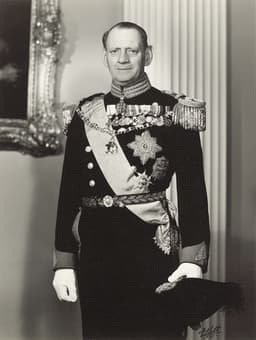
Frederick IX of Denmark
Emperor · Modern
51.7Total

Rudolf Duala Manga Bell
Emperor · Modern
42.3Total
Basic Information
Born
1899
1873
Died
1972
1914
Era
Modern
Modern
Nationality
Denmark
Cameroon
Occupation
Emperor
Emperor
Civilization
Western
Other
Score Comparison
Military (10%)
11.4
20.0
Political (20%)
60.0
32.2
Influence (20%)
51.8
52.5
Legacy (20%)
42.5
42.5
Leadership (15%)
79.8
41.5
Strategy (15%)
60.0
54.8
TOTAL
51.7
42.3
Frederick IX of Denmark — Complete Timeline
1947 AD
Accession to the ThronePolitical Action◆ Major
Frederick IX became King of Denmark upon the death of his father, King Christian X. His reign began during post-World War II reconstruction. He was known for his informal style and love of sailing, which helped modernize the Danish monarchy's public image.
AccessionMonarchyDenmark
Impact: nationalconstructive
1950 AD
Danish Economic ModernizationReform
During Frederick IX's reign, Denmark underwent significant economic modernization, transitioning from agriculture to an industrial and welfare state. The king supported social reforms and infrastructure projects, though his role was largely ceremonial. This period saw rising living standards and urbanization.
Economic ReformModernizationWelfare State
Impact: nationalconstructive
1953 AD
Signing of the Danish Constitution of 1953Reform◆ Major
Frederick IX signed the new Danish constitution, which abolished the Landsting (upper house) and established a unicameral parliament (Folketing). The constitution also allowed for female succession to the throne, paving the way for his daughter Margrethe II to become queen.
ConstitutionReformSuccession
Impact: nationalprogressive
Rudolf Duala Manga Bell — Complete Timeline
1912 AD
Petition Against German Land ExpropriationPolitical Action◆ Major
Rudolf Duala Manga Bell led a delegation of Duala chiefs to petition the German colonial government against the expropriation of Duala lands for European plantations. The petition was rejected, escalating tensions between the Duala and German authorities.
Land RightsColonial ResistanceDuala
Impact: regional
1914 AD
Execution by German AuthoritiesPolitical Action◆ Major
German colonial authorities arrested Rudolf Duala Manga Bell on charges of high treason for allegedly conspiring with the British during World War I. He was executed by hanging in Douala, becoming a symbol of anti-colonial resistance in Cameroon.
ExecutionAnti-Colonial ResistanceWorld War I
Impact: regionaltragic
This comparison has not been analyzed yet.
One-time AI generation (~1 minute). Scores and timeline are already available below.
Rankings
🥇
Frederick IX of DenmarkLeader
Mil: 11.4Pol: 60.0Inf: 51.8
51.7
🥈
Rudolf Duala Manga Bell
Mil: 20.0Pol: 32.2Inf: 52.5
42.3
+9.4 behind
How This Comparison Works
Algorithm
Each figure is scored on 6 dimensions (0—100 scale) based on structured historical data: Military (10%), Political (20%), Influence (20%), Legacy (20%), Leadership (15%), Strategy (15%). The weighted total produces the final ranking.
Data Sources
Scores are computed from structured sub-indicators in the database. Scale factors adjust for era (Ancient ×0.85, Modern ×1.0) and civilization size (Eastern ×1.05, Other ×0.80) to account for differences in population and military scale.
Maximum 3 Figures
Comparisons are limited to 2—3 figures to ensure readability and statistical meaningfulness.
Error Margins
±5 points per dimension — Sub-scores are derived from historical records with inherent uncertainty. Two figures within 5 points on a dimension should be considered roughly equivalent in that area.
Total Score Accuracy
±3 points overall — The weighted combination of 6 dimensions produces a total score with approximately ±3 points of uncertainty. Differences of less than 3 points are not statistically significant— the figures are effectively tied.
Known Limitations
- Historical records are incomplete and uneven across civilizations
- Figures from oral-tradition societies may be underrepresented
- Occupation labels can misclassify multi-role figures
- Scores measure capability and impact, not moral character
- Quantitative scoring is a comparison tool, not absolute truth
Capability Radar
Military (10%) — Battles & Warfare
Battles
39
5
Win Rate
40
5
Expansion
42
5
Political (20%) — Governance & Reform
Reform
65
15
Diplomacy
55
25
Economy
60
10
Influence (20%) — Cultural & Global Reach
Cultural
30
30
Global
20
25
Legacy (20%) — Historical Impact
Historical
35
35
Longevity
30
30
Leadership (15%) — Power & Stability
Tenure
60
20
Stability
70
10
Strategy (15%) — Tactics & Innovation
Strategy
47
10
Tactics
49
10
Reform
54
5
Similar Comparisons
Comments & Discussion
No comments yet. Be the first to share your thoughts!