Loading...
Frederick IX of Denmark vs King Faisal I of Iraq
King Faisal I of Iraq leads by 0.6 pts · 2 figures compared
…
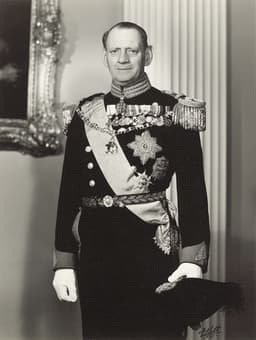
Frederick IX of Denmark
Emperor · Modern
51.7Total

King Faisal I of Iraq
Emperor · Modern
52.3Total
Basic Information
Born
1899
1885
Died
1972
1933
Era
Modern
Modern
Nationality
Denmark
Iraq
Occupation
Emperor
Emperor
Civilization
Western
Middle Eastern
Score Comparison
Military (10%)
11.4
30.0
Political (20%)
60.0
45.0
Influence (20%)
51.8
55.0
Legacy (20%)
42.5
50.0
Leadership (15%)
79.8
74.0
Strategy (15%)
60.0
51.7
TOTAL
51.7
52.3
Frederick IX of Denmark — Complete Timeline
1947 AD
Accession to the ThronePolitical Action◆ Major
Frederick IX became King of Denmark upon the death of his father, King Christian X. His reign began during post-World War II reconstruction. He was known for his informal style and love of sailing, which helped modernize the Danish monarchy's public image.
AccessionMonarchyDenmark
Impact: nationalconstructive
1950 AD
Danish Economic ModernizationReform
During Frederick IX's reign, Denmark underwent significant economic modernization, transitioning from agriculture to an industrial and welfare state. The king supported social reforms and infrastructure projects, though his role was largely ceremonial. This period saw rising living standards and urbanization.
Economic ReformModernizationWelfare State
Impact: nationalconstructive
1953 AD
Signing of the Danish Constitution of 1953Reform◆ Major
Frederick IX signed the new Danish constitution, which abolished the Landsting (upper house) and established a unicameral parliament (Folketing). The constitution also allowed for female succession to the throne, paving the way for his daughter Margrethe II to become queen.
ConstitutionReformSuccession
Impact: nationalprogressive
King Faisal I of Iraq — Complete Timeline
1918 AD
Arab Revolt and Capture of Damascus (1918)War◆ Major
Prince Faisal, leading Arab forces alongside British officer T.E. Lawrence, captured Damascus from the Ottoman Empire. This victory was a key moment in the Arab Revolt against Ottoman rule. Faisal established an Arab government in Syria, but his rule was short-lived due to French colonial ambitions.
Arab RevoltWorld War IDamascus
Impact: regionalconstructive
1920 AD
Proclamation as King of Syria and French Expulsion (1920)Political Action◆ Major
Faisal was proclaimed King of Syria by the Syrian National Congress. However, France, which had been granted a mandate over Syria, invaded and defeated his forces at the Battle of Maysalun. Faisal was expelled from Syria, ending his brief reign and leading to French colonial rule.
SyriaFrench MandateBattle of Maysalun
Impact: regionaltragic
1921 AD
Coronation as King of Iraq (1921)Political Action◆ Major
Faisal was crowned King of Iraq under British auspices, following a plebiscite organized by the British authorities. He was chosen as a compromise candidate acceptable to both the British and local Sunni and Shia leaders. His reign aimed to build a modern Iraqi state from three former Ottoman provinces.
CoronationIraqBritish Mandate
Impact: regionalconstructive
1932 AD
Independence of Iraq (1932)Political Action◆ Major
Under Faisal's leadership, Iraq achieved formal independence from the British Mandate and was admitted to the League of Nations. This was a major milestone for the country, though Britain retained significant influence through military bases and oil concessions. Faisal died the following year.
IndependenceLeague of NationsBritish Influence
Impact: regionalconstructive
Expert Analysis
Origins
Frederick IX of Denmark was born on March 11, 1899, into the Oldenburg dynasty, the eldest son of King Christian X and Queen Alexandrine. His upbringing was steeped in naval tradition; he attended the Royal Danish Naval Academy and served as a naval officer, earning the nickname 'the Sailor King.' His early life was marked by the constraints of constitutional monarchy, where his role was largely ceremonial. In contrast, King Faisal I of Iraq was born on May 20, 1885, in Taif (now Saudi Arabia), as the third son of Hussein bin Ali, Sharif of Mecca. He grew up in the Ottoman Empire, educated in Istanbul and Mecca, steeped in Arab nationalism and the desire for independence from Ottoman rule. His formative years were shaped by the Arab Revolt (1916-1918), where he emerged as a military leader.
Rise to Power
Frederick IX ascended the Danish throne on April 20, 1947, upon his father's death. His rise was straightforward, as heir apparent in a stable constitutional monarchy. His key turning point was signing the Danish Constitution of 1953, which abolished the upper house and allowed female succession. This reform cemented his role as a modern constitutional monarch. Faisal's rise was far more tumultuous. In 1918, he led Arab forces with T.E. Lawrence to capture Damascus from the Ottomans, a pivotal moment in the Arab Revolt. He was proclaimed King of Syria in March 1920 by the Syrian National Congress, but France expelled him in July 1920 after the Battle of Maysalun. Undeterred, the British offered him the throne of Iraq, and after a plebiscite in 1921, he was crowned King Faisal I of Iraq on August 23, 1921. His rise was a product of war, diplomacy, and colonial maneuvering.
Leadership & Governance
Frederick IX's leadership style was informal and approachable; he shed royal protocol to connect with citizens, often seen cycling or sailing. His governance was limited by Denmark's parliamentary system, but he used his influence to support the 1953 constitutional reform, scoring 79.8 in leadership. He focused on modernization, overseeing Denmark's transition from an agricultural to an industrial welfare state. Faisal I, scoring 74.0 in leadership, faced a more challenging environment. As king of a newly created state with diverse ethnic and religious groups (Sunni, Shia, Kurds), he promoted a unified Iraqi identity through education and infrastructure. He navigated British influence, securing Iraq's independence in 1932 and admission to the League of Nations. His political score of 45.0 reflects the constraints of a fragile state, while Frederick's 60.0 represents stability.
Triumph & Tragedy
Frederick IX's greatest success was the 1953 constitution, which modernized Danish governance and ensured gender equality in succession. His reign saw economic growth and the expansion of the welfare state. His military score of 11.4 reflects his lack of martial achievement. His tragedy was the limited power of monarchy in a constitutional system; he could not prevent the decline of royal influence. Faisal's triumph was the independence of Iraq in 1932, a milestone for Arab nationalism. He also survived an early assassination attempt in 1921. His tragedy was the instability of his kingdom; he struggled to integrate Kurds and Shia, and his death in 1933 from a heart attack left Iraq vulnerable to future coups. His military score of 30.0 reflects his role in the Arab Revolt, but he was not a great strategist (51.7).
Character & Destiny
Frederick IX was known for his down-to-earth personality, love of jazz, and tattoos from his naval days. His character suited a constitutional monarch: non-confrontational and symbolic. His destiny was to preside over a peaceful, prosperous Denmark. Faisal was a pragmatic nationalist, skilled in diplomacy but forced to compromise with colonial powers. His character was shaped by the betrayal of Arab aspirations after WWI, and his destiny was to rule a fragile state that would later descend into chaos. Historical assessments often note Faisal's vision for a unified Iraq, but his early death prevented its realization.
Legacy
Frederick IX's legacy is a modernized Danish monarchy and the 1953 constitution, which still governs Denmark. He is remembered as a beloved 'people's king.' His legacy score of 42.5 reflects the limited impact of constitutional monarchs. Faisal's legacy is more significant: he founded the Kingdom of Iraq and set the stage for Arab nationalism. However, the monarchy was overthrown in 1958, and Iraq's subsequent instability often overshadows his achievements. His legacy score of 50.0 is higher, reflecting his foundational role. The score gap of 0.6 points overall favors Faisal (52.3 vs 51.7), but this is narrow.
Conclusion
King Faisal I of Iraq had greater impact, despite a similar total score. Frederick IX's influence was confined to Denmark's constitutional evolution, while Faisal shaped the modern Middle East. Faisal's political score of 45.0 is lower than Frederick's 60.0, but his legacy score of 50.0 surpasses Frederick's 42.5. Faisal's role in the Arab Revolt and Iraq's independence had regional and global consequences, whereas Frederick's reign was peaceful but less transformative. Faisal's leadership (74.0) and influence (55.0) slightly edge Frederick's (79.8 and 51.8), but the context of state-building in a volatile region gives Faisal more weight. Thus, Faisal I emerges as the more historically significant figure.
Rankings
🥇
King Faisal I of IraqLeader
Mil: 30.0Pol: 45.0Inf: 55.0
52.3
🥈
Frederick IX of Denmark
Mil: 11.4Pol: 60.0Inf: 51.8
51.7
+0.6 behind
How This Comparison Works
Algorithm
Each figure is scored on 6 dimensions (0—100 scale) based on structured historical data: Military (10%), Political (20%), Influence (20%), Legacy (20%), Leadership (15%), Strategy (15%). The weighted total produces the final ranking.
Data Sources
Scores are computed from structured sub-indicators in the database. Scale factors adjust for era (Ancient ×0.85, Modern ×1.0) and civilization size (Eastern ×1.05, Other ×0.80) to account for differences in population and military scale.
Maximum 3 Figures
Comparisons are limited to 2—3 figures to ensure readability and statistical meaningfulness.
Error Margins
±5 points per dimension — Sub-scores are derived from historical records with inherent uncertainty. Two figures within 5 points on a dimension should be considered roughly equivalent in that area.
Total Score Accuracy
±3 points overall — The weighted combination of 6 dimensions produces a total score with approximately ±3 points of uncertainty. Differences of less than 3 points are not statistically significant— the figures are effectively tied.
Known Limitations
- Historical records are incomplete and uneven across civilizations
- Figures from oral-tradition societies may be underrepresented
- Occupation labels can misclassify multi-role figures
- Scores measure capability and impact, not moral character
- Quantitative scoring is a comparison tool, not absolute truth
Capability Radar
Military (10%) — Battles & Warfare
Battles
39
45
Win Rate
40
50
Expansion
42
35
Political (20%) — Governance & Reform
Reform
65
55
Diplomacy
55
70
Economy
60
40
Influence (20%) — Cultural & Global Reach
Cultural
30
50
Global
20
55
Legacy (20%) — Historical Impact
Historical
35
60
Longevity
30
45
Leadership (15%) — Power & Stability
Tenure
60
60
Stability
70
30
Strategy (15%) — Tactics & Innovation
Strategy
47
55
Tactics
49
40
Reform
54
30
Similar Comparisons
Comments & Discussion
No comments yet. Be the first to share your thoughts!