Loading...
Frederick IX of Denmark vs Julius Caesar
Julius Caesar leads by 31.1 pts · 2 figures compared
…
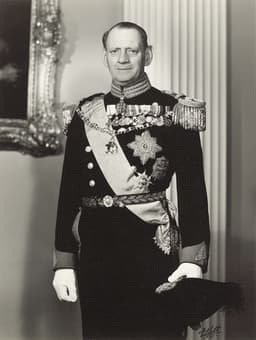
Frederick IX of Denmark
Emperor · Modern
51.7Total

Julius Caesar
General · Ancient
82.8Total
Basic Information
Born
1899
-100
Died
1972
-44
Era
Modern
Ancient
Nationality
Denmark
Roman Republic
Occupation
Emperor
General
Civilization
Western
Western
Score Comparison
Military (10%)
11.4
88.0
Political (20%)
60.0
78.0
Influence (20%)
51.8
85.0
Legacy (20%)
42.5
82.0
Leadership (15%)
79.8
80.0
Strategy (15%)
60.0
85.0
TOTAL
51.7
82.8
Frederick IX of Denmark — Complete Timeline
1947 AD
Accession to the ThronePolitical Action◆ Major
Frederick IX became King of Denmark upon the death of his father, King Christian X. His reign began during post-World War II reconstruction. He was known for his informal style and love of sailing, which helped modernize the Danish monarchy's public image.
AccessionMonarchyDenmark
Impact: nationalconstructive
1950 AD
Danish Economic ModernizationReform
During Frederick IX's reign, Denmark underwent significant economic modernization, transitioning from agriculture to an industrial and welfare state. The king supported social reforms and infrastructure projects, though his role was largely ceremonial. This period saw rising living standards and urbanization.
Economic ReformModernizationWelfare State
Impact: nationalconstructive
1953 AD
Signing of the Danish Constitution of 1953Reform◆ Major
Frederick IX signed the new Danish constitution, which abolished the Landsting (upper house) and established a unicameral parliament (Folketing). The constitution also allowed for female succession to the throne, paving the way for his daughter Margrethe II to become queen.
ConstitutionReformSuccession
Impact: nationalprogressive
Julius Caesar — Complete Timeline
58 BC
Gallic WarsWar◆ Major
Caesar, as proconsul of Gaul, launched a series of campaigns that conquered all of Gaul (modern France, Belgium, and parts of Switzerland). He fought numerous battles, including against the Helvetii, the Belgae, and the Gallic chieftain Vercingetorix. The wars brought immense wealth and a loyal army to Caesar.
Gallic WarsConquestRoman Expansion
Impact: regional
49 BC
Crossing the RubiconPolitical Action◆ Major
Caesar led Legio XIII across the Rubicon River into Italy, defying the Roman Senate's order to disband his army. This act triggered a civil war against Pompey and the Optimates, ultimately leading to Caesar's dictatorship and the end of the Roman Republic.
Roman Civil WarEnd of RepublicPower Struggle
Impact: global
48 BC
Battle of PharsalusWar◆ Major
Caesar's outnumbered army defeated the larger forces of Pompey the Great at Pharsalus in Greece. Caesar's tactical use of a reserve line to counter Pompey's cavalry charge proved decisive. Pompey fled to Egypt, where he was assassinated, leaving Caesar as the undisputed master of the Roman world.
Roman Civil WarBattleDecisive Victory
Impact: regional
44 BC
Appointment as Dictator for LifePolitical Action◆ Major
The Roman Senate appointed Caesar dictator perpetuo (dictator for life), granting him unprecedented personal power. This move concentrated military, legislative, and judicial authority in one person, effectively ending the Roman Republic's traditional system of checks and balances and alarming many senators.
DictatorshipEnd of RepublicPower Consolidation
Impact: regionaldestructive
Assassination on the Ides of MarchPolitical Action◆ Major
A group of Roman senators, led by Marcus Junius Brutus and Gaius Cassius Longinus, stabbed Caesar to death at a meeting of the Senate in the Theatre of Pompey. The assassination was intended to restore the Republic, but instead triggered another civil war that led to the rise of the Roman Empire.
AssassinationRoman PoliticsEnd of Republic
Impact: globaldestructive
Expert Analysis
frederick-ix-of-denmark-vs-julius-caesar
# The General and the Sailor King
On a crisp March morning in 44 BCE, Julius Caesar fell beneath the daggers of his closest allies, his blood pooling on the floor of the Roman Senate. The man who had conquered Gaul, crossed the Rubicon, and remade the Roman world died in a chaos of his own making. Just over two thousand years later, in January 1972, Frederick IX of Denmark passed away quietly in Copenhagen, surrounded by his family, a king who had steered his nation through the quiet revolutions of the modern age. One life ended in violent upheaval; the other in peaceful transition. What separates these two fates is not merely time, but the very nature of power itself—and the limits of ambition.
Origins
Julius Caesar was born into the chaos of a dying republic. Rome in 100 BCE was a city of ruthless ambition, where noble families clawed for influence amid civil wars, slave revolts, and the constant threat of foreign invasion. Caesar’s patrician lineage was ancient but impoverished, and his early years were marked by a desperate need to restore his family’s honor. He was educated in rhetoric and philosophy, but his true classroom was the Forum, where he watched men rise and fall on the strength of their alliances and armies.
Frederick IX of Denmark entered a world already tamed by law and tradition. Born in 1899 at the dawn of a new century, he was the eldest son of King Christian X, a monarch whose power had already been circumscribed by Denmark’s 1849 constitution. The young prince grew up in a comfortable palace, trained for a role that required dignity rather than daring. He was a sailor at heart, spending his youth aboard naval vessels, earning tattoos and a nickname—the “tattooed sailor king”—that would define his down-to-earth charm. His era was one of social democracy, not senatorial conspiracy.
Rise to Power
Caesar’s ascent was a masterpiece of calculated risk. He served as a military tribune, then quaestor in Spain, where he reportedly wept before a statue of Alexander the Great, lamenting that he had achieved so little by an age when Alexander had conquered the world. He formed the First Triumvirate with Pompey and Crassus in 60 BCE, a political alliance that vaulted him to the consulship. But his true breakthrough came with the governorship of Gaul. From 58 to 50 BCE, Caesar waged a brutal war of conquest, subduing hundreds of tribes, crossing the Rhine into Germany, and even landing in Britain. His *Commentaries* made him a legend, and his army made him a power unto himself.
Frederick IX’s path was far quieter. He became king in 1947, upon the death of his father, Christian X, who had been a symbol of national unity during the Nazi occupation. Frederick inherited a throne already stripped of real authority. His accession was a ceremonial affair, marked by speeches and processions, not civil war. He had no need to conquer—his kingdom was already secure within the borders of a peaceful, neutral state.
Leadership & Governance
As dictator, Caesar governed with breathtaking speed and ambition. He reformed the calendar, granting the world the Julian system that would last for sixteen centuries. He extended Roman citizenship to provinces, initiated massive public works, and centralized tax collection. Yet his rule was also autocratic: he packed the Senate with his supporters, minted coins with his own image, and accepted the title “dictator for life.” His military genius was undeniable—his siege of Alesia in 52 BCE remains a textbook example of strategic encirclement—but his political wisdom was undermined by a refusal to share power.
Frederick IX governed as a constitutional figurehead. The 1953 Danish Constitution, which he signed into law, abolished the upper house and established a unicameral parliament, cementing Denmark’s transition to a modern democracy. He did not command armies or dictate policy; instead, he presided over state banquets, toured factories, and shook hands with workers. His “military” score of 45 reflects a king who never led troops in battle—but his political score of 71.5 captures a ruler who understood that the true art of leadership in a democracy is knowing when to step back.
Triumph & Tragedy
Caesar’s greatest triumph was the conquest of Gaul, which brought immense wealth and prestige to Rome—and to himself. His greatest tragedy was his own success. By centralizing power so completely, he made enemies of every senator who valued the old Republic. The Ides of March was not a spontaneous rebellion; it was the logical outcome of a system bent to its breaking point.
Frederick IX’s triumph was subtler. He presided over Denmark’s post-war economic modernization, a transformation that saw the nation shift from agriculture to industry and welfare. His tragedy was personal: he was a sailor who loved the sea, yet spent most of his reign on land, bound by protocol. He could not escape the gilded cage of monarchy, but he wore it with grace.
Character & Destiny
Caesar was driven by an insatiable hunger for glory. He was brilliant, charming, and ruthless—a man who could weep for Alexander while slaughtering Gauls. His personality shaped his decisions: he pardoned his enemies (like Brutus) because he believed his magnanimity would win loyalty, but it only bought time for conspiracy. He believed in his own destiny, and that belief destroyed him.
Frederick IX was shaped by duty, not destiny. He was a modest man in an age that no longer tolerated imperial pretensions. His tattoos and sailor’s slang made him beloved, but they also reflected a king who understood that his role was symbolic, not sovereign. He did not seek to change the world; he sought to represent it.
Legacy
Caesar’s legacy is monumental. His name became synonymous with imperial rule—*Kaiser* and *Tsar* both derive from it. His reforms laid the groundwork for the Roman Empire, and his writings shaped Western military thought. Yet his assassination also became a warning: absolute power corrupts absolutely, and its possessors rarely die in bed.
Frederick IX’s legacy is quieter but no less significant. He helped guide Denmark through its transition to a modern constitutional monarchy, a model that has proven remarkably stable. He is remembered not for conquest, but for character—a king who dressed as a sailor, spoke to his people as equals, and left a throne that his successors still occupy with dignity.
Conclusion
What separates the general from the king is not talent or ambition—Caesar had both in abundance, while Frederick had neither in excess. It is the nature of the world they inherited. Caesar lived in an age when power was seized by the sword; Frederick lived in one where power was yielded by the constitution. One man tried to bend history to his will and was broken by it; the other accepted history’s current and was carried gently to his rest. Their stories remind us that greatness is not merely a matter of what a person does, but of when and where they are born. The Ides of March and the quiet Copenhagen morning are two sides of the same coin—the eternal tension between ambition and acceptance, between the man who would be god and the man who was content to be king.
Rankings
🥇
Julius CaesarLeader
Mil: 88.0Pol: 78.0Inf: 85.0
82.8
🥈
Frederick IX of Denmark
Mil: 11.4Pol: 60.0Inf: 51.8
51.7
+31.1 behind
How This Comparison Works
Algorithm
Each figure is scored on 6 dimensions (0—100 scale) based on structured historical data: Military (10%), Political (20%), Influence (20%), Legacy (20%), Leadership (15%), Strategy (15%). The weighted total produces the final ranking.
Data Sources
Scores are computed from structured sub-indicators in the database. Scale factors adjust for era (Ancient ×0.85, Modern ×1.0) and civilization size (Eastern ×1.05, Other ×0.80) to account for differences in population and military scale.
Maximum 3 Figures
Comparisons are limited to 2—3 figures to ensure readability and statistical meaningfulness.
Error Margins
±5 points per dimension — Sub-scores are derived from historical records with inherent uncertainty. Two figures within 5 points on a dimension should be considered roughly equivalent in that area.
Total Score Accuracy
±3 points overall — The weighted combination of 6 dimensions produces a total score with approximately ±3 points of uncertainty. Differences of less than 3 points are not statistically significant— the figures are effectively tied.
Known Limitations
- Historical records are incomplete and uneven across civilizations
- Figures from oral-tradition societies may be underrepresented
- Occupation labels can misclassify multi-role figures
- Scores measure capability and impact, not moral character
- Quantitative scoring is a comparison tool, not absolute truth
Capability Radar
Military (10%) — Battles & Warfare
Battles
39
95
Win Rate
40
92
Expansion
42
97
Political (20%) — Governance & Reform
Reform
65
90
Diplomacy
55
85
Economy
60
82
Influence (20%) — Cultural & Global Reach
Cultural
30
88
Global
20
94
Legacy (20%) — Historical Impact
Historical
35
95
Longevity
30
96
Leadership (15%) — Power & Stability
Tenure
60
75
Stability
70
60
Strategy (15%) — Tactics & Innovation
Strategy
47
94
Tactics
49
96
Reform
54
88
Similar Comparisons
Comments & Discussion
CaesarConquersAll6/17/2026
Comparing Frederick IX to Caesar is like comparing a rowboat to a trireme. Caesar conquered Gaul, defeated Pompey, and restructured the entire Roman state in under two decades. Frederick's "greatest achievement" was signing papers while the Social Democrats ran Denmark. One forged an empire through sheer will and military genius, the other inherited a job with more ceremonial duties than my local Rotary Club president.|
数据怀疑者Dash6/17/2026
这对比就是数据钓鱼。公元前44年罗马死亡率和1972年丹麦死亡率差了至少两个数量级——婴儿死亡率从300‰降到15‰。历史环境根本不在同一维度。说Frederick IX“和平转型”就等于说你家金鱼成功游过了浴缸——技术上没错,但有什么意义呢?控制变量才是对比的底线。|
RostraRhetor6/17/2026
The crucial difference the analysis misses is agency. Caesar wasn't assassinated because he was ambitious—he was assassinated because he refused to become a constitutional monarch. He had absolute power and chose to wield it openly. Frederick inherited a crown already wrapped in parliamentary velvet. One built the bridge between republic and empire; the other was a well-liked hologram of kingship. Caesar's death precipitated a civil war that birthed the Roman Empire. Frederick's death prompted a
哥本哈根批评家6/17/2026
把Frederick IX说成“和平转交权力”简直是对丹麦1814年损失挪威和1864年失去石勒苏益格-荷尔斯泰因历史遗产的侮辱。Frederick的父亲Christian X在1920年复活节危机中还试图动用王室特权,差点让君主制崩塌。Frederick真正做的不过是把祖父用血换来的影响力彻底归档成茶话会角色。他不是伟大国王,而是在制度面前体面退场的最后一位。|
LegionaryLogos6/17/2026
Let's not pretend these lives are comparable by endpoint. Caesar's assassination was the logical conclusion of a man who personally led legions across the Rhine and built a dictatorship that lasted 500 years. Frederick's death was the graceful exit of a man who signed the 1953 constitution effectively neutering his own office. One died because he had too much power; the other died because he never had any real power to begin with. The analysis should celebrate Caesar's ambition, not sanitize Fre