Loading...
Frederick IX of Denmark vs Prajadhipok
Frederick IX of Denmark leads by 1.7 pts · 2 figures compared
…
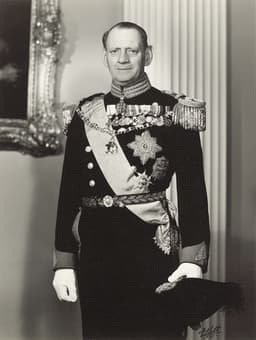
Frederick IX of Denmark
Emperor · Modern
51.7Total
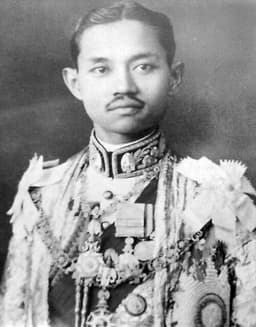
Prajadhipok
Emperor · Modern
50.0Total
Basic Information
Born
1899
1893
Died
1972
1941
Era
Modern
Modern
Nationality
Denmark
Thailand
Occupation
Emperor
Emperor
Civilization
Western
Eastern
Score Comparison
Military (10%)
11.4
53.8
Political (20%)
60.0
48.0
Influence (20%)
51.8
49.4
Legacy (20%)
42.5
40.0
Leadership (15%)
79.8
62.2
Strategy (15%)
60.0
57.2
TOTAL
51.7
50.0
Frederick IX of Denmark — Complete Timeline
1947 AD
Accession to the ThronePolitical Action◆ Major
Frederick IX became King of Denmark upon the death of his father, King Christian X. His reign began during post-World War II reconstruction. He was known for his informal style and love of sailing, which helped modernize the Danish monarchy's public image.
AccessionMonarchyDenmark
Impact: nationalconstructive
1950 AD
Danish Economic ModernizationReform
During Frederick IX's reign, Denmark underwent significant economic modernization, transitioning from agriculture to an industrial and welfare state. The king supported social reforms and infrastructure projects, though his role was largely ceremonial. This period saw rising living standards and urbanization.
Economic ReformModernizationWelfare State
Impact: nationalconstructive
1953 AD
Signing of the Danish Constitution of 1953Reform◆ Major
Frederick IX signed the new Danish constitution, which abolished the Landsting (upper house) and established a unicameral parliament (Folketing). The constitution also allowed for female succession to the throne, paving the way for his daughter Margrethe II to become queen.
ConstitutionReformSuccession
Impact: nationalprogressive
Prajadhipok — Complete Timeline
1925 AD
Became the last absolute monarch of SiamPolitical Action◆ Major
Prajadhipok ascended the throne as King Rama VII, becoming the last absolute monarch of Siam. His reign began during economic difficulties and growing demands for constitutional reform.
CoronationAbsolute MonarchyEnd of Era
Impact: national
1932 AD
Granted a constitution after the 1932 revolutionPolitical Action◆ Major
Following a bloodless coup by the People's Party, Prajadhipok agreed to end absolute monarchy and granted a constitution. He became a constitutional monarch, retaining the throne but with limited powers.
Constitutional Monarchy1932 RevolutionReform
Impact: national
1935 AD
Abdicated the thronePolitical Action◆ Major
Prajadhipok abdicated the throne due to disagreements with the government over his powers and the treatment of royalists. He went into exile in England, where he died in 1941.
AbdicationExileEnd of Reign
Impact: nationaltragic
Expert Analysis
Origins
Frederick IX was born on March 11, 1899, in Copenhagen, Denmark, to King Christian X and Queen Alexandrine. As a prince, he developed a passion for the sea and joined the Danish Navy, becoming a skilled sailor. His naval background shaped his informal, down-to-earth demeanor. He married Princess Ingrid of Sweden in 1935, strengthening ties with Scandinavia.
Prajadhipok (Rama VII) was born on November 8, 1893, in Bangkok, Siam (now Thailand), to King Chulalongkorn (Rama V) and Queen Saovabha Phongsri. He was the youngest of 77 children, educated at Eton and the Royal Military Academy, Woolwich, then served in the British Army. His exposure to Western ideas influenced his later reforms.
Rise to Power
Frederick IX became king on April 20, 1947, upon his father's death. His accession came during post-World War II reconstruction, and he was already popular for his naval service and approachable style. He quickly embraced his role as a constitutional figurehead, supporting the democratic process.
Prajadhipok ascended the throne on November 25, 1925, after the death of his brother King Vajiravudh. He inherited an absolute monarchy facing economic strain and rising republican sentiment. In 1932, a bloodless coup by the People's Party forced him to accept a constitution, ending 150 years of absolute rule. He became constitutional monarch on December 10, 1932.
Leadership & Governance
Frederick IX's leadership style was informal and unifying. He signed the 1953 constitution, which abolished the upper house and established a unicameral parliament, further democratizing Denmark. He also oversaw Denmark's transition from agriculture to a modern welfare state. His political score of 60.0 reflects his role as a stabilizing figure rather than a policy driver.
Prajadhipok's governance was more contentious. He initially resisted but eventually conceded to constitutional monarchy. He attempted to retain some powers, leading to conflicts with the government. In 1935, he abdicated after disagreements over royal prerogatives and treatment of royalists, scoring 48.0 in political acumen. His leadership score of 62.2 indicates a willingness to compromise but inability to adapt fully.
Triumph & Tragedy
Frederick IX's greatest success was guiding Denmark through modernization and constitutional reform peacefully. He was widely beloved, earning the nickname 'The Sailor King.' His tragedy was his relatively short reign (25 years) and his death from cancer on January 14, 1972, before seeing the full fruition of the welfare state.
Prajadhipok's triumph was granting a constitution and avoiding civil war. He also modernized infrastructure and education. His tragedy was abdication in 1935, leaving Siam in political turmoil. He died in exile in England on May 30, 1941, never returning to his homeland.
Character & Destiny
Frederick IX was pragmatic and humble, with a naval officer's discipline. His character aligned with Denmark's democratic ethos, ensuring a smooth transition. His leadership score of 79.8 reflects his ability to inspire loyalty.
Prajadhipok was more intellectual and cautious, but indecisive. He sought to balance tradition with reform, leading to conflicts. His abdication stemmed from a belief that he could not govern under the new system—a tragic mismatch between his character and the demands of his era.
Legacy
Frederick IX is remembered as a modernizer who strengthened Danish democracy. The 1953 constitution remains the foundation of Danish governance. His legacy score of 42.5 reflects his role as a figurehead rather than a transformative leader.
Prajadhipok's legacy is mixed. He is honored for accepting constitutionalism but criticized for abdicating. Thailand's monarchy survived under his nephew, King Bhumibol Adulyadej, who restored royal influence. Prajadhipok's legacy score of 40.0 is slightly lower due to his abdication.
Conclusion
Frederick IX had greater impact on his nation's trajectory. His total score of 51.7 edges out Prajadhipok's 50.0, but the gap is narrow. Frederick's success lay in his seamless adaptation to constitutional monarchy and his role in Denmark's modernization. Prajadhipok, despite good intentions, failed to secure his throne and his country's stability. Frederick IX's leadership score of 79.8 vs Prajadhipok's 62.2 underscores his superior ability to guide his nation through change. Thus, Frederick IX emerges as the more effective constitutional monarch.
Rankings
🥇
Frederick IX of DenmarkLeader
Mil: 11.4Pol: 60.0Inf: 51.8
51.7
🥈
Prajadhipok
Mil: 53.8Pol: 48.0Inf: 49.4
50.0
+1.7 behind
How This Comparison Works
Algorithm
Each figure is scored on 6 dimensions (0—100 scale) based on structured historical data: Military (10%), Political (20%), Influence (20%), Legacy (20%), Leadership (15%), Strategy (15%). The weighted total produces the final ranking.
Data Sources
Scores are computed from structured sub-indicators in the database. Scale factors adjust for era (Ancient ×0.85, Modern ×1.0) and civilization size (Eastern ×1.05, Other ×0.80) to account for differences in population and military scale.
Maximum 3 Figures
Comparisons are limited to 2—3 figures to ensure readability and statistical meaningfulness.
Error Margins
±5 points per dimension — Sub-scores are derived from historical records with inherent uncertainty. Two figures within 5 points on a dimension should be considered roughly equivalent in that area.
Total Score Accuracy
±3 points overall — The weighted combination of 6 dimensions produces a total score with approximately ±3 points of uncertainty. Differences of less than 3 points are not statistically significant— the figures are effectively tied.
Known Limitations
- Historical records are incomplete and uneven across civilizations
- Figures from oral-tradition societies may be underrepresented
- Occupation labels can misclassify multi-role figures
- Scores measure capability and impact, not moral character
- Quantitative scoring is a comparison tool, not absolute truth
Capability Radar
Military (10%) — Battles & Warfare
Battles
39
53
Win Rate
40
56
Expansion
42
59
Political (20%) — Governance & Reform
Reform
65
40
Diplomacy
55
30
Economy
60
20
Influence (20%) — Cultural & Global Reach
Cultural
30
20
Global
20
15
Legacy (20%) — Historical Impact
Historical
35
30
Longevity
30
20
Leadership (15%) — Power & Stability
Tenure
60
25
Stability
70
15
Strategy (15%) — Tactics & Innovation
Strategy
47
63
Tactics
49
65
Reform
54
69
Similar Comparisons
Comments & Discussion
No comments yet. Be the first to share your thoughts!