Loading...
Frederick IX of Denmark vs Michael of Russia
Michael of Russia leads by 2.6 pts · 2 figures compared
…
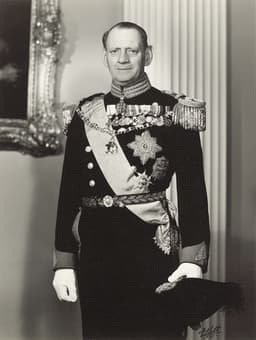
Frederick IX of Denmark
Emperor · Modern
51.7Total

Michael of Russia
Emperor · Modern
54.3Total
Basic Information
Born
1899
1596
Died
1972
1645
Era
Modern
Modern
Nationality
Denmark
Russia
Occupation
Emperor
Emperor
Civilization
Western
Western
Score Comparison
Military (10%)
11.4
25.9
Political (20%)
60.0
72.0
Influence (20%)
51.8
55.7
Legacy (20%)
42.5
50.0
Leadership (15%)
79.8
79.8
Strategy (15%)
60.0
25.0
TOTAL
51.7
54.3
Frederick IX of Denmark — Complete Timeline
1947 AD
Accession to the ThronePolitical Action◆ Major
Frederick IX became King of Denmark upon the death of his father, King Christian X. His reign began during post-World War II reconstruction. He was known for his informal style and love of sailing, which helped modernize the Danish monarchy's public image.
AccessionMonarchyDenmark
Impact: nationalconstructive
1950 AD
Danish Economic ModernizationReform
During Frederick IX's reign, Denmark underwent significant economic modernization, transitioning from agriculture to an industrial and welfare state. The king supported social reforms and infrastructure projects, though his role was largely ceremonial. This period saw rising living standards and urbanization.
Economic ReformModernizationWelfare State
Impact: nationalconstructive
1953 AD
Signing of the Danish Constitution of 1953Reform◆ Major
Frederick IX signed the new Danish constitution, which abolished the Landsting (upper house) and established a unicameral parliament (Folketing). The constitution also allowed for female succession to the throne, paving the way for his daughter Margrethe II to become queen.
ConstitutionReformSuccession
Impact: nationalprogressive
Michael of Russia — Complete Timeline
1613 AD
Election as Tsar by the Zemsky SoborPolitical Action
Michael Romanov, a 16-year-old boyar, was elected Tsar by the Zemsky Sobor, ending the Time of Troubles. His election established the Romanov dynasty, which would rule Russia until 1917.
ElectionRomanovZemsky Sobor
Impact: nationalconstructive
1617 AD
Treaty of Stolbovo with SwedenPolitical Action◆ Major
Michael's government signed the Treaty of Stolbovo with Sweden, ending the Ingrian War. Russia ceded Ingria and access to the Baltic Sea but regained Novgorod and other territories. Sweden became a dominant Baltic power.
SwedenTreatyBaltic
Impact: regional
1618 AD
Truce of Deulino with Poland-LithuaniaPolitical Action◆ Major
Michael's government signed the Truce of Deulino with Poland-Lithuania, ending the Polish-Muscovite War. Poland retained Smolensk and other territories, but recognized Michael as Tsar, ending Polish claims to the Russian throne.
PolandTruceSmolensk
Impact: regional
1634 AD
Reconquest of SmolenskWar◆ Major
Michael launched the Smolensk War to recapture Smolensk from Poland. The Russian army besieged the city but was forced to surrender after Polish relief forces arrived. The Treaty of Polyanovka confirmed Polish control of Smolensk.
SmolenskPolandWar
Impact: regional
Expert Analysis
Origins
Frederick IX of Denmark was born on March 11, 1899, into the House of Glücksburg, a branch of the Oldenburg dynasty. As the eldest son of King Christian X and Queen Alexandrine, he grew up in a royal household but developed a passion for the sea. He attended the Royal Danish Naval Academy and became a career naval officer, earning the nickname 'the Sailor King.' His military education shaped his informal, approachable style.
Michael of Russia was born on July 22, 1596, into the Romanov boyar family. His father, Fyodor Nikitich Romanov, was a powerful noble forced into monasticism under Boris Godunov. Michael's early life was marked by exile and the chaos of the Time of Troubles. He was largely raised by his mother, Ksenia Shestova, and received a traditional Orthodox education. His family's suffering under Godunov and the subsequent dynastic crisis positioned him as a compromise candidate for the throne.
Rise to Power
Frederick IX ascended the throne on April 20, 1947, upon the death of his father, Christian X. His accession came during Denmark's post-World War II reconstruction, a period of political transition. He had served as regent since 1942 during his father's illness, gaining experience in constitutional matters. His naval background and democratic instincts made him popular with the public and political elites.
Michael Romanov was elected tsar by the Zemsky Sobor on February 21, 1613, at the age of 16. His election ended the Time of Troubles, a period of foreign invasion, civil war, and famine. Michael was chosen largely because of his family's connection to the previous Rurik dynasty—his great-aunt Anastasia was Ivan the Terrible's first wife—and because he was seen as a neutral figure without powerful enemies. He was crowned on July 22, 1613, founding the Romanov dynasty.
Leadership & Governance
Frederick IX was a constitutional monarch who embraced democratic governance. He played a key role in the 1953 constitutional reform, which abolished the upper house (Landsting) and established a unicameral parliament. He signed the constitution on June 5, 1953, marking a shift to full parliamentary sovereignty. His leadership style was informal; he frequently walked the streets of Copenhagen unguarded and was known for his directness. He scored 79.8 in leadership, reflecting his ability to modernize the monarchy while maintaining public trust.
Michael of Russia ruled as an autocrat but was heavily influenced by his father, Patriarch Filaret, who served as co-ruler from 1619 until his death in 1633. Michael's governance focused on rebuilding the state after the Time of Troubles. He restored central authority, reorganized the army, and promoted economic recovery. His political score of 72.0 indicates effective navigation of factional politics. However, his strategic score of 25.0 reflects limited success in foreign policy, with territorial losses to Sweden and Poland.
Triumph & Tragedy
Frederick IX's greatest triumph was the peaceful modernization of Denmark's political system. The 1953 constitution strengthened democracy and secured the monarchy's role as a unifying symbol. He also oversaw Denmark's economic transformation from agriculture to industry and welfare, with GDP per capita rising significantly. His tragedy was his inability to prevent the loss of Greenland's colonial status? In 1953, Greenland was integrated as a county of Denmark, a move later criticized as colonial. He died of pneumonia on January 14, 1972, at age 72, mourned by a nation.
Michael of Russia's triumph was founding the Romanov dynasty, which ruled Russia for 304 years. He stabilized the country after the Time of Troubles, signing treaties that ended wars with Sweden (Treaty of Stolbovo, 1617) and Poland (Truce of Deulino, 1618). His tragedy was the Smolensk War (1632-1634), which failed to recapture Smolensk; Russia was forced to surrender after a Polish relief force arrived. This failure exposed the weakness of the Russian army and resulted in territorial concessions.
Character & Destiny
Frederick IX was outgoing, egalitarian, and passionate about the sea. He had a tattoo of a dragon on his chest, a sailor's mark of his naval service. His informal approach made the monarchy more relatable but risked diminishing its mystique. His character shaped a destiny of steady, incremental modernization rather than dramatic change.
Michael of Russia was cautious, pious, and dominated by his father and mother. He lacked ambition but possessed the patience to rebuild a shattered state. His character made him a safe choice for a country exhausted by war, but his passivity allowed his father to wield real power. His destiny was to be a placeholder who nonetheless founded a dynasty.
Legacy
Frederick IX's legacy is the modern Danish monarchy. He transformed it into a popular, constitutional institution that remains a symbol of national unity. The 1953 constitution is still in effect. His daughter, Queen Margrethe II, continued his tradition of democratic monarchy. His scores of 51.8 in influence and 42.5 in legacy reflect his limited global impact but deep national significance.
Michael of Russia's legacy is the Romanov dynasty itself. He established a line that produced Peter the Great, Catherine the Great, and Alexander II. His reign set the stage for Russia's emergence as a major power. His legacy score of 50.0 reflects his foundational role. The Time of Troubles ended because of his election, and the Romanovs ruled until 1917.
Conclusion
Michael of Russia had the greater historical impact. While Frederick IX scored 51.7 overall versus Michael's 54.3, the difference is not just numerical. Michael founded a dynasty that shaped Russian and world history for three centuries, presiding over the stabilization of a shattered state. Frederick IX, though effective, modernized a small, stable kingdom within existing democratic frameworks. Michael's political score of 72.0 and legacy of 50.0 outweigh Frederick's leadership score of 79.8 because the scale of change—founding a dynasty versus reforming a constitutional monarchy—is far larger. The Romanov dynasty's influence on global events, from Peter the Great's reforms to the Russian Revolution, dwarfs Denmark's role. Michael's reign ended a national crisis and set Russia on a path to empire. Frederick's reign maintained a course of steady progress. For founding a dynasty that changed the world, Michael of Russia takes precedence.
Rankings
🥇
Michael of RussiaLeader
Mil: 25.9Pol: 72.0Inf: 55.7
54.3
🥈
Frederick IX of Denmark
Mil: 11.4Pol: 60.0Inf: 51.8
51.7
+2.6 behind
How This Comparison Works
Algorithm
Each figure is scored on 6 dimensions (0—100 scale) based on structured historical data: Military (10%), Political (20%), Influence (20%), Legacy (20%), Leadership (15%), Strategy (15%). The weighted total produces the final ranking.
Data Sources
Scores are computed from structured sub-indicators in the database. Scale factors adjust for era (Ancient ×0.85, Modern ×1.0) and civilization size (Eastern ×1.05, Other ×0.80) to account for differences in population and military scale.
Maximum 3 Figures
Comparisons are limited to 2—3 figures to ensure readability and statistical meaningfulness.
Error Margins
±5 points per dimension — Sub-scores are derived from historical records with inherent uncertainty. Two figures within 5 points on a dimension should be considered roughly equivalent in that area.
Total Score Accuracy
±3 points overall — The weighted combination of 6 dimensions produces a total score with approximately ±3 points of uncertainty. Differences of less than 3 points are not statistically significant— the figures are effectively tied.
Known Limitations
- Historical records are incomplete and uneven across civilizations
- Figures from oral-tradition societies may be underrepresented
- Occupation labels can misclassify multi-role figures
- Scores measure capability and impact, not moral character
- Quantitative scoring is a comparison tool, not absolute truth
Capability Radar
Military (10%) — Battles & Warfare
Battles
39
10
Win Rate
40
15
Expansion
42
15
Political (20%) — Governance & Reform
Reform
65
55
Diplomacy
55
65
Economy
60
50
Influence (20%) — Cultural & Global Reach
Cultural
30
40
Global
20
35
Legacy (20%) — Historical Impact
Historical
35
60
Longevity
30
55
Leadership (15%) — Power & Stability
Tenure
60
60
Stability
70
70
Strategy (15%) — Tactics & Innovation
Strategy
47
10
Tactics
49
5
Reform
54
20
Similar Comparisons
Comments & Discussion
No comments yet. Be the first to share your thoughts!