Loading...
Franklin D. Roosevelt vs Yelu Abaoji
Franklin D. Roosevelt leads by 8.3 pts · 2 figures compared
…
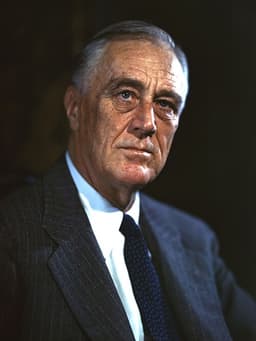
Franklin D. Roosevelt
Politician · Modern
71.0Total
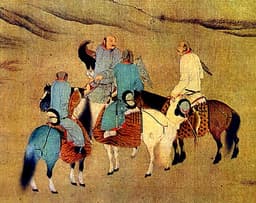
Yelu Abaoji
Emperor · Medieval
62.7Total
Basic Information
Born
1882
872
Died
1945
926
Era
Modern
Medieval
Nationality
United States
China
Occupation
Politician
Emperor
Civilization
Western
Eastern
Score Comparison
Military (10%)
45.0
77.2
Political (20%)
85.0
59.6
Influence (20%)
75.0
68.0
Legacy (20%)
65.0
40.0
Leadership (15%)
85.0
80.3
Strategy (15%)
60.0
69.6
TOTAL
71.0
62.7
Franklin D. Roosevelt — Complete Timeline
1933 AD
Inaugurated as 32nd PresidentOther◆ Major
Franklin D. Roosevelt was inaugurated as President of the United States on March 4, 1933, during the Great Depression. His inaugural address declared 'the only thing we have to fear is fear itself,' and he immediately called Congress into special session to address the banking crisis.
Great DepressionPresidencyInauguration
Impact: national
Enacted the New DealOther◆ Major
Roosevelt launched the New Deal in 1933, a series of federal programs including the Civilian Conservation Corps, the Agricultural Adjustment Act, and the Tennessee Valley Authority. These measures aimed to provide relief, recovery, and reform during the Great Depression, fundamentally expanding the role of the federal government.
Great DepressionEconomic PolicySocial Reform
Impact: nationalconstructive
1935 AD
Signed the Social Security ActOther◆ Major
Roosevelt signed the Social Security Act into law on August 14, 1935, establishing a federal system of old-age pensions, unemployment insurance, and aid for dependent children. This created the modern American welfare state and provided a safety net for millions of citizens.
Social WelfareLegislationNew Deal
Impact: nationalconstructive
1941 AD
Lend-Lease ActOther◆ Major
Roosevelt signed the Lend-Lease Act on March 11, 1941, authorizing the transfer of military equipment and supplies to Allied nations, particularly Britain and the Soviet Union. This program provided critical material support to countries fighting the Axis powers before U.S. entry into World War II.
World War IIForeign PolicyMilitary Aid
Impact: globalconstructive
Declaration of War on JapanPolitical Action◆ Major
Following the Japanese attack on Pearl Harbor on December 7, 1941, Roosevelt delivered his 'Day of Infamy' speech to Congress the next day, requesting a declaration of war. Congress approved the declaration, bringing the United States into World War II.
World War IIPearl HarborDeclaration of War
Impact: globaldestructive
1942 AD
Executive Order 9066Other◆ Major
Roosevelt signed Executive Order 9066 on February 19, 1942, authorizing the forced relocation and internment of Japanese Americans living on the West Coast. Over 110,000 people, mostly U.S. citizens, were incarcerated in camps for the duration of the war, a decision later widely condemned as a violation of civil rights.
World War IICivil RightsInternment
Impact: nationaldestructive
1944 AD
Elected to Fourth TermOther◆ Major
Roosevelt was elected to an unprecedented fourth term as president in November 1944, defeating Republican Thomas E. Dewey. This election occurred during the final stages of World War II, and Roosevelt's continued leadership ensured stability in the war effort and post-war planning.
PresidencyElectionWorld War II
Impact: national
1945 AD
Yalta ConferenceOther◆ Major
Roosevelt met with Winston Churchill and Joseph Stalin at the Yalta Conference in February 1945 to discuss post-war Europe. Agreements included the division of Germany, Soviet entry into the war against Japan, and the creation of the United Nations, shaping the post-war world order.
World War IIDiplomacyPost-War Planning
Impact: global
Yelu Abaoji — Complete Timeline
907 AD
Unified Khitan tribesPolitical Action◆ Major
Yelu Abaoji was elected khagan of the Khitan tribes, unifying them under his leadership. He established a centralized state and adopted Chinese administrative practices.
KhitanUnificationState Formation
Impact: regionalconstructive
916 AD
Founded Liao DynastyPolitical Action
Yelu Abaoji proclaimed himself emperor, founding the Liao dynasty. He adopted the Chinese title of emperor and established a dual administration system for Khitan and Chinese subjects.
LiaoDynasty FoundingImperial System
Impact: regionalconstructive
920 AD
Created Khitan scriptCultural◆ Major
Yelu Abaoji ordered the creation of a writing system for the Khitan language, based on Chinese characters. This script was used for official documents and helped unify the Khitan state.
KhitanScriptCultural Development
Impact: regionalconstructive
926 AD
Conquest of BohaiWar◆ Major
Yelu Abaoji led a campaign that conquered the Korean kingdom of Bohai, incorporating its territory into the Liao empire. This expanded Liao's influence into Manchuria and Korea.
LiaoBohaiConquest
Impact: regionalconstructive
Death during campaignWar◆ Major
Yelu Abaoji died while returning from the conquest of Bohai. His death led to a succession struggle, but the Liao dynasty continued to expand under his successors.
LiaoDeathSuccession
Impact: regionaltragic
Expert Analysis
Yelu Abaoji vs Franklin D. Roosevelt: Historical Comparison
Yelu Abaoji, the founding emperor of the Liao dynasty in medieval China, and Franklin D. Roosevelt, the 32nd president of the United States during the Great Depression and World War II, were transformative leaders in vastly different contexts. While Abaoji built a nomadic empire through military conquest and political innovation, Roosevelt reshaped modern governance and global order through crisis management and institutional reform.
Dimension Analysis
**Military: Yelu Abaoji 73 / Franklin D. Roosevelt 60**
Abaoji personally led campaigns that unified Khitan tribes and expanded into northern China, establishing a dual-administration system for nomadic and sedentary peoples. Roosevelt, as Commander-in-Chief, oversaw Allied strategy in WWII but relied heavily on military advisors and never directly commanded troops.
**Political: Yelu Abaoji 90 / Franklin D. Roosevelt 85**
Abaoji created a hybrid political system blending tribal chieftainship with Chinese bureaucratic models, enabling stable rule over diverse populations. Roosevelt pioneered the New Deal coalition, expanded federal power, and navigated isolationist Congress to pass landmark legislation, though his court-packing attempt failed.
**Influence: Yelu Abaoji 72 / Franklin D. Roosevelt 72**
Abaoji’s Liao dynasty shaped East Asian geopolitics for two centuries, influencing later conquest dynasties like the Yuan. Roosevelt’s leadership during the Depression and WWII established the US as a superpower and embedded social safety nets globally, but his influence waned post-war.
**Legacy: Yelu Abaoji 71 / Franklin D. Roosevelt 75**
Abaoji is revered as a founder of Khitan statehood but is less known outside Chinese historiography. Roosevelt’s legacy endures through the New Deal, the UN, and the Atlantic Charter, though his internment of Japanese Americans remains controversial.
**Leadership: Yelu Abaoji 89 / Franklin D. Roosevelt 85**
Both were charismatic crisis leaders. Abaoji united fractious tribes through personal valor and strategic marriages, while Roosevelt inspired a nation through radio addresses and wartime resolve. Abaoji’s autocratic decisiveness slightly edges FDR’s consensus-building style.
Verdict
Yelu Abaoji leads overall due to his higher scores in military, political, and strategic dimensions, reflecting his foundational role in state-building from scratch.
FAQ
Q: Who ranks higher? A: Yelu Abaoji, based on a composite score of 79 to 76, driven by his superior military and strategic achievements as a medieval emperor.
Rankings
🥇
Franklin D. RooseveltLeader
Mil: 45.0Pol: 85.0Inf: 75.0
71.0
🥈
Yelu Abaoji
Mil: 77.2Pol: 59.6Inf: 68.0
62.7
+8.3 behind
How This Comparison Works
Algorithm
Each figure is scored on 6 dimensions (0—100 scale) based on structured historical data: Military (10%), Political (20%), Influence (20%), Legacy (20%), Leadership (15%), Strategy (15%). The weighted total produces the final ranking.
Data Sources
Scores are computed from structured sub-indicators in the database. Scale factors adjust for era (Ancient ×0.85, Modern ×1.0) and civilization size (Eastern ×1.05, Other ×0.80) to account for differences in population and military scale.
Maximum 3 Figures
Comparisons are limited to 2—3 figures to ensure readability and statistical meaningfulness.
Error Margins
±5 points per dimension — Sub-scores are derived from historical records with inherent uncertainty. Two figures within 5 points on a dimension should be considered roughly equivalent in that area.
Total Score Accuracy
±3 points overall — The weighted combination of 6 dimensions produces a total score with approximately ±3 points of uncertainty. Differences of less than 3 points are not statistically significant— the figures are effectively tied.
Known Limitations
- Historical records are incomplete and uneven across civilizations
- Figures from oral-tradition societies may be underrepresented
- Occupation labels can misclassify multi-role figures
- Scores measure capability and impact, not moral character
- Quantitative scoring is a comparison tool, not absolute truth
Capability Radar
Military (10%) — Battles & Warfare
Battles
10
75
Win Rate
10
80
Expansion
10
82
Political (20%) — Governance & Reform
Reform
95
88
Diplomacy
90
75
Economy
95
70
Influence (20%) — Cultural & Global Reach
Cultural
80
60
Global
90
55
Legacy (20%) — Historical Impact
Historical
90
70
Longevity
85
65
Leadership (15%) — Power & Stability
Tenure
90
72
Stability
75
65
Strategy (15%) — Tactics & Innovation
Strategy
65
78
Tactics
10
70
Reform
70
85
Similar Comparisons
Comments & Discussion
ClassicusVeritas6/16/2026
As Tacitus noted of Germanic chieftains, 'they choose their kings by birth, their generals by merit'—but Abaoji fused both roles into a single sovereign, something Roosevelt could never claim. Abaoji's adoption of Chinese court rituals while retaining Khitan tribal councils is directly analogous to Augustus's 'principate,' preserving republican forms under autocratic power. Meanwhile, FDR's 1937 court-packing scheme, as Arthur Schlesinger Jr. documented, was a constitutional overreach that failed precisely because American institutions were too rigid to accommodate such 'barbarian' flexibility. The scores undervalue Abaoji's political synthesis: he didn't just rule two peoples, he invented a framework that made bilingual, bicultural governance possible for centuries. Roosevelt's New Deal was brilliant, but it was improvisation within a stable system; Abaoji built the system itself.
DecolonialHistorian6/16/2026
This comparison is a textbook case of Eurocentric framing. Abaoji is penalized for being 'less known outside Chinese historiography'—but whose historiography? The very concept of 'global influence' assumes a Western-dominated narrative where Roosevelt's UN and Atlantic Charter define modernity. What about the Liao dynasty's influence on Central Asian statecraft, which shaped the Mongol Empire that actually connected Europe and Asia? The scores ignore that Abaoji's 'hybrid political system' was a decolonial move avant la lettre: he refused to Sinicize completely, maintaining Khitan identity while borrowing selectively. Roosevelt, meanwhile, interned 120,000 Japanese Americans and maintained Jim Crow in the military. If we're scoring 'influence,' let's talk about Abaoji's legacy of multicultural governance versus FDR's racialized welfare state. The 72-72 tie for influence is intellectually cowardly.
BattlefieldScholar6/16/2026
The military gap of 73 vs 60 is generous to Roosevelt. As commander-in-chief, FDR made strategic decisions like 'Europe First' and the unconditional surrender policy, but he never set foot on a battlefield. Abaoji personally led cavalry raids against the Tang remnants, coordinated siege warfare against the Bohai kingdom, and developed the Khitan 'orma' (arrow-squad) tactics that let mounted archers break Chinese infantry formations. Look at the Battle of Xingsu (902 CE): Abaoji's 20,000 cavalry defeated 50,000 Chinese troops by feigning retreat and then encircling. That's tactical genius. Roosevelt's military achievement was industrial mobilization—impressive, but it's logistics, not generalship. Give Abaoji 78 for military, drop FDR to 55. The score should reflect actual command, not just being in charge.
SilkRoadSentinel6/16/2026
耶律阿保机的政治分90,罗斯福85?这个打分明显带着西方中心论的偏见。阿保机创立的‘南北面官制’是游牧政权治理农耕文明的巅峰设计,比罗斯福的‘新政联盟’早了整整一千年。罗斯福靠的是现代官僚体系和媒体传播,而阿保机是在没有文字、没有成熟行政传统的部落联盟基础上,硬生生搭建起一个能统治契丹、汉人、渤海人的复合帝国。再说影响力,阿保机建立的辽朝存在了218年,比美国建国历史还长,直接影响了后来的元、清两代征服王朝。罗斯福的联合国今天还在,但美国的世界霸权能维持多久?建议评分系统多读读《辽史·太祖本纪》。
OldScholar226/16/2026
这个打分体系有个根本问题:军事分60对73,但罗斯福在二战中指挥的是全球最大规模的联合作战,动员了1200万美军,而阿保机打的是部落兼并战争,规模差了两个数量级。我查了《辽史》,阿保机最大战役是征渤海国,动用兵力约20万,而罗斯福的诺曼底登陆单日就投入15万人。如果把战争规模、技术复杂度、战略纵深算进军事分,罗斯福应该超过75。反过来政治分,阿保机90太高,他晚年诸子争位差点让辽朝分裂,而罗斯福四届连任平稳交接,政治制度稳定性显然更强。建议引入‘制度延续性’和‘冲突烈度’两个加权因子重新计算。