Loading...
Franklin D. Roosevelt vs Wu Zetian
Franklin D. Roosevelt leads by 1.0 pts · 2 figures compared
…
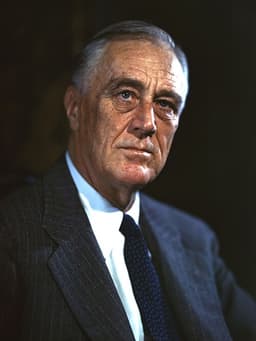
Franklin D. Roosevelt
Politician · Modern
71.0Total

Wu Zetian
Emperor · Medieval
70.0Total
Basic Information
Born
1882
624
Died
1945
705
Era
Modern
Medieval
Nationality
United States
China
Occupation
Politician
Emperor
Civilization
Western
Eastern
Score Comparison
Military (10%)
45.0
60.0
Political (20%)
85.0
62.7
Influence (20%)
75.0
65.0
Legacy (20%)
65.0
80.0
Leadership (15%)
85.0
78.0
Strategy (15%)
60.0
66.3
TOTAL
71.0
70.0
Franklin D. Roosevelt — Complete Timeline
1933 AD
Inaugurated as 32nd PresidentOther◆ Major
Franklin D. Roosevelt was inaugurated as President of the United States on March 4, 1933, during the Great Depression. His inaugural address declared 'the only thing we have to fear is fear itself,' and he immediately called Congress into special session to address the banking crisis.
Great DepressionPresidencyInauguration
Impact: national
Enacted the New DealOther◆ Major
Roosevelt launched the New Deal in 1933, a series of federal programs including the Civilian Conservation Corps, the Agricultural Adjustment Act, and the Tennessee Valley Authority. These measures aimed to provide relief, recovery, and reform during the Great Depression, fundamentally expanding the role of the federal government.
Great DepressionEconomic PolicySocial Reform
Impact: nationalconstructive
1935 AD
Signed the Social Security ActOther◆ Major
Roosevelt signed the Social Security Act into law on August 14, 1935, establishing a federal system of old-age pensions, unemployment insurance, and aid for dependent children. This created the modern American welfare state and provided a safety net for millions of citizens.
Social WelfareLegislationNew Deal
Impact: nationalconstructive
1941 AD
Lend-Lease ActOther◆ Major
Roosevelt signed the Lend-Lease Act on March 11, 1941, authorizing the transfer of military equipment and supplies to Allied nations, particularly Britain and the Soviet Union. This program provided critical material support to countries fighting the Axis powers before U.S. entry into World War II.
World War IIForeign PolicyMilitary Aid
Impact: globalconstructive
Declaration of War on JapanPolitical Action◆ Major
Following the Japanese attack on Pearl Harbor on December 7, 1941, Roosevelt delivered his 'Day of Infamy' speech to Congress the next day, requesting a declaration of war. Congress approved the declaration, bringing the United States into World War II.
World War IIPearl HarborDeclaration of War
Impact: globaldestructive
1942 AD
Executive Order 9066Other◆ Major
Roosevelt signed Executive Order 9066 on February 19, 1942, authorizing the forced relocation and internment of Japanese Americans living on the West Coast. Over 110,000 people, mostly U.S. citizens, were incarcerated in camps for the duration of the war, a decision later widely condemned as a violation of civil rights.
World War IICivil RightsInternment
Impact: nationaldestructive
1944 AD
Elected to Fourth TermOther◆ Major
Roosevelt was elected to an unprecedented fourth term as president in November 1944, defeating Republican Thomas E. Dewey. This election occurred during the final stages of World War II, and Roosevelt's continued leadership ensured stability in the war effort and post-war planning.
PresidencyElectionWorld War II
Impact: national
1945 AD
Yalta ConferenceOther◆ Major
Roosevelt met with Winston Churchill and Joseph Stalin at the Yalta Conference in February 1945 to discuss post-war Europe. Agreements included the division of Germany, Soviet entry into the war against Japan, and the creation of the United Nations, shaping the post-war world order.
World War IIDiplomacyPost-War Planning
Impact: global
Wu Zetian — Complete Timeline
655 AD
Became Empress ConsortPolitical Action◆ Major
Wu Zetian was elevated from concubine to empress consort of Emperor Gaozong of Tang in 655. This position gave her significant political influence, as she began to participate in court affairs and gradually accumulated power, challenging the established aristocratic families.
Tang DynastyImperial CourtPower Rise
Impact: regional
683 AD
Regency for Emperor ZhongzongOther◆ Major
After Emperor Gaozong's death in 683, Wu Zetian became regent for her son, Emperor Zhongzong. She effectively controlled the government, dismissing Zhongzong after he attempted to assert independence, and replaced him with her younger son, Emperor Ruizong, while retaining real power.
Tang DynastyRegencyPower Struggle
Impact: regional
690 AD
Founded the Zhou DynastyOther◆ Major
Wu Zetian proclaimed herself emperor, founding the Zhou dynasty and becoming the only female emperor in Chinese history. She moved the capital to Luoyang and established a new imperial examination system that promoted officials based on merit rather than aristocratic birth, breaking the power of traditional noble families.
Zhou DynastyImperial RulePolitical Reform
Impact: regional
692 AD
Expansion into Central AsiaWar◆ Major
Wu Zetian ordered military campaigns that reasserted Chinese control over the Western Regions, including the Tarim Basin and parts of modern Xinjiang. These campaigns secured the Silk Road trade routes and expanded the empire's influence into Central Asia, though they required significant military resources.
Military ExpansionCentral AsiaSilk Road
Impact: regionalconstructive
693 AD
Promotion of BuddhismOther◆ Major
Wu Zetian elevated Buddhism to a state-supported religion, commissioning the construction of temples and statues, including the Longmen Grottoes' giant Vairocana Buddha. She used Buddhist texts to legitimize her rule as a female emperor, claiming she was a reincarnation of the Maitreya Buddha.
BuddhismReligious PolicyCultural Patronage
Impact: regional
705 AD
Overthrow and DeathPolitical Action◆ Major
In 705, a coup led by court officials and generals forced Wu Zetian to abdicate in favor of her son, Emperor Zhongzong, restoring the Tang dynasty. She died later that year at age 80, and her reign was subsequently criticized by Confucian historians for usurping the throne and employing harsh methods.
Tang DynastyCoupAbdication
Impact: regionaldestructive
Expert Analysis
Wu Zetian vs Franklin D. Roosevelt
# The Throne and the Wheelchair: Wu Zetian and Franklin D. Roosevelt
The year is 690 in the Tang capital of Luoyang. A sixty-six-year-old woman, robed in imperial yellow, ascends a marble platform before a thousand prostrate officials. She declares herself emperor—a word that had never before described a woman in Chinese history. Thirteen centuries later, on a gray March day in 1933, a man in a wheelchair faces a nation of shuttered banks and empty factories. His legs are paralyzed by polio, but his voice, crackling over the radio, tells Americans that the only thing they have to fear is fear itself. Wu Zetian and Franklin D. Roosevelt: one built a dynasty from a concubine’s bedchamber, the other rebuilt a nation from economic collapse. They never met, never knew each other’s worlds, yet their lives pose a question that haunts history: What does it take to rule when everything—gender, disability, tradition—says you cannot?
Origins
Wu Zetian was born in 624, the daughter of a timber merchant who had risen to become a provincial governor. In Tang China, a woman’s path was narrow: marriage, motherhood, silence. Yet the Tang dynasty was unusually cosmopolitan—Buddhist nuns, Persian merchants, Turkish generals all mingled at court. Wu entered the palace at fourteen as a low-ranking concubine to Emperor Taizong. She was sharp, literate, and ruthless. When Taizong died, custom demanded she shave her head and become a nun. Instead, she seduced his son, the new emperor Gaozong, and clawed her way back.
Franklin D. Roosevelt was born in 1882 into a world of Hudson Valley estates, private tutors, and summer homes in Campobello. His fifth cousin Theodore Roosevelt had made the presidency a bully pulpit. Franklin was a privileged patrician, educated at Groton, Harvard, and Columbia Law School—a man who had never known want. But in 1921, at age thirty-nine, polio struck. He lost the use of his legs. His mother urged him to retire to Hyde Park and live as an invalid. He refused.
Two figures, two eras, two kinds of marginalization. Wu faced a system that saw women as property; Roosevelt faced a body that betrayed him. Both learned early that the world would not hand them power—they had to take it.
Rise to Power
Wu’s ascent was a slow, bloody masterpiece. After Gaozong suffered a stroke in 660, she began ruling through him, issuing edicts from behind a screen. She eliminated rivals with surgical precision: Empress Wang and Consort Xiao were mutilated and left to die in a wine vat. She promoted men of humble birth—the future chancellor Di Renjie, a magistrate from a poor family—and crushed the old aristocracy. In 690, after Gaozong’s death and a brief puppet reign by her son, she took the throne herself. She was sixty-six. The Zhou dynasty she founded lasted only fifteen years, but its message was permanent: a woman could rule the Middle Kingdom.
Roosevelt’s rise was gentler, but no less determined. He returned to politics in 1924, nominating Al Smith at the Democratic convention with crutches and a cane. In 1928, he won the governorship of New York. When the Great Depression struck in 1929, he turned the state into a laboratory for relief programs, building a reputation as a man who acted while Herbert Hoover hesitated. By 1932, the nation was desperate. Roosevelt promised a New Deal. He won in a landslide.
The difference is striking: Wu fought through a palace of daggers and eunuchs; Roosevelt fought through a democracy of ballots and microphones. Both understood that power flows to those who appear indispensable.
Leadership & Governance
Wu Zetian governed with a blend of terror and meritocracy. She established a secret police network to root out dissent—officials who criticized her were tortured, exiled, or executed. But she also reformed the civil service examination system, opening it to commoners and reducing the influence of noble families. Under her reign, the empire expanded into Central Asia, and Buddhism flourished as a state religion. She built magnificent temples and sponsored art. Her military record was mixed: campaigns in Korea and Tibet succeeded, but a war against the Turks in 696 ended in defeat. She was not a conqueror; she was a consolidator.
Roosevelt governed with a blend of improvisation and conviction. In his first hundred days, he pushed through fifteen major laws—banking reform, agricultural subsidies, public works. The Social Security Act of 1935 created a safety net that still endures. He took America off the gold standard, devalued the dollar, and experimented with price controls. During World War II, he became commander-in-chief of the largest military mobilization in history, forging alliances with Churchill and Stalin. He made mistakes: the internment of Japanese Americans, the court-packing scheme that damaged his credibility. But his leadership was defined by action. As he said, “It is common sense to take a method and try it. If it fails, admit it frankly and try another.”
Wu ruled through fear and patronage; Roosevelt ruled through hope and persuasion. Wu’s courtiers trembled; Roosevelt’s citizens listened to his fireside chats. Two different tools for two different worlds.
Triumph & Tragedy
Wu’s greatest triumph was her existence as emperor. No other woman in Chinese history achieved what she did. Her tragedy came in old age: she grew paranoid, isolated, dependent on male favorites. In 705, a coup forced her to abdicate in favor of her son. She died later that year, alone in a cold palace.
Roosevelt’s greatest triumph was leading the Allies to the brink of victory in World War II. He saw the war through D-Day, through the liberation of Paris, through the Yalta Conference. His tragedy came on April 12, 1945, in Warm Springs, Georgia. He died of a cerebral hemorrhage, weeks before Germany’s surrender. He never saw the peace he had helped design.
Both ended in loss: Wu lost her throne; Roosevelt lost his life. But both left their nations fundamentally changed.
Character & Destiny
Wu was calculating, vindictive, and brilliant. She had to be. In a world that denied women authority, she wielded cruelty as a weapon and intelligence as a shield. Her personality shaped a reign of constant vigilance. Roosevelt was optimistic, pragmatic, and charming. He had to be. In a world that pitied the disabled, he used his smile and his voice to project strength. His personality shaped a presidency of constant reassurance.
Destiny gave them impossible obstacles. They made those obstacles into foundations.
Legacy
Wu Zetian’s legacy is contested. Confucian historians vilified her as a usurper and a murderer. Modern historians see her as a pioneer. Her tomb, the Qianling Mausoleum, stands near Xi’an with a blank stone tablet—no inscription, as if to say: let history judge. Her scores: Political 80, Leadership 82.5, Legacy 85.
Franklin D. Roosevelt’s legacy is monumental. He is ranked among the three greatest American presidents, alongside Washington and Lincoln. The New Deal reshaped American capitalism. Social Security, the minimum wage, the SEC—these are his monuments. His scores: Political 85, Leadership 85, Legacy 75.
Conclusion
What do these two rulers tell us? That power is not a birthright but a performance. Wu Zetian performed the role of emperor so convincingly that she changed what an emperor could be. Franklin Roosevelt performed the role of president so convincingly that he changed what a president could do. One ruled through terror, the other through trust. One was a woman in a man’s world; the other was a cripple in a world that worshiped strength. Both succeeded beyond measure.
And both remind us that history’s greatest leaders are not those who inherit power, but those who seize it—and then, against all odds, make it look natural.
Rankings
🥇
Franklin D. RooseveltLeader
Mil: 45.0Pol: 85.0Inf: 75.0
71.0
🥈
Wu Zetian
Mil: 60.0Pol: 62.7Inf: 65.0
70.0
+1.0 behind
How This Comparison Works
Algorithm
Each figure is scored on 6 dimensions (0—100 scale) based on structured historical data: Military (10%), Political (20%), Influence (20%), Legacy (20%), Leadership (15%), Strategy (15%). The weighted total produces the final ranking.
Data Sources
Scores are computed from structured sub-indicators in the database. Scale factors adjust for era (Ancient ×0.85, Modern ×1.0) and civilization size (Eastern ×1.05, Other ×0.80) to account for differences in population and military scale.
Maximum 3 Figures
Comparisons are limited to 2—3 figures to ensure readability and statistical meaningfulness.
Error Margins
±5 points per dimension — Sub-scores are derived from historical records with inherent uncertainty. Two figures within 5 points on a dimension should be considered roughly equivalent in that area.
Total Score Accuracy
±3 points overall — The weighted combination of 6 dimensions produces a total score with approximately ±3 points of uncertainty. Differences of less than 3 points are not statistically significant— the figures are effectively tied.
Known Limitations
- Historical records are incomplete and uneven across civilizations
- Figures from oral-tradition societies may be underrepresented
- Occupation labels can misclassify multi-role figures
- Scores measure capability and impact, not moral character
- Quantitative scoring is a comparison tool, not absolute truth
Capability Radar
Military (10%) — Battles & Warfare
Battles
10
65
Win Rate
10
70
Expansion
10
75
Political (20%) — Governance & Reform
Reform
95
85
Diplomacy
90
80
Economy
95
85
Influence (20%) — Cultural & Global Reach
Cultural
80
85
Global
90
70
Legacy (20%) — Historical Impact
Historical
90
90
Longevity
85
85
Leadership (15%) — Power & Stability
Tenure
90
90
Stability
75
75
Strategy (15%) — Tactics & Innovation
Strategy
65
75
Tactics
10
60
Reform
70
80
Similar Comparisons
Comments & Discussion
No comments yet. Be the first to share your thoughts!