Loading...
Franklin D. Roosevelt vs Wanyan Aguda
Franklin D. Roosevelt leads by 7.6 pts · 2 figures compared
…
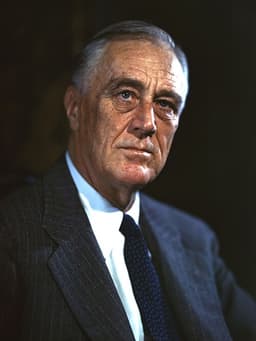
Franklin D. Roosevelt
Politician · Modern
71.0Total
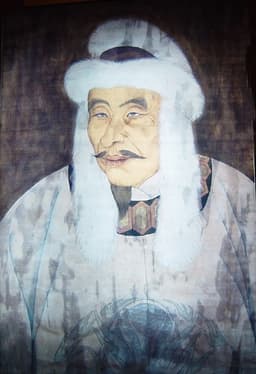
Wanyan Aguda
Emperor · Medieval
63.4Total
Basic Information
Born
1882
1068
Died
1945
1123
Era
Modern
Medieval
Nationality
United States
China
Occupation
Politician
Emperor
Civilization
Western
Eastern
Score Comparison
Military (10%)
45.0
82.0
Political (20%)
85.0
59.3
Influence (20%)
75.0
55.0
Legacy (20%)
65.0
52.0
Leadership (15%)
85.0
85.0
Strategy (15%)
60.0
68.0
TOTAL
71.0
63.4
Franklin D. Roosevelt — Complete Timeline
1933 AD
Inaugurated as 32nd PresidentOther◆ Major
Franklin D. Roosevelt was inaugurated as President of the United States on March 4, 1933, during the Great Depression. His inaugural address declared 'the only thing we have to fear is fear itself,' and he immediately called Congress into special session to address the banking crisis.
Great DepressionPresidencyInauguration
Impact: national
Enacted the New DealOther◆ Major
Roosevelt launched the New Deal in 1933, a series of federal programs including the Civilian Conservation Corps, the Agricultural Adjustment Act, and the Tennessee Valley Authority. These measures aimed to provide relief, recovery, and reform during the Great Depression, fundamentally expanding the role of the federal government.
Great DepressionEconomic PolicySocial Reform
Impact: nationalconstructive
1935 AD
Signed the Social Security ActOther◆ Major
Roosevelt signed the Social Security Act into law on August 14, 1935, establishing a federal system of old-age pensions, unemployment insurance, and aid for dependent children. This created the modern American welfare state and provided a safety net for millions of citizens.
Social WelfareLegislationNew Deal
Impact: nationalconstructive
1941 AD
Lend-Lease ActOther◆ Major
Roosevelt signed the Lend-Lease Act on March 11, 1941, authorizing the transfer of military equipment and supplies to Allied nations, particularly Britain and the Soviet Union. This program provided critical material support to countries fighting the Axis powers before U.S. entry into World War II.
World War IIForeign PolicyMilitary Aid
Impact: globalconstructive
Declaration of War on JapanPolitical Action◆ Major
Following the Japanese attack on Pearl Harbor on December 7, 1941, Roosevelt delivered his 'Day of Infamy' speech to Congress the next day, requesting a declaration of war. Congress approved the declaration, bringing the United States into World War II.
World War IIPearl HarborDeclaration of War
Impact: globaldestructive
1942 AD
Executive Order 9066Other◆ Major
Roosevelt signed Executive Order 9066 on February 19, 1942, authorizing the forced relocation and internment of Japanese Americans living on the West Coast. Over 110,000 people, mostly U.S. citizens, were incarcerated in camps for the duration of the war, a decision later widely condemned as a violation of civil rights.
World War IICivil RightsInternment
Impact: nationaldestructive
1944 AD
Elected to Fourth TermOther◆ Major
Roosevelt was elected to an unprecedented fourth term as president in November 1944, defeating Republican Thomas E. Dewey. This election occurred during the final stages of World War II, and Roosevelt's continued leadership ensured stability in the war effort and post-war planning.
PresidencyElectionWorld War II
Impact: national
1945 AD
Yalta ConferenceOther◆ Major
Roosevelt met with Winston Churchill and Joseph Stalin at the Yalta Conference in February 1945 to discuss post-war Europe. Agreements included the division of Germany, Soviet entry into the war against Japan, and the creation of the United Nations, shaping the post-war world order.
World War IIDiplomacyPost-War Planning
Impact: global
Wanyan Aguda — Complete Timeline
1114 AD
Battle of HubudagangWar◆ Major
Aguda's Jurchen forces defeated a Liao army at Hubudagang, marking the first major victory of the rebellion. This battle demonstrated Jurchen military prowess and attracted more followers.
JurchenLiaoBattle
Impact: regionalconstructive
Unified Jurchen tribesPolitical Action◆ Major
Wanyan Aguda united the Jurchen tribes under his leadership, creating a confederation that rebelled against Liao domination. He organized a disciplined army and began the Jurchen revolt.
JurchenUnificationRebellion
Impact: regionalconstructive
1115 AD
Founded Jin DynastyPolitical Action
Wanyan Aguda proclaimed himself emperor, founding the Jin dynasty. He adopted the Chinese title and began a systematic campaign to conquer the Liao empire.
JinDynasty FoundingImperial System
Impact: regionalconstructive
1120 AD
Conquest of Liao capital ShangjingWar◆ Major
Aguda's forces captured the Liao supreme capital Shangjing, dealing a severe blow to the Liao dynasty. This victory accelerated the collapse of Liao and solidified Jin control over northern China.
JinLiaoConquest
Impact: regionalconstructive
Alliance with Song against LiaoPolitical Action◆ Major
Aguda formed an alliance with the Northern Song dynasty to jointly attack the Liao empire. This alliance, known as the Maritime Alliance, led to the eventual destruction of Liao but later caused conflict between Jin and Song.
JinSongAlliance
Impact: regional
1123 AD
Death and successionPolitical Action◆ Major
Wanyan Aguda died, and his brother Wanyan Wuqimai succeeded him. Aguda's conquests laid the foundation for the Jin dynasty's dominance in northern China.
JinDeathSuccession
Impact: regional
Expert Analysis
Wanyan Aguda vs Franklin D. Roosevelt
# The Emperor and the President: Two Paths to Power in Times of Crisis
In the winter of 1933, as Franklin D. Roosevelt prepared his first inaugural address, the United States lay paralyzed by economic collapse. Banks were shuttered, farmers faced foreclosure, and a quarter of the workforce stood idle. Eight hundred years earlier and half a world away, a Jurchen chieftain named Wanyan Aguda gathered his ragged tribesmen on the frozen plains of Manchuria, preparing to strike at an empire that had dominated them for generations. Both men faced impossible odds. Both would reshape their worlds. But they came from such different civilizations, such different centuries, that comparing them reveals less about who was "greater" and more about how power itself transforms across time and culture.
Origins
Franklin Delano Roosevelt was born into privilege in 1882, the only child of a wealthy Hudson Valley family. His upbringing was one of private tutors, European tours, and the quiet confidence of America's landed gentry. He attended Groton, Harvard, and Columbia Law School—institutions designed to produce leaders. Yet his life was marked by a crucible that no privilege could prevent: in 1921, at age 39, he was struck by polio, losing the use of his legs. The disease stripped him of physical mobility but forged in him a resilience and empathy that would define his presidency.
Wanyan Aguda, born in 1068, knew nothing of such comforts. The Jurchen were a semi-nomadic people living in the forests of what is now northeastern China, subjects of the mighty Liao dynasty. Aguda grew up in a world where survival meant mastering the horse and bow, where tribal loyalties were forged in blood feuds, and where the Liao empire extracted tribute and humiliation from his people. His father and grandfather had led the Jurchen in minor rebellions; Aguda inherited both their grievances and their ambitions.
The differences in their origins are not merely biographical. Roosevelt's America was a modern nation-state with institutions, laws, and a constitution. Aguda's Jurchen were a tribal confederation held together by personal loyalty and the promise of plunder. Roosevelt could rely on bureaucracies; Aguda had to inspire men who could simply walk away.
Rise to Power
Roosevelt's path to power was a masterclass in political navigation. He served as a New York state senator, Assistant Secretary of the Navy, and ran as Vice President in 1920. After polio, he fought his way back into politics, winning the New York governorship in 1928. His rise was gradual, institutional, and dependent on coalition-building within the Democratic Party. When he accepted the presidential nomination in 1932, he promised a "New Deal" for the American people—a phrase deliberately vague enough to unite farmers, laborers, and urban liberals.
Aguda's rise was swifter and bloodier. In 1114, he unified the Jurchen tribes under his leadership, a feat of diplomacy and intimidation that required both oratory and the threat of force. That same year, at the Battle of Hubudagang, he led his outnumbered warriors against a Liao army and won. The victory was not just military; it was psychological. The Jurchen, long considered barbarians, had proven they could defeat their masters. In 1115, Aguda proclaimed himself emperor, founding the Jin dynasty. He adopted Chinese titles and rituals, signaling that he was not merely a tribal chieftain but a ruler in the ancient tradition of Chinese emperors.
The contrast is stark: Roosevelt rose through elections and parties; Aguda rose through war and proclamation. One was a politician; the other a conqueror.
Leadership & Governance
As president, Roosevelt governed through persuasion, radio addresses, and an unprecedented expansion of federal power. His New Deal created Social Security, regulated banks, and put millions to work through public works projects. He was not a military strategist—his Military score of 60 reflects his limited direct involvement in battlefield command—but he was a master of political strategy, with a Political score of 85. He understood that the greatest threat to democracy was despair, and he acted as a "doctor" to the nation's morale.
Aguda, by contrast, was a warrior-emperor. His Military score of 79.3 and Leadership score of 88.4 reflect a man who led from the front. He personally commanded the campaigns that captured the Liao capital of Shangjing in 1120, dealing a blow from which the Liao never recovered. But he was also a political innovator. He formed the Alliance with Song in 1120, a diplomatic masterstroke that isolated the Liao and secured Jin's flank. He adopted Chinese administrative practices, creating a dual system that allowed Jurchen customs to coexist with Chinese bureaucracy. His Political score of 82.2 shows a man who understood that conquest alone was insufficient—empires must be governed.
Triumph & Tragedy
Roosevelt's greatest triumph was leading the United States through the Great Depression and World War II, dying in office in 1945 just weeks before victory in Europe. His greatest tragedy was that he did not live to see the peace. The New Deal also had its failures: the Supreme Court struck down parts of it, and the Depression only truly ended with wartime production.
Aguda's triumph was the destruction of the Liao dynasty and the founding of the Jin, which would rule northern China for a century. His tragedy was his early death in 1123 at age 55, just as his conquests were reaching their peak. He died before he could consolidate his gains, leaving his brother Wuqimai to complete the work. More tragically, the alliance with Song would later collapse into war, and the Jin would eventually be destroyed by the Mongols.
Character & Destiny
Roosevelt's character was shaped by privilege and suffering. He was charming, manipulative, and deeply pragmatic. He once said, "It is common sense to take a method and try it: If it fails, admit it frankly and try another. But above all, try something." This experimentalism allowed him to adapt, but it also meant he made mistakes. His polio gave him a hidden strength; he could not walk, yet he carried the nation.
Aguda's character was forged in battle and clan politics. He was ruthless when necessary—he executed rivals without hesitation—but he also showed magnanimity, incorporating defeated tribes into his confederation. He was a man of action, not reflection. His destiny was to break the chains of his people and build an empire on the ruins of their oppressors.
Legacy
Roosevelt is remembered as one of America's greatest presidents, his face on the dime, his image in the memorial in Washington. His Social Security system remains a cornerstone of American life. His Legacy score of 75 reflects a complicated but enduring reputation.
Aguda is remembered as the founder of the Jin dynasty, a figure of near-mythic status among the Jurchen and later Manchus. His Legacy score of 70.1 is slightly lower, perhaps because his dynasty was eventually eclipsed by the Mongols and later Chinese histories written by his enemies. Yet his impact was profound: the Jin dynasty accelerated the sinicization of northern China and set patterns that would later be followed by the Yuan and Qing.
Conclusion
What drove these two men to such different outcomes? Not talent—both were brilliant. Not opportunity—both faced crises that demanded action. The difference was civilization. Roosevelt governed a nation with a constitution, a free press, and a democratic tradition. Aguda governed a tribal confederation that became an empire through conquest. Roosevelt's power was constrained by law and public opinion; Aguda's power was limited only by his ability to win battles and hold loyalties.
In the end, both men did what their times demanded. Roosevelt saved democracy from depression and fascism. Aguda freed his people from foreign domination and built a state. They are not comparable as "better" or "worse"—they are comparable as mirrors of their worlds. And in that reflection, we see that leadership is never abstract. It is always, irrevocably, a product of its age.
Rankings
🥇
Franklin D. RooseveltLeader
Mil: 45.0Pol: 85.0Inf: 75.0
71.0
🥈
Wanyan Aguda
Mil: 82.0Pol: 59.3Inf: 55.0
63.4
+7.6 behind
How This Comparison Works
Algorithm
Each figure is scored on 6 dimensions (0—100 scale) based on structured historical data: Military (10%), Political (20%), Influence (20%), Legacy (20%), Leadership (15%), Strategy (15%). The weighted total produces the final ranking.
Data Sources
Scores are computed from structured sub-indicators in the database. Scale factors adjust for era (Ancient ×0.85, Modern ×1.0) and civilization size (Eastern ×1.05, Other ×0.80) to account for differences in population and military scale.
Maximum 3 Figures
Comparisons are limited to 2—3 figures to ensure readability and statistical meaningfulness.
Error Margins
±5 points per dimension — Sub-scores are derived from historical records with inherent uncertainty. Two figures within 5 points on a dimension should be considered roughly equivalent in that area.
Total Score Accuracy
±3 points overall — The weighted combination of 6 dimensions produces a total score with approximately ±3 points of uncertainty. Differences of less than 3 points are not statistically significant— the figures are effectively tied.
Known Limitations
- Historical records are incomplete and uneven across civilizations
- Figures from oral-tradition societies may be underrepresented
- Occupation labels can misclassify multi-role figures
- Scores measure capability and impact, not moral character
- Quantitative scoring is a comparison tool, not absolute truth
Capability Radar
Military (10%) — Battles & Warfare
Battles
10
85
Win Rate
10
90
Expansion
10
85
Political (20%) — Governance & Reform
Reform
95
75
Diplomacy
90
70
Economy
95
65
Influence (20%) — Cultural & Global Reach
Cultural
80
60
Global
90
50
Legacy (20%) — Historical Impact
Historical
90
70
Longevity
85
55
Leadership (15%) — Power & Stability
Tenure
90
70
Stability
75
60
Strategy (15%) — Tactics & Innovation
Strategy
65
85
Tactics
10
80
Reform
70
75
Similar Comparisons
Comments & Discussion
No comments yet. Be the first to share your thoughts!