Loading...
Franklin D. Roosevelt vs Suleiman the Magnificent
Suleiman the Magnificent leads by 2.2 pts · 2 figures compared
…
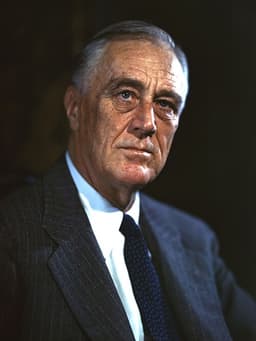
Franklin D. Roosevelt
Politician · Modern
71.0Total
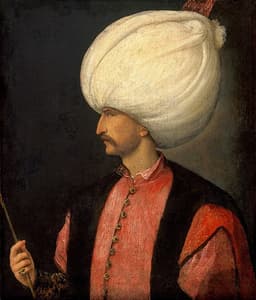
Suleiman the Magnificent
Emperor · Medieval
73.2Total
Basic Information
Born
1882
1494
Died
1945
1566
Era
Modern
Medieval
Nationality
United States
Ottoman Empire
Occupation
Politician
Emperor
Civilization
Western
Middle Eastern
Score Comparison
Military (10%)
45.0
85.0
Political (20%)
85.0
78.0
Influence (20%)
75.0
72.0
Legacy (20%)
65.0
68.0
Leadership (15%)
85.0
72.0
Strategy (15%)
60.0
72.0
TOTAL
71.0
73.2
Franklin D. Roosevelt — Complete Timeline
1933 AD
Inaugurated as 32nd PresidentOther◆ Major
Franklin D. Roosevelt was inaugurated as President of the United States on March 4, 1933, during the Great Depression. His inaugural address declared 'the only thing we have to fear is fear itself,' and he immediately called Congress into special session to address the banking crisis.
Great DepressionPresidencyInauguration
Impact: national
Enacted the New DealOther◆ Major
Roosevelt launched the New Deal in 1933, a series of federal programs including the Civilian Conservation Corps, the Agricultural Adjustment Act, and the Tennessee Valley Authority. These measures aimed to provide relief, recovery, and reform during the Great Depression, fundamentally expanding the role of the federal government.
Great DepressionEconomic PolicySocial Reform
Impact: nationalconstructive
1935 AD
Signed the Social Security ActOther◆ Major
Roosevelt signed the Social Security Act into law on August 14, 1935, establishing a federal system of old-age pensions, unemployment insurance, and aid for dependent children. This created the modern American welfare state and provided a safety net for millions of citizens.
Social WelfareLegislationNew Deal
Impact: nationalconstructive
1941 AD
Lend-Lease ActOther◆ Major
Roosevelt signed the Lend-Lease Act on March 11, 1941, authorizing the transfer of military equipment and supplies to Allied nations, particularly Britain and the Soviet Union. This program provided critical material support to countries fighting the Axis powers before U.S. entry into World War II.
World War IIForeign PolicyMilitary Aid
Impact: globalconstructive
Declaration of War on JapanPolitical Action◆ Major
Following the Japanese attack on Pearl Harbor on December 7, 1941, Roosevelt delivered his 'Day of Infamy' speech to Congress the next day, requesting a declaration of war. Congress approved the declaration, bringing the United States into World War II.
World War IIPearl HarborDeclaration of War
Impact: globaldestructive
1942 AD
Executive Order 9066Other◆ Major
Roosevelt signed Executive Order 9066 on February 19, 1942, authorizing the forced relocation and internment of Japanese Americans living on the West Coast. Over 110,000 people, mostly U.S. citizens, were incarcerated in camps for the duration of the war, a decision later widely condemned as a violation of civil rights.
World War IICivil RightsInternment
Impact: nationaldestructive
1944 AD
Elected to Fourth TermOther◆ Major
Roosevelt was elected to an unprecedented fourth term as president in November 1944, defeating Republican Thomas E. Dewey. This election occurred during the final stages of World War II, and Roosevelt's continued leadership ensured stability in the war effort and post-war planning.
PresidencyElectionWorld War II
Impact: national
1945 AD
Yalta ConferenceOther◆ Major
Roosevelt met with Winston Churchill and Joseph Stalin at the Yalta Conference in February 1945 to discuss post-war Europe. Agreements included the division of Germany, Soviet entry into the war against Japan, and the creation of the United Nations, shaping the post-war world order.
World War IIDiplomacyPost-War Planning
Impact: global
Suleiman the Magnificent — Complete Timeline
1522 AD
Siege of RhodesWar◆ Major
Suleiman personally led a massive Ottoman campaign against the Knights Hospitaller on Rhodes. After a six-month siege, the knights surrendered and were allowed to leave. This victory secured Ottoman control over the eastern Mediterranean.
SiegeMediterraneanKnights Hospitaller
Impact: regional
1526 AD
Battle of MohácsWar
Suleiman's Ottoman army defeated the Hungarian forces of King Louis II at Moh
BattleHungaryOttoman expansion
Impact: regional
1529 AD
Siege of ViennaWar◆ Major
Suleiman besieged Vienna, the Habsburg capital, with a large army. The siege failed due to supply issues, disease, and strong defenses. This defeat halted Ottoman expansion into central Europe and marked the empire's furthest advance westward.
SiegeViennaDefeat
Impact: regional
1530 AD
Codification of Ottoman lawReform◆ Major
Suleiman oversaw the compilation and standardization of Ottoman legal codes, known as Kanun. These laws regulated criminal justice, land tenure, and taxation, creating a unified legal system that balanced sharia with secular law. He earned the title 'Kanuni' (the Lawgiver).
Legal reformKanunOttoman Empire
Impact: nationalconstructive
1536 AD
Execution of Ibrahim PashaPolitical Action◆ Major
Suleiman ordered the execution of his grand vizier and close friend Ibrahim Pasha, who had served for 13 years. The reasons remain debated, but likely involved Ibrahim's growing power and conflicts with Suleiman's wife, Hurrem Sultan. This event demonstrated the absolute power of the sultan.
ExecutionCourt politicsPower
Impact: nationaltragic
Expert Analysis
Franklin D. Roosevelt vs Suleiman the Magnificent
# The Two Faces of Power: Franklin Roosevelt and Suleiman the Magnificent
On a bitter January morning in 1933, Franklin Delano Roosevelt stood before the United States Capitol, his leg braces hidden beneath the folds of his coat, and told a nation paralyzed by fear that “the only thing we have to fear is fear itself.” Four centuries earlier, on a dusty plain outside Mohács, Suleiman the Magnificent watched his cannon tear through the Hungarian cavalry and claimed a kingdom in a single afternoon. One man inherited a shattered economy and rebuilt it with words and laws; the other inherited an empire and expanded it with steel and blood. Both are remembered as giants, yet they moved through history on radically different trajectories. What drove these two titans—and why did their paths diverge so sharply?
Origins
Franklin Roosevelt was born into privilege on a Hudson Valley estate in 1882, a scion of the Dutch patrician class. His childhood was one of horses, private tutors, and summers in Europe. He was groomed for leadership, but not of the battlefield. The Gilded Age America he grew up in was a sprawling, chaotic democracy, suspicious of kings and enamored of progress. Roosevelt’s polio diagnosis in 1921, at age thirty-nine, was his crucible. It stripped him of physical mobility and taught him patience, cunning, and the art of hiding weakness behind a radiant smile.
Suleiman, born in 1494 in Trabzon, was raised in the Ottoman palace’s suffocating embrace. His father, Selim the Grim, had seized the throne by killing his own brothers—a tradition Suleiman would inherit. The young prince learned Persian poetry and Islamic jurisprudence, but also the cold calculus of power: that love was a liability and loyalty a weapon. The Ottoman Empire of his youth was a machine of conquest, stretching from the Danube to the Euphrates, and its sultan was expected to be both warrior and lawgiver.
Rise to Power
Roosevelt’s ascent was a slow climb through the American system: state senator, Assistant Secretary of the Navy, and a failed vice-presidential bid in 1920. His real opportunity came in 1928, when he was elected Governor of New York—just in time for the Great Depression. He did not seize power; he was summoned by a desperate public. His 1932 election was a referendum on hope, not a conquest.
Suleiman’s rise was both more brutal and more seamless. He became sultan in 1520 upon his father’s death, facing no internal challenge. But he immediately had to prove himself to a warrior elite that expected expansion. His first major test came in 1522 at the Siege of Rhodes, where he personally directed a six-month campaign against the Knights Hospitaller. The victory was decisive, and it announced to Europe that the new sultan was no less formidable than his father.
Leadership & Governance
Roosevelt governed through persuasion and institutional creativity. The New Deal was not a single plan but a cascade of experiments: the Civilian Conservation Corps put young men to work in forests; the Tennessee Valley Authority brought electricity to the rural South; the Social Security Act of 1935 created a safety net for the elderly. He spoke to Americans directly via “fireside chats” on the radio, his patrician voice a balm to a frightened nation. His military leadership during World War II was strategic and delegative—he chose generals like George Marshall and Dwight Eisenhower and let them fight, while he managed the alliance with Churchill and Stalin.
Suleiman ruled through presence and codification. He personally led campaigns into Hungary and Persia, but his greatest domestic achievement was the *Kanun*—a systematic compilation of Ottoman law that balanced Islamic sharia with secular imperial decrees. He standardized criminal penalties, regulated land tenure, and curbed the power of corrupt officials. His reign was the Ottoman golden age: poets like Baki flourished, the architect Sinan built the Süleymaniye Mosque, and Istanbul became a crossroads of cultures. Yet his governance was deeply personal and absolute. When his grand vizier and childhood friend Ibrahim Pasha grew too powerful, Suleiman had him executed in 1536, with no trial and no explanation.
Triumph & Tragedy
Roosevelt’s finest hour was the survival of democracy itself. He lifted America from 25% unemployment to victory in the greatest war in history. But his tragedy was incomplete: the New Deal did not end the Depression—World War II did. And his decision to intern Japanese Americans remains a stain on his legacy. He died in April 1945, weeks before victory in Europe, never seeing the peace he had helped forge.
Suleiman’s triumph was the Siege of Mohács in 1526, where he annihilated the Hungarian army in under two hours, killing King Louis II and opening Central Europe to Ottoman influence. But his tragedy was the failed Siege of Vienna in 1529, where supply lines collapsed and disease ravaged his army. That failure marked the empire’s northern limit. His later years were shadowed by paranoia: he executed his own son Mustafa on suspicion of rebellion, a wound from which the dynasty never fully recovered.
Character & Destiny
Roosevelt was a pragmatist with a hidden iron will. He once told an advisor, “I am a juggler, and I never let my right hand know what my left hand does.” His polio forced him to cultivate charm and manipulation as tools. He believed in progress, in the possibility of reform, and in the American experiment. His character made him flexible, but also opaque.
Suleiman was a man of law and war, but also of poetry. He wrote verses under the pen name “Muhibbi” (the Lover), yet ordered the death of his closest friend. He believed in the divine right of sultans, and his character was one of majestic isolation. His decisions were final, and his loneliness was absolute. Where Roosevelt thrived on coalition, Suleiman ruled through fear and reverence.
Legacy
Roosevelt remade the American presidency and the social contract. He is remembered as the man who saved capitalism from itself, who stood up to fascism, and who gave ordinary people a stake in their government. His four terms led to the Twenty-second Amendment limiting presidential tenure. His face is on the dime, his image in the FDR Memorial.
Suleiman is remembered as the lawgiver and the magnificent. The *Kanun* influenced Ottoman governance for centuries. His architectural legacy still defines Istanbul’s skyline. But his empire began its long decline within a generation of his death, culminating in the naval defeat at Lepanto in 1571—a battle fought by his successor, but lost because Suleiman’s fleet had been allowed to atrophy.
Conclusion
Roosevelt and Suleiman never met, never could have met. One was a democrat in an age of rising tyranny; the other was an autocrat in an age of rising democracy. Yet both understood that power is not merely exercised—it is performed. Roosevelt performed hope; Suleiman performed majesty. One built institutions to outlast him; the other built monuments to remember him. In the end, the difference between them is not the size of their empires or the length of their reigns, but the answer to a single question: Did they trust the people they ruled? Roosevelt did, and it saved him. Suleiman did not, and it doomed his dynasty. That trust, or its absence, is the invisible fault line that divides not just two leaders, but two worlds.
Rankings
🥇
Suleiman the MagnificentLeader
Mil: 85.0Pol: 78.0Inf: 72.0
73.2
🥈
Franklin D. Roosevelt
Mil: 45.0Pol: 85.0Inf: 75.0
71.0
+2.2 behind
How This Comparison Works
Algorithm
Each figure is scored on 6 dimensions (0—100 scale) based on structured historical data: Military (10%), Political (20%), Influence (20%), Legacy (20%), Leadership (15%), Strategy (15%). The weighted total produces the final ranking.
Data Sources
Scores are computed from structured sub-indicators in the database. Scale factors adjust for era (Ancient ×0.85, Modern ×1.0) and civilization size (Eastern ×1.05, Other ×0.80) to account for differences in population and military scale.
Maximum 3 Figures
Comparisons are limited to 2—3 figures to ensure readability and statistical meaningfulness.
Error Margins
±5 points per dimension — Sub-scores are derived from historical records with inherent uncertainty. Two figures within 5 points on a dimension should be considered roughly equivalent in that area.
Total Score Accuracy
±3 points overall — The weighted combination of 6 dimensions produces a total score with approximately ±3 points of uncertainty. Differences of less than 3 points are not statistically significant— the figures are effectively tied.
Known Limitations
- Historical records are incomplete and uneven across civilizations
- Figures from oral-tradition societies may be underrepresented
- Occupation labels can misclassify multi-role figures
- Scores measure capability and impact, not moral character
- Quantitative scoring is a comparison tool, not absolute truth
Capability Radar
Military (10%) — Battles & Warfare
Battles
10
95
Win Rate
10
90
Expansion
10
95
Political (20%) — Governance & Reform
Reform
95
90
Diplomacy
90
88
Economy
95
85
Influence (20%) — Cultural & Global Reach
Cultural
80
90
Global
90
88
Legacy (20%) — Historical Impact
Historical
90
92
Longevity
85
85
Leadership (15%) — Power & Stability
Tenure
90
95
Stability
75
85
Strategy (15%) — Tactics & Innovation
Strategy
65
92
Tactics
10
85
Reform
70
80
Similar Comparisons
Comments & Discussion
No comments yet. Be the first to share your thoughts!