Loading...
Franklin D. Roosevelt vs Pachacuti
Franklin D. Roosevelt leads by 1.6 pts · 2 figures compared
…
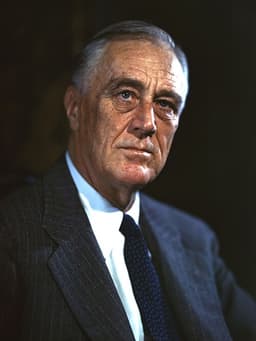
Franklin D. Roosevelt
Politician · Modern
71.0Total
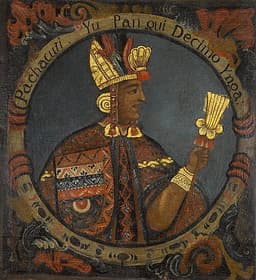
Pachacuti
Emperor · Medieval
69.4Total
Basic Information
Born
1882
1418
Died
1945
1472
Era
Modern
Medieval
Nationality
United States
Inca Empire
Occupation
Politician
Emperor
Civilization
Western
Other
Score Comparison
Military (10%)
45.0
78.5
Political (20%)
85.0
58.1
Influence (20%)
75.0
65.0
Legacy (20%)
65.0
72.0
Leadership (15%)
85.0
78.0
Strategy (15%)
60.0
69.2
TOTAL
71.0
69.4
Franklin D. Roosevelt — Complete Timeline
1933 AD
Inaugurated as 32nd PresidentOther◆ Major
Franklin D. Roosevelt was inaugurated as President of the United States on March 4, 1933, during the Great Depression. His inaugural address declared 'the only thing we have to fear is fear itself,' and he immediately called Congress into special session to address the banking crisis.
Great DepressionPresidencyInauguration
Impact: national
Enacted the New DealOther◆ Major
Roosevelt launched the New Deal in 1933, a series of federal programs including the Civilian Conservation Corps, the Agricultural Adjustment Act, and the Tennessee Valley Authority. These measures aimed to provide relief, recovery, and reform during the Great Depression, fundamentally expanding the role of the federal government.
Great DepressionEconomic PolicySocial Reform
Impact: nationalconstructive
1935 AD
Signed the Social Security ActOther◆ Major
Roosevelt signed the Social Security Act into law on August 14, 1935, establishing a federal system of old-age pensions, unemployment insurance, and aid for dependent children. This created the modern American welfare state and provided a safety net for millions of citizens.
Social WelfareLegislationNew Deal
Impact: nationalconstructive
1941 AD
Lend-Lease ActOther◆ Major
Roosevelt signed the Lend-Lease Act on March 11, 1941, authorizing the transfer of military equipment and supplies to Allied nations, particularly Britain and the Soviet Union. This program provided critical material support to countries fighting the Axis powers before U.S. entry into World War II.
World War IIForeign PolicyMilitary Aid
Impact: globalconstructive
Declaration of War on JapanPolitical Action◆ Major
Following the Japanese attack on Pearl Harbor on December 7, 1941, Roosevelt delivered his 'Day of Infamy' speech to Congress the next day, requesting a declaration of war. Congress approved the declaration, bringing the United States into World War II.
World War IIPearl HarborDeclaration of War
Impact: globaldestructive
1942 AD
Executive Order 9066Other◆ Major
Roosevelt signed Executive Order 9066 on February 19, 1942, authorizing the forced relocation and internment of Japanese Americans living on the West Coast. Over 110,000 people, mostly U.S. citizens, were incarcerated in camps for the duration of the war, a decision later widely condemned as a violation of civil rights.
World War IICivil RightsInternment
Impact: nationaldestructive
1944 AD
Elected to Fourth TermOther◆ Major
Roosevelt was elected to an unprecedented fourth term as president in November 1944, defeating Republican Thomas E. Dewey. This election occurred during the final stages of World War II, and Roosevelt's continued leadership ensured stability in the war effort and post-war planning.
PresidencyElectionWorld War II
Impact: national
1945 AD
Yalta ConferenceOther◆ Major
Roosevelt met with Winston Churchill and Joseph Stalin at the Yalta Conference in February 1945 to discuss post-war Europe. Agreements included the division of Germany, Soviet entry into the war against Japan, and the creation of the United Nations, shaping the post-war world order.
World War IIDiplomacyPost-War Planning
Impact: global
Pachacuti — Complete Timeline
1438 AD
Conquest of the Chanka KingdomWar
Pachacuti led the Inca army to defeat the Chanka, a powerful rival, in a decisive battle near Cusco. This victory secured his position as Sapa Inca and initiated a period of rapid expansion, transforming the Inca from a small kingdom into a vast empire.
ConquestInca ExpansionChanka
Impact: regional
1440 AD
Reconstruction of CuscoCultural◆ Major
Pachacuti rebuilt Cusco as the imperial capital, designing it in the shape of a puma and constructing massive stone structures like Sacsayhuam
Urban PlanningArchitectureInca Empire
Impact: regionalconstructive
1450 AD
Initiation of Machu Picchu's ConstructionCultural◆ Major
Pachacuti ordered the construction of Machu Picchu, a royal estate and ceremonial site high in the Andes. The complex featured sophisticated dry-stone masonry and terraced agriculture, serving as a symbol of Inca engineering and a retreat for the emperor.
ArchitectureRoyal EstateInca Engineering
Impact: regionalconstructive
Expert Analysis
Pachacuti vs Franklin D. Roosevelt
### The Architect and the Builder: Two Visions of Power
In the winter of 1933, a man paralyzed from the waist down leaned on his son’s arm and shuffled, inch by agonizing inch, to a podium in Washington, D.C. He was about to tell a terrified nation that the only thing it had to fear was fear itself. Five centuries earlier and half a world away, another man climbed to a windswept ridge in the Andes, looked down at a valley of stone, and conceived a city in the shape of a puma. Both men were architects of worlds. Franklin D. Roosevelt built a new social contract for a modern democracy. Pachacuti built an empire of earth and sky. One worked with words and laws; the other with armies and mountains. The question is not who was greater, but what each man’s story tells us about the nature of power itself.
### Origins
Roosevelt was born into the warm bath of American aristocracy, a Hudson Valley patrician who never knew hunger. His world was one of privilege, but also of duty—his cousin Theodore had taught the family that the wealthy must serve. He was educated at Groton, Harvard, and Columbia Law, trained in the art of polite persuasion. Pachacuti, by contrast, rose from a world of jagged peaks and constant threat. The Inca were a small kingdom in the Cusco Valley, surrounded by enemies. Pachacuti was not the firstborn son; he was a prince who earned his place through blood. When the Chanka attacked in 1438, the reigning Inca fled. Pachacuti, then a young commander, rallied the army and won the impossible victory that made him emperor. Roosevelt inherited a name; Pachacuti forged one.
### Rise to Power
Roosevelt’s ascent was a masterclass in political patience. He served as Assistant Secretary of the Navy, ran for Vice President in 1920 and lost, then contracted polio in 1921. The disease stripped him of his legs but sharpened his will. He returned to politics as Governor of New York, and in 1932, as the Great Depression hollowed out America, he was elected President. His path was one of endurance and reinvention. Pachacuti’s rise was far more dramatic. After the Chanka victory in 1438, he did not just take power—he redefined it. He purged the old nobility, centralized authority, and declared himself Sapa Inca, the son of the sun. He did not wait for a crisis; he created the conditions for his own ascent.
### Leadership & Governance
Roosevelt governed through words and institutions. His Fireside Chats made the radio a tool of intimacy; the New Deal made the federal government a shield against poverty. He was a coalition-builder, holding together southern Democrats, urban liberals, and labor unions. His military score of 60 reflects a man who was no general—he let Marshall and Eisenhower run the war—but his political score of 85 captures his genius for managing a fractious democracy. Pachacuti was the opposite. He was the general. His military and strategy scores of 67 and 77 show a commander who personally led campaigns, engineering roads, storehouses, and relay runners to bind his empire. But he was also a political architect of the highest order: he imposed a single language, Quechua, standardized tribute, and rebuilt Cusco as a sacred grid of stone. His leadership score of 85 matches Roosevelt’s, but it was a leadership of command, not consensus.
### Triumph & Tragedy
Roosevelt’s greatest moment was the creation of Social Security in 1935—a system that said no American should die in poverty. His greatest failure was the 1937 court-packing scheme, an overreach that nearly broke his presidency. He won the war, but he also interned Japanese Americans and broke the two-term tradition that had held since Washington. Pachacuti’s triumph was the transformation of a hilltop village into an imperial capital of cyclopean stone, and the initiation of Machu Picchu around 1450, a mountain sanctuary that still humbles visitors. His tragedy was the system he built: a total state that left no room for dissent, a machine that would shatter when the Spanish arrived because the people had never learned to question the sun.
### Character & Destiny
Roosevelt was a man of masks—charming, elusive, unreadable. His polio gave him a reserve of iron patience; he could wait out enemies, allies, and history itself. He believed in progress, in the possibility of a better world. Pachacuti was a man of stone—unyielding, visionary, and absolute. He believed in order. One built a system that could adapt; the other built a system that could endure. One was a pragmatist; the other was a prophet.
### Legacy
Roosevelt’s legacy is the modern American state—Social Security, the minimum wage, the regulatory state, the very idea that government owes its citizens a basic floor of decency. His influence score of 72 and legacy of 75 reflect a man whose ideas are still fought over in every election. Pachacuti’s legacy is the Inca Empire itself—a civilization that, for a hundred years, was the largest and most efficient in the Americas. His legacy score of 66 is lower, but that is history’s cruelty: the empire he built was erased by disease and steel, while Roosevelt’s survived its founder.
### Conclusion
In the end, these two men faced the same question: how do you hold a vast, diverse population together? Roosevelt answered with persuasion, institutions, and a safety net. Pachacuti answered with roads, religion, and a state that owned everything. One trusted the people; the other trusted the plan. Their scores are nearly identical—75.7 to 73.7—but the numbers miss the deeper truth. Roosevelt built a house that could be remodeled by every generation. Pachacuti built a temple that could only be worshipped. Which one lasts longer? History has not yet decided.
Rankings
🥇
Franklin D. RooseveltLeader
Mil: 45.0Pol: 85.0Inf: 75.0
71.0
🥈
Pachacuti
Mil: 78.5Pol: 58.1Inf: 65.0
69.4
+1.6 behind
How This Comparison Works
Algorithm
Each figure is scored on 6 dimensions (0—100 scale) based on structured historical data: Military (10%), Political (20%), Influence (20%), Legacy (20%), Leadership (15%), Strategy (15%). The weighted total produces the final ranking.
Data Sources
Scores are computed from structured sub-indicators in the database. Scale factors adjust for era (Ancient ×0.85, Modern ×1.0) and civilization size (Eastern ×1.05, Other ×0.80) to account for differences in population and military scale.
Maximum 3 Figures
Comparisons are limited to 2—3 figures to ensure readability and statistical meaningfulness.
Error Margins
±5 points per dimension — Sub-scores are derived from historical records with inherent uncertainty. Two figures within 5 points on a dimension should be considered roughly equivalent in that area.
Total Score Accuracy
±3 points overall — The weighted combination of 6 dimensions produces a total score with approximately ±3 points of uncertainty. Differences of less than 3 points are not statistically significant— the figures are effectively tied.
Known Limitations
- Historical records are incomplete and uneven across civilizations
- Figures from oral-tradition societies may be underrepresented
- Occupation labels can misclassify multi-role figures
- Scores measure capability and impact, not moral character
- Quantitative scoring is a comparison tool, not absolute truth
Capability Radar
Military (10%) — Battles & Warfare
Battles
10
85
Win Rate
10
90
Expansion
10
90
Political (20%) — Governance & Reform
Reform
95
92
Diplomacy
90
75
Economy
95
80
Influence (20%) — Cultural & Global Reach
Cultural
80
85
Global
90
65
Legacy (20%) — Historical Impact
Historical
90
80
Longevity
85
70
Leadership (15%) — Power & Stability
Tenure
90
85
Stability
75
82
Strategy (15%) — Tactics & Innovation
Strategy
65
88
Tactics
10
80
Reform
70
85
Similar Comparisons
Comments & Discussion
PumaPrince6/16/2026
People forget FDR governed the largest economy in human history while managing a polio-induced wheelchair—Pachacuti had llamas. I'm a military historian, and let's be real: Pachacuti's conquests relied on psychological warfare so effective that entire valleys surrendered without a fight, but he never faced a Japanese admiral planning Pearl Harbor. Roosevelt's 12-year wartime leadership across two theaters dwarfs any pre-industrial empire builder.
征服者之眼6/16/2026
数据怀疑论者必须指出:拿一个20世纪工业化强国的领导人跟15世纪安第斯山区的酋长比,本身就是统计学上的驴马杂交。Pachacuti治理的帝国最多1200万人,没有货币,没有文字——他连税收都靠麻绳结账。FDR面对的是1.3亿人口的新政实施和全球性经济危机。规模差两个数量级,就像比较一条皮划艇和航空母舰的舵手。
IncaDendrochronologist6/16/2026
Classics scholar here—the Inca had no writing system, so every "fact" about Pachacuti is essentially state propaganda carved on memory knots. FDR's fireside chats reached millions of literate citizens; Pachacuti's speeches survive only as mythical echoes. We can literally read Roosevelt's tax returns. The asymmetry of evidence makes this comparison more about our need for origin stories than historical reality.
唐顿叛徒6/16/2026
热爱英式庄园的怀旧爱好者请注意:Pachacuti是位真正的开拓者,他用石头和人力在海拔四千米的地方建起马丘比丘,没有铁器,没有车轮,连头羊都嫌累。FDR最大的建筑成就不过是田纳西河流域管理局的水坝。一个改写了地球的面貌,另一个只改写了福利支票的寄送地址。我选印加人,至少他们的建筑现在还站着。
AnticolonialEmber6/16/2026
Revisionist take: praising Pachacuti as "great" repeats colonial romanticism—he violently consolidated ethnic groups into a tribute-based empire, executed nobles who resisted, and imposed Quechua as a weapon of cultural erasure. FDR, meanwhile, interned Japanese Americans. Both were architects who built on broken bones. Let's stop mythologizing empire-builders and start measuring them by who they crushed. Neither is a moral hero; they're just more effective conquerors.