Loading...
Franklin D. Roosevelt vs Julius Caesar
Julius Caesar leads by 11.8 pts · 2 figures compared
…
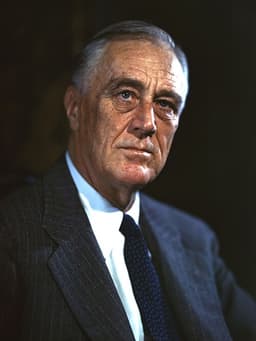
Franklin D. Roosevelt
Politician · Modern
71.0Total

Julius Caesar
General · Ancient
82.8Total
Basic Information
Born
1882
-100
Died
1945
-44
Era
Modern
Ancient
Nationality
United States
Roman Republic
Occupation
Politician
General
Civilization
Western
Western
Score Comparison
Military (10%)
45.0
88.0
Political (20%)
85.0
78.0
Influence (20%)
75.0
85.0
Legacy (20%)
65.0
82.0
Leadership (15%)
85.0
80.0
Strategy (15%)
60.0
85.0
TOTAL
71.0
82.8
Franklin D. Roosevelt — Complete Timeline
1933 AD
Inaugurated as 32nd PresidentOther◆ Major
Franklin D. Roosevelt was inaugurated as President of the United States on March 4, 1933, during the Great Depression. His inaugural address declared 'the only thing we have to fear is fear itself,' and he immediately called Congress into special session to address the banking crisis.
Great DepressionPresidencyInauguration
Impact: national
Enacted the New DealOther◆ Major
Roosevelt launched the New Deal in 1933, a series of federal programs including the Civilian Conservation Corps, the Agricultural Adjustment Act, and the Tennessee Valley Authority. These measures aimed to provide relief, recovery, and reform during the Great Depression, fundamentally expanding the role of the federal government.
Great DepressionEconomic PolicySocial Reform
Impact: nationalconstructive
1935 AD
Signed the Social Security ActOther◆ Major
Roosevelt signed the Social Security Act into law on August 14, 1935, establishing a federal system of old-age pensions, unemployment insurance, and aid for dependent children. This created the modern American welfare state and provided a safety net for millions of citizens.
Social WelfareLegislationNew Deal
Impact: nationalconstructive
1941 AD
Lend-Lease ActOther◆ Major
Roosevelt signed the Lend-Lease Act on March 11, 1941, authorizing the transfer of military equipment and supplies to Allied nations, particularly Britain and the Soviet Union. This program provided critical material support to countries fighting the Axis powers before U.S. entry into World War II.
World War IIForeign PolicyMilitary Aid
Impact: globalconstructive
Declaration of War on JapanPolitical Action◆ Major
Following the Japanese attack on Pearl Harbor on December 7, 1941, Roosevelt delivered his 'Day of Infamy' speech to Congress the next day, requesting a declaration of war. Congress approved the declaration, bringing the United States into World War II.
World War IIPearl HarborDeclaration of War
Impact: globaldestructive
1942 AD
Executive Order 9066Other◆ Major
Roosevelt signed Executive Order 9066 on February 19, 1942, authorizing the forced relocation and internment of Japanese Americans living on the West Coast. Over 110,000 people, mostly U.S. citizens, were incarcerated in camps for the duration of the war, a decision later widely condemned as a violation of civil rights.
World War IICivil RightsInternment
Impact: nationaldestructive
1944 AD
Elected to Fourth TermOther◆ Major
Roosevelt was elected to an unprecedented fourth term as president in November 1944, defeating Republican Thomas E. Dewey. This election occurred during the final stages of World War II, and Roosevelt's continued leadership ensured stability in the war effort and post-war planning.
PresidencyElectionWorld War II
Impact: national
1945 AD
Yalta ConferenceOther◆ Major
Roosevelt met with Winston Churchill and Joseph Stalin at the Yalta Conference in February 1945 to discuss post-war Europe. Agreements included the division of Germany, Soviet entry into the war against Japan, and the creation of the United Nations, shaping the post-war world order.
World War IIDiplomacyPost-War Planning
Impact: global
Julius Caesar — Complete Timeline
58 BC
Gallic WarsWar◆ Major
Caesar, as proconsul of Gaul, launched a series of campaigns that conquered all of Gaul (modern France, Belgium, and parts of Switzerland). He fought numerous battles, including against the Helvetii, the Belgae, and the Gallic chieftain Vercingetorix. The wars brought immense wealth and a loyal army to Caesar.
Gallic WarsConquestRoman Expansion
Impact: regional
49 BC
Crossing the RubiconPolitical Action◆ Major
Caesar led Legio XIII across the Rubicon River into Italy, defying the Roman Senate's order to disband his army. This act triggered a civil war against Pompey and the Optimates, ultimately leading to Caesar's dictatorship and the end of the Roman Republic.
Roman Civil WarEnd of RepublicPower Struggle
Impact: global
48 BC
Battle of PharsalusWar◆ Major
Caesar's outnumbered army defeated the larger forces of Pompey the Great at Pharsalus in Greece. Caesar's tactical use of a reserve line to counter Pompey's cavalry charge proved decisive. Pompey fled to Egypt, where he was assassinated, leaving Caesar as the undisputed master of the Roman world.
Roman Civil WarBattleDecisive Victory
Impact: regional
44 BC
Appointment as Dictator for LifePolitical Action◆ Major
The Roman Senate appointed Caesar dictator perpetuo (dictator for life), granting him unprecedented personal power. This move concentrated military, legislative, and judicial authority in one person, effectively ending the Roman Republic's traditional system of checks and balances and alarming many senators.
DictatorshipEnd of RepublicPower Consolidation
Impact: regionaldestructive
Assassination on the Ides of MarchPolitical Action◆ Major
A group of Roman senators, led by Marcus Junius Brutus and Gaius Cassius Longinus, stabbed Caesar to death at a meeting of the Senate in the Theatre of Pompey. The assassination was intended to restore the Republic, but instead triggered another civil war that led to the rise of the Roman Empire.
AssassinationRoman PoliticsEnd of Republic
Impact: globaldestructive
Expert Analysis
Julius Caesar vs Franklin D. Roosevelt: Historical Comparison
Julius Caesar, a Roman general and dictator, and Franklin D. Roosevelt, an American president, both reshaped their nations during crises—Caesar through military conquest and political upheaval, Roosevelt through economic depression and global war. Their comparative scores highlight distinct strengths in different domains.
Dimension Analysis
**Military: Julius Caesar 88 / Franklin D. Roosevelt 60**
Caesar conquered Gaul, won the Civil War, and personally led legions in decisive battles. Roosevelt, while serving as Commander-in-Chief during WWII, relied on military advisors and never commanded troops directly, making his military role strategic rather than tactical.
**Political: Julius Caesar 78 / Franklin D. Roosevelt 85**
Roosevelt built the New Deal coalition, won four presidential terms, and navigated Congress to pass transformative legislation. Caesar, though a skilled politician, alienated the Senate and ended the Roman Republic through dictatorship, limiting his political sustainability.
**Influence: Julius Caesar 85 / Franklin D. Roosevelt 72**
Caesar’s conquests spread Roman culture across Europe, and his name became synonymous with imperial rule (e.g., “Kaiser,” “Tsar”). Roosevelt shaped the modern welfare state and postwar international order, but his influence was more contained to the 20th century.
**Legacy: Julius Caesar 82 / Franklin D. Roosevelt 75**
Caesar’s legacy spans millennia, from Shakespeare’s plays to political models of dictatorship. Roosevelt’s legacy includes Social Security and the UN, but it is more debated and less globally pervasive than Caesar’s archetypal impact.
**Leadership: Julius Caesar 82 / Franklin D. Roosevelt 85**
Roosevelt inspired a nation through fireside chats and wartime resolve, fostering collective resilience. Caesar commanded fierce loyalty from his troops and was a brilliant strategist, but his authoritarian turn undermined institutional leadership.
Verdict
Julius Caesar leads with an overall score of 83 to Roosevelt’s 76, driven by superior military genius and lasting global influence.
FAQ
Q: Who ranks higher? A: Julius Caesar ranks higher overall, due to his unmatched military conquests and enduring cultural archetype.
Rankings
🥇
Julius CaesarLeader
Mil: 88.0Pol: 78.0Inf: 85.0
82.8
🥈
Franklin D. Roosevelt
Mil: 45.0Pol: 85.0Inf: 75.0
71.0
+11.8 behind
How This Comparison Works
Algorithm
Each figure is scored on 6 dimensions (0—100 scale) based on structured historical data: Military (10%), Political (20%), Influence (20%), Legacy (20%), Leadership (15%), Strategy (15%). The weighted total produces the final ranking.
Data Sources
Scores are computed from structured sub-indicators in the database. Scale factors adjust for era (Ancient ×0.85, Modern ×1.0) and civilization size (Eastern ×1.05, Other ×0.80) to account for differences in population and military scale.
Maximum 3 Figures
Comparisons are limited to 2—3 figures to ensure readability and statistical meaningfulness.
Error Margins
±5 points per dimension — Sub-scores are derived from historical records with inherent uncertainty. Two figures within 5 points on a dimension should be considered roughly equivalent in that area.
Total Score Accuracy
±3 points overall — The weighted combination of 6 dimensions produces a total score with approximately ±3 points of uncertainty. Differences of less than 3 points are not statistically significant— the figures are effectively tied.
Known Limitations
- Historical records are incomplete and uneven across civilizations
- Figures from oral-tradition societies may be underrepresented
- Occupation labels can misclassify multi-role figures
- Scores measure capability and impact, not moral character
- Quantitative scoring is a comparison tool, not absolute truth
Capability Radar
Military (10%) — Battles & Warfare
Battles
10
95
Win Rate
10
92
Expansion
10
97
Political (20%) — Governance & Reform
Reform
95
90
Diplomacy
90
85
Economy
95
82
Influence (20%) — Cultural & Global Reach
Cultural
80
88
Global
90
94
Legacy (20%) — Historical Impact
Historical
90
95
Longevity
85
96
Leadership (15%) — Power & Stability
Tenure
90
75
Stability
75
60
Strategy (15%) — Tactics & Innovation
Strategy
65
94
Tactics
10
96
Reform
70
88
Similar Comparisons
Comments & Discussion
HistoryNerd20246/16/2026
Okay, so I just finished a deep dive on Caesar's Gallic Wars and FDR's New Deal, and I gotta say—the military score gap makes sense but it's not the whole story. Yeah, Caesar personally led legions at Alesia and Pharsalus, that's hardcore. But FDR literally had to build up the US military from the ground up after the Depression, and he made the call on D-Day even when Churchill was dragging his feet. That's command decision-making under pressure, same as Caesar crossing the Rubicon. The influence gap too—Caesar's name is everywhere, sure, but FDR's Social Security and GI Bill are still running today. Like, I get the scores, but maybe Caesar's legacy is more symbolic while FDR's is more functional? Just throwing it out there.
Latinist506/16/2026
The scoring is broadly defensible, though it flattens crucial nuances. Suetonius tells us Caesar 'seized the state by force' (vi rem publicam occupavit), but he also notes Caesar's clementia—his pardons after Pharsalus, which were deliberately propagandistic yet effective. This complicates the political score: if Caesar's authoritarianism 'alienated the Senate,' it also generated genuine loyalty among provincials and soldiers. On FDR, one might recall Plutarch's observation that successful leaders must be 'like the helmsman who steers against the wind'—Roosevelt's court-packing scheme failed, yet he still got his New Deal through. The military gap, however, is not merely quantitative but qualitative: Caesar commanded at the centurion level, while FDR's military role was entirely constitutional. As Tacitus would say, the comparison hinges on whether one values virtus (personal martial excellence) or imperium (legitimate authority). The scores reflect a preference for the former.
Historian4216/16/2026
这个评分体系存在明显偏差。Caesar军事88分,但他在高卢战争中的后勤保障完全依赖罗马奴隶制经济,而罗斯福在二战期间通过租借法案支撑了全球反法西斯战线,这种战略协调能力难道不该加分?另外,政治维度上Caesar 78分、Roosevelt 85分,但Caesar在短短十年内完成了从流亡者到终身独裁官的跃升,还推行了历法改革和公民权扩展,这在中国历史上相当于从贬官到摄政王的跨越。如果按中国史学对‘经世致用’的标准,Caesar的政治操作能力至少应在80分以上。评分体系似乎过于看重制度延续性,而低估了打破旧制度所需的魄力。
Historian7646/16/2026
这个对比让我想起中国历史上的秦始皇和汉武帝。Caesar像秦始皇,都是通过军事统一结束混乱,但秦始皇的郡县制延续两千年,而Caesar的帝国在他死后就陷入内战。Roosevelt则更像汉武帝,利用国家力量干预经济(盐铁官营 vs 新政),但汉武帝晚年下罪己诏,Roosevelt却没来得及面对战后秩序的重建。不过评分把Roosevelt的军事分压这么低有点不公——汉武帝也没有亲自上阵,但他对匈奴的战略布局和Roosevelt对二战的全球规划本质类似,都是统帅而非战将。西方史学常低估这种‘庙算’的价值,放到中国语境下,Roosevelt至少该有70分以上。