Loading...
Francis II Rakoczi vs Napoleon Bonaparte
Napoleon Bonaparte leads by 16.7 pts · 2 figures compared
…
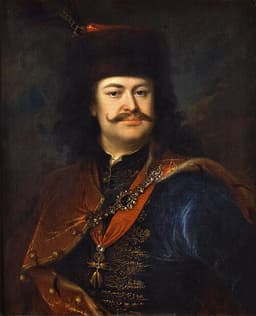
Francis II Rakoczi
Revolutionary · Modern
54.2Total

Napoleon Bonaparte
General · Modern
70.9Total
Basic Information
Born
1676
1769
Died
1735
1821
Era
Modern
Modern
Nationality
Hungary
France
Occupation
Revolutionary
General
Civilization
Western
Western
Score Comparison
Military (10%)
55.0
94.0
Political (20%)
46.6
72.0
Influence (20%)
57.2
40.0
Legacy (20%)
52.0
80.0
Leadership (15%)
57.6
78.0
Strategy (15%)
57.5
90.0
TOTAL
54.2
70.9
Francis II Rakoczi — Complete Timeline
1703 AD
Rákóczi's War of IndependenceWar◆ Major
Francis II Rakoczi led a major uprising against Habsburg rule in Hungary, known as R
War of IndependenceHabsburgRebellion
Impact: regional
1704 AD
Election as Prince of TransylvaniaPolitical Action◆ Major
Francis II Rakoczi was elected Prince of Transylvania by the Hungarian estates, leading the anti-Habsburg rebellion. His election marked the formal leadership of the uprising.
ElectionRebellion
Impact: regional
1708 AD
Battle of TrencinWar◆ Major
Francis II Rakoczi's forces were decisively defeated by the Habsburg army at the Battle of Trencin. The defeat marked a turning point, leading to the decline of the rebellion.
BattleDefeatTurning Point
Impact: regionaltragic
1711 AD
Exile in the Ottoman EmpirePolitical Action◆ Major
After the failure of the rebellion, Francis II Rakoczi went into exile in the Ottoman Empire. He refused to accept Habsburg amnesty and lived in Ottoman territory until his death.
ExileOttoman
Impact: regionaltragic
Napoleon Bonaparte — Complete Timeline
1799 AD
Coup of 18 BrumaireOther◆ Major
Napoleon Bonaparte, with support from his brother Lucien and key political figures, overthrew the Directory in a bloodless coup. He established the Consulate with himself as First Consul, effectively becoming the ruler of France. This event ended the French Revolution's most unstable period.
French RevolutionCoupRise to Power
Impact: regional
1804 AD
Promulgation of the Napoleonic CodeOther◆ Major
Napoleon enacted the Civil Code of the French, known as the Napoleonic Code, a comprehensive set of laws that replaced the fragmented feudal legal systems. The code established legal equality, protected property rights, and secularized law. It became the basis for legal systems in many European and world countries.
Legal ReformNapoleonic CodeCivil Law
Impact: globalconstructive
1805 AD
Battle of AusterlitzWar◆ Major
Napoleon's Grande Arm
Napoleonic WarsBattleDecisive Victory
Impact: global
1812 AD
Invasion of RussiaWar◆ Major
Napoleon led the Grande Arm
Napoleonic WarsInvasionDisaster
Impact: globaldestructive
1815 AD
Battle of WaterlooWar◆ Major
Napoleon's French army was defeated by the combined forces of the Duke of Wellington's Anglo-Allied army and Gebhard Leberecht von Bl
Napoleonic WarsBattleFinal Defeat
Impact: globaldestructive
Expert Analysis
francis-ii-rakoczi-vs-napoleon-bonaparte
# The Emperor and the Exile
On a June evening in 1815, Napoleon Bonaparte stood on a muddy field in Belgium, watching his Imperial Guard—the finest soldiers in Europe—break and flee for the first time in history. A hundred years earlier, another rebel leader had watched his own army scatter at the Battle of Trencin in 1708, his dream of Hungarian independence dissolving into the smoke of Habsburg cannon. Both men reached for greatness; one grasped an empire, the other only a memory. What separated them was not ambition, but the cruel geometry of opportunity.
Origins
Napoleon was born in 1769 on Corsica, an island that had just passed from Italian to French control. His family was minor nobility, poor enough to feel the sting of social inferiority, proud enough to nurture resentment. He spoke French with a thick accent, a perpetual outsider in the Parisian salons where careers were made. This marginality became his fuel. He studied artillery—the most mathematical, least aristocratic branch of the military—and read voraciously: Caesar, Alexander, Machiavelli.
Francis II Rákóczi, born in 1676, inherited a different kind of wound. His family had once ruled Transylvania; his stepfather was implicated in a conspiracy against the Habsburgs. The boy grew up in Austrian custody, a prince without a throne, a nobleman without a homeland. Where Napoleon learned to calculate, Rákóczi learned to wait. His Hungary was a kingdom crushed after the Ottoman withdrawal, its nobility stripped of power, its peasantry ground under foreign boots. The stage was set for a liberator—but the stage was also a cage.
Rise to Power
Napoleon’s ascent was a masterpiece of timing. The French Revolution had decimated the old officer class. At twenty-four, he cleared the streets of Paris with a "whiff of grapeshot" in 1795; at twenty-seven, he conquered Italy. He understood that in revolutionary France, merit could outrank blood. His Italian campaign of 1796-1797 wasn't just a military triumph—it was a political announcement. A general who paid his army with plunder, who wrote his own dispatches, who posed as the bringer of liberty to oppressed peoples: this was a new kind of leader for a new age.
Rákóczi’s path was narrower. When he launched his war of independence in 1703, he did so as the head of a feudal uprising—peasants armed with scythes, nobles with rusty swords. He was elected Prince of Transylvania in 1704, a title that sounded grand but commanded few resources. Unlike Napoleon, who could draw on the wealth and manpower of France, Rákóczi led a coalition of the desperate. His Hungary was a battlefield between empires, not a unified nation-state. He had no Paris, no treasury, no professional army—only the hope that the Habsburgs would be distracted by the War of the Spanish Succession.
Leadership & Governance
Napoleon governed as he conquered: with speed, clarity, and ruthless efficiency. His Napoleonic Code standardized French law, abolished feudal privileges, and spread across Europe like a legal gospel. He built roads, founded banks, reformed education. He was a modernizer who believed that order was liberty’s foundation. His military genius—scoring 93 in strategy—lay in his ability to concentrate force at the decisive point, to read terrain like a book, to inspire men who would die for a word from him.
Rákóczi governed differently, because he had less to govern. His rebellion was always a negotiation between factions: Catholic magnates, Protestant nobles, Orthodox peasants. He issued coins, printed manifestos, tried to build a Hungarian state from scratch. But his military score of 55 reflects a painful truth: he was not a great general. The Battle of Trencin in 1708 was not just a defeat—it was a demonstration that courage without coordination, patriotism without artillery, cannot defeat a professional army.
Triumph & Tragedy
Napoleon’s greatest moment was Austerlitz in 1805, where he destroyed an Austro-Russian army and crowned himself master of Central Europe. His worst was the invasion of Russia in 1812, a catastrophe of hubris and logistics that cost half a million lives. He returned from exile in 1815, rallied France, and lost everything at Waterloo. His tragedy was that he could not stop; victory was a drug, and he was an addict.
Rákóczi’s triumph was the rebellion itself—the fact that a Hungarian prince could unite his people against the Habsburgs for eight years. His tragedy was the exile that followed the defeat at Trencin. He refused the Habsburg amnesty in 1711, choosing instead a life in the Ottoman Empire, then France, then finally a death in Turkish Tekirdağ in 1735. He never saw Hungary again.
Character & Destiny
Napoleon was a man of will. He believed that history was something to be seized, not suffered. "Impossible," he once said, "is a word found only in the dictionary of fools." This conviction made him emperor; it also made him a prisoner on Saint Helena. He could not imagine limits, so he found them the hard way.
Rákóczi was a man of principle. He could have accepted the Habsburg pardon, returned to his estates, lived comfortably. He chose exile instead. "Better to be a free exile," he wrote, "than a slave at home." His rebellion failed, but his refusal to compromise made him a symbol. He traded power for memory.
Legacy
Napoleon’s legacy is written in stone and law. The Napoleonic Code shapes legal systems from Louisiana to Lebanon. His military innovations are studied in every war college. His score of 82 in influence reflects a man who redrew the map of Europe and the mind of the West. He is remembered as both liberator and tyrant, genius and monster—a figure too large for simple judgment.
Rákóczi’s legacy is more intimate. He is a Hungarian national hero, his statue in Budapest, his name on streets and squares. His score of 67.6 in total reflects a figure of regional importance, not global impact. But in Hungary, he is what Napoleon never was: a symbol of resistance, of the dignity of the defeated. His failure became the foundation of a national identity.
Conclusion
Napoleon and Rákóczi both reached for greatness. One found an empire; the other found an idea. The difference was not courage or intelligence—it was circumstance. Napoleon inherited a revolution; Rákóczi inherited a rebellion. Napoleon had a nation; Rákóczi had a cause. In the end, the emperor conquered Europe and lost it; the prince lost Hungary and kept it—in the hearts of his people. Perhaps the true measure of a leader is not what he wins, but what he refuses to surrender.
Rankings
🥇
Napoleon BonaparteLeader
Mil: 94.0Pol: 72.0Inf: 40.0
70.9
🥈
Francis II Rakoczi
Mil: 55.0Pol: 46.6Inf: 57.2
54.2
+16.7 behind
How This Comparison Works
Algorithm
Each figure is scored on 6 dimensions (0—100 scale) based on structured historical data: Military (10%), Political (20%), Influence (20%), Legacy (20%), Leadership (15%), Strategy (15%). The weighted total produces the final ranking.
Data Sources
Scores are computed from structured sub-indicators in the database. Scale factors adjust for era (Ancient ×0.85, Modern ×1.0) and civilization size (Eastern ×1.05, Other ×0.80) to account for differences in population and military scale.
Maximum 3 Figures
Comparisons are limited to 2—3 figures to ensure readability and statistical meaningfulness.
Error Margins
±5 points per dimension — Sub-scores are derived from historical records with inherent uncertainty. Two figures within 5 points on a dimension should be considered roughly equivalent in that area.
Total Score Accuracy
±3 points overall — The weighted combination of 6 dimensions produces a total score with approximately ±3 points of uncertainty. Differences of less than 3 points are not statistically significant— the figures are effectively tied.
Known Limitations
- Historical records are incomplete and uneven across civilizations
- Figures from oral-tradition societies may be underrepresented
- Occupation labels can misclassify multi-role figures
- Scores measure capability and impact, not moral character
- Quantitative scoring is a comparison tool, not absolute truth
Capability Radar
Military (10%) — Battles & Warfare
Battles
65
95
Win Rate
55
90
Expansion
45
95
Political (20%) — Governance & Reform
Reform
55
95
Diplomacy
50
80
Economy
40
85
Influence (20%) — Cultural & Global Reach
Cultural
60
85
Global
45
90
Legacy (20%) — Historical Impact
Historical
65
95
Longevity
55
90
Leadership (15%) — Power & Stability
Tenure
50
85
Stability
30
70
Strategy (15%) — Tactics & Innovation
Strategy
65
95
Tactics
60
98
Reform
50
92
Similar Comparisons
Comments & Discussion
No comments yet. Be the first to share your thoughts!