Loading...
Francis II Rakoczi vs Julius Caesar
Julius Caesar leads by 28.6 pts · 2 figures compared
…
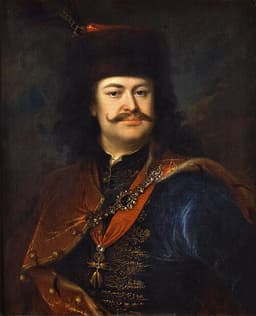
Francis II Rakoczi
Revolutionary · Modern
54.2Total

Julius Caesar
General · Ancient
82.8Total
Basic Information
Born
1676
-100
Died
1735
-44
Era
Modern
Ancient
Nationality
Hungary
Roman Republic
Occupation
Revolutionary
General
Civilization
Western
Western
Score Comparison
Military (10%)
55.0
88.0
Political (20%)
46.6
78.0
Influence (20%)
57.2
85.0
Legacy (20%)
52.0
82.0
Leadership (15%)
57.6
80.0
Strategy (15%)
57.5
85.0
TOTAL
54.2
82.8
Francis II Rakoczi — Complete Timeline
1703 AD
Rákóczi's War of IndependenceWar◆ Major
Francis II Rakoczi led a major uprising against Habsburg rule in Hungary, known as R
War of IndependenceHabsburgRebellion
Impact: regional
1704 AD
Election as Prince of TransylvaniaPolitical Action◆ Major
Francis II Rakoczi was elected Prince of Transylvania by the Hungarian estates, leading the anti-Habsburg rebellion. His election marked the formal leadership of the uprising.
ElectionRebellion
Impact: regional
1708 AD
Battle of TrencinWar◆ Major
Francis II Rakoczi's forces were decisively defeated by the Habsburg army at the Battle of Trencin. The defeat marked a turning point, leading to the decline of the rebellion.
BattleDefeatTurning Point
Impact: regionaltragic
1711 AD
Exile in the Ottoman EmpirePolitical Action◆ Major
After the failure of the rebellion, Francis II Rakoczi went into exile in the Ottoman Empire. He refused to accept Habsburg amnesty and lived in Ottoman territory until his death.
ExileOttoman
Impact: regionaltragic
Julius Caesar — Complete Timeline
58 BC
Gallic WarsWar◆ Major
Caesar, as proconsul of Gaul, launched a series of campaigns that conquered all of Gaul (modern France, Belgium, and parts of Switzerland). He fought numerous battles, including against the Helvetii, the Belgae, and the Gallic chieftain Vercingetorix. The wars brought immense wealth and a loyal army to Caesar.
Gallic WarsConquestRoman Expansion
Impact: regional
49 BC
Crossing the RubiconPolitical Action◆ Major
Caesar led Legio XIII across the Rubicon River into Italy, defying the Roman Senate's order to disband his army. This act triggered a civil war against Pompey and the Optimates, ultimately leading to Caesar's dictatorship and the end of the Roman Republic.
Roman Civil WarEnd of RepublicPower Struggle
Impact: global
48 BC
Battle of PharsalusWar◆ Major
Caesar's outnumbered army defeated the larger forces of Pompey the Great at Pharsalus in Greece. Caesar's tactical use of a reserve line to counter Pompey's cavalry charge proved decisive. Pompey fled to Egypt, where he was assassinated, leaving Caesar as the undisputed master of the Roman world.
Roman Civil WarBattleDecisive Victory
Impact: regional
44 BC
Appointment as Dictator for LifePolitical Action◆ Major
The Roman Senate appointed Caesar dictator perpetuo (dictator for life), granting him unprecedented personal power. This move concentrated military, legislative, and judicial authority in one person, effectively ending the Roman Republic's traditional system of checks and balances and alarming many senators.
DictatorshipEnd of RepublicPower Consolidation
Impact: regionaldestructive
Assassination on the Ides of MarchPolitical Action◆ Major
A group of Roman senators, led by Marcus Junius Brutus and Gaius Cassius Longinus, stabbed Caesar to death at a meeting of the Senate in the Theatre of Pompey. The assassination was intended to restore the Republic, but instead triggered another civil war that led to the rise of the Roman Empire.
AssassinationRoman PoliticsEnd of Republic
Impact: globaldestructive
Expert Analysis
francis-ii-rakoczi-vs-julius-caesar
# The Ides of March and the Long Road to Exile
On a March morning in 44 BCE, Julius Caesar walked into the Senate chamber in Rome, ignoring a soothsayer's warning. Within moments, he was surrounded by senators he had pardoned, men he had promoted, and friends he had trusted. Sixty knives later, the most powerful man in the Western world lay bleeding at the foot of Pompey's statue. Half a continent away and seventeen centuries later, another rebel leader—Francis II Rákóczi—would face a different kind of end. No daggers awaited him, only the slow erosion of hope, a final ride across the Hungarian plain, and a lifetime of exile in Ottoman lands. Two men who rose against the established order. One changed the world forever; the other became a symbol of what might have been. Why did their fates diverge so dramatically?
Origins
Julius Caesar was born into the twilight of the Roman Republic, a world of senatorial intrigue, civil wars, and restless legions. His family, the Julii, claimed descent from the goddess Venus, but their political fortunes had long since faded. Young Caesar grew up in a Rome where power belonged to men who could command armies, control grain shipments, and sway the mob. He learned early that in a republic rotten with corruption, the only law that mattered was the law of survival.
Francis II Rákóczi entered the world in 1676, a prince of Transylvania born into a Hungary crushed under Habsburg heels. His stepfather had been executed for treason; his mother raised him in secrecy and defiance. Where Caesar inherited a name and a desperate ambition to reclaim lost glory, Rákóczi inherited a wound—a nation bleeding from a century of Ottoman wars, religious persecution, and foreign rule. His Hungary was not a republic teetering on empire's edge but a kingdom already devoured by one.
Rise to Power
Caesar's ascent was a masterpiece of calculated risk. He borrowed fortunes to fund games, allied with Crassus and Pompey in the First Triumvirate, and conquered Gaul with a speed that shocked even his enemies. By 49 BCE, he had an army that worshipped him, a reputation that terrified the Senate, and a political calculus that told him the Rubicon was a line drawn in water. He crossed it, and the Republic fell.
Rákóczi's rise came later and harder. In 1703, at age 27, he raised the Kuruc flag, calling Hungarians to arms against Habsburg oppression. The response was overwhelming—peasants, lesser nobles, and Protestant refugees flocked to his banner. He was elected Prince of Transylvania in 1704, a title that sounded grand but commanded no treasury, no navy, and no professional army. His power rested on the fury of a people, not the discipline of legions. Caesar conquered Gaul with steel and siege engines; Rákóczi rallied a nation with words and the memory of martyrs.
Leadership & Governance
Caesar ruled with an iron hand wrapped in velvet rhetoric. He reformed the calendar, granted citizenship to provincials, launched public works, and centralized authority in ways that made the old senatorial class irrelevant. His military genius was undeniable—at Alesia, he starved a Gallic army into submission while simultaneously defeating a relief force. He understood that war was politics by other means, and politics was war by other means.
Rákóczi governed differently. He issued proclamations, convened diets, and tried to build a modern state from the ruins of feudal Hungary. He printed currency, organized a postal system, and attempted to create a standing army. But his military record was mixed at best. The Battle of Trencin in 1708 was his Alesia—except he lost. His forces were crushed by Habsburg regulars, and the rebellion never truly recovered. Where Caesar combined political vision with tactical brilliance, Rákóczi possessed the vision but lacked the steel.
Triumph & Tragedy
Caesar's greatest triumph was also his tragedy: he became too powerful to live. His dictatorship for life, his acceptance of divine honors, his affair with Cleopatra—each act made the conspiracy against him inevitable. The Ides of March was the Republic's last gasp and his own.
Rákóczi's tragedy was quieter but no less profound. After Trencin, his rebellion bled out slowly. By 1711, he refused the Habsburgs' offer of amnesty and chose exile in the Ottoman Empire rather than submission. He died in 1735 at Tekirdağ, on the shores of the Sea of Marmara, far from the Carpathian mountains he had tried to free. His body was eventually returned to Hungary, but his dream of independence was buried with him.
Character & Destiny
Caesar was audacity incarnate. "The die is cast," he said at the Rubicon, and he meant it—not as a gamble but as a statement of will. He believed that history belonged to those who seized it. His character made him unstoppable, then made him a target. He could not imagine a world where he was not the center of it, and that blindness cost him everything.
Rákóczi was a man of principle, not pragmatism. He refused to compromise, refused to negotiate, refused to accept defeat. His memoirs, written in exile, are filled with dignity and sorrow. He was a nobleman who became a revolutionary, but he never fully shed the old world's constraints. He believed in honor when the Habsburgs believed in power. That made him a hero—and a failure.
Legacy
Caesar's legacy is the Roman Empire itself. His name became a title—Kaiser, Tsar, Caesar—and his reforms shaped Western governance for two millennia. He is remembered as a genius, a tyrant, and the man who ended the Republic. His assassination did not restore liberty; it merely cleared the stage for Augustus.
Rákóczi's legacy is quieter but enduring. He is Hungary's national hero, a symbol of resistance against overwhelming odds. His statue stands in Budapest, his portrait hangs in Parliament, and his name is taught to every Hungarian schoolchild. But his war of independence failed. He did not free his nation; he only proved that it could dream of freedom. His total score of 67.6, modest by history's reckoning, reflects a life of noble effort without decisive victory.
Conclusion
Caesar and Rákóczi both dared to challenge the world as it was. One succeeded beyond measure, only to be destroyed by his success. The other failed in his lifetime but became immortal in his people's memory. Their stories remind us that history judges not only by outcomes but by intentions—and that the line between triumph and tragedy is often drawn by the sharp edge of circumstance. Caesar crossed the Rubicon and changed the world. Rákóczi crossed into exile and kept a nation's hope alive. Which is the greater legacy? Perhaps it depends on whether you measure history by what was built—or by what was dreamed.
Rankings
🥇
Julius CaesarLeader
Mil: 88.0Pol: 78.0Inf: 85.0
82.8
🥈
Francis II Rakoczi
Mil: 55.0Pol: 46.6Inf: 57.2
54.2
+28.6 behind
How This Comparison Works
Algorithm
Each figure is scored on 6 dimensions (0—100 scale) based on structured historical data: Military (10%), Political (20%), Influence (20%), Legacy (20%), Leadership (15%), Strategy (15%). The weighted total produces the final ranking.
Data Sources
Scores are computed from structured sub-indicators in the database. Scale factors adjust for era (Ancient ×0.85, Modern ×1.0) and civilization size (Eastern ×1.05, Other ×0.80) to account for differences in population and military scale.
Maximum 3 Figures
Comparisons are limited to 2—3 figures to ensure readability and statistical meaningfulness.
Error Margins
±5 points per dimension — Sub-scores are derived from historical records with inherent uncertainty. Two figures within 5 points on a dimension should be considered roughly equivalent in that area.
Total Score Accuracy
±3 points overall — The weighted combination of 6 dimensions produces a total score with approximately ±3 points of uncertainty. Differences of less than 3 points are not statistically significant— the figures are effectively tied.
Known Limitations
- Historical records are incomplete and uneven across civilizations
- Figures from oral-tradition societies may be underrepresented
- Occupation labels can misclassify multi-role figures
- Scores measure capability and impact, not moral character
- Quantitative scoring is a comparison tool, not absolute truth
Capability Radar
Military (10%) — Battles & Warfare
Battles
65
95
Win Rate
55
92
Expansion
45
97
Political (20%) — Governance & Reform
Reform
55
90
Diplomacy
50
85
Economy
40
82
Influence (20%) — Cultural & Global Reach
Cultural
60
88
Global
45
94
Legacy (20%) — Historical Impact
Historical
65
95
Longevity
55
96
Leadership (15%) — Power & Stability
Tenure
50
75
Stability
30
60
Strategy (15%) — Tactics & Innovation
Strategy
65
94
Tactics
60
96
Reform
50
88
Similar Comparisons
Comments & Discussion
No comments yet. Be the first to share your thoughts!