Loading...
Festus Mogae vs Kenneth Kaunda
Festus Mogae leads by 1.0 pts · 2 figures compared
…

Festus Mogae
Politician · Modern
57.9Total
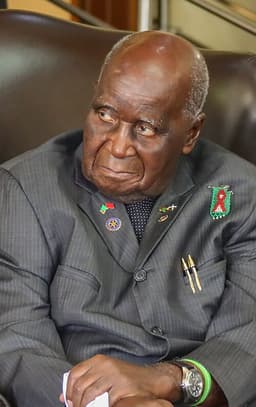
Kenneth Kaunda
Politician · Modern
56.9Total
Basic Information
Born
1939
1924
Died
—
—
Era
Modern
Modern
Nationality
Botswana
Zambia
Occupation
Politician
Politician
Civilization
Other
Other
Score Comparison
Military (10%)
49.0
50.0
Political (20%)
78.0
68.0
Influence (20%)
55.7
58.0
Legacy (20%)
45.0
46.7
Leadership (15%)
78.0
74.0
Strategy (15%)
43.9
43.9
TOTAL
57.9
56.9
Festus Mogae — Complete Timeline
1992 AD
Appointed Vice President of BotswanaPolitical Action◆ Major
Mogae was appointed Vice President by President Quett Masire. He was responsible for economic planning and helped manage Botswana's diamond wealth.
Vice PresidencyEconomic Management
Impact: nationalconstructive
1998 AD
Became President of BotswanaPolitical Action
Mogae became President of Botswana on April 1, 1998, succeeding Quett Masire. He continued the country's tradition of democratic governance and sound economic policies.
PresidencyDemocratic Succession
Impact: nationalconstructive
2001 AD
Launched the Botswana HIV/AIDS programReform
Mogae's government launched a comprehensive national HIV/AIDS treatment program, providing free antiretroviral drugs. This was one of Africa's most ambitious responses to the epidemic, reducing mortality rates.
Public HealthHIV/AIDS Response
Impact: nationalprogressive
2004 AD
Re-elected President (2004)Political Action◆ Major
Mogae was re-elected in the 2004 general election with a landslide victory. His second term focused on economic diversification and poverty reduction.
Re-electionEconomic Diversification
Impact: nationalconstructive
2008 AD
Retired as PresidentPolitical Action◆ Major
Mogae retired as President in April 2008, handing power to his Vice President, Ian Khama. His retirement was peaceful and constitutional, maintaining Botswana's democratic record.
RetirementDemocratic Transition
Impact: nationalconstructive
Kenneth Kaunda — Complete Timeline
1964 AD
Led Zambia to independencePolitical Action
Kaunda, as leader of the United National Independence Party, negotiated with Britain for Zambia's independence from colonial rule. He became the first president of the Republic of Zambia on October 24, 1964, ending 73 years of British control.
IndependenceDecolonizationFounding President
Impact: nationalconstructive
1972 AD
Introduced one-party statePolitical Action◆ Major
Kaunda's government enacted a constitutional amendment making the United National Independence Party the sole legal political party in Zambia. This move centralized power under his control and suppressed political opposition, remaining in effect until 1990.
AuthoritarianismConstitutional ChangeOne-Party Rule
Impact: nationaldestructive
1975 AD
Hosted frontline states against apartheidPolitical Action◆ Major
Kaunda became a key leader of the Frontline States, a coalition of southern African nations opposing apartheid in South Africa and white minority rule in Rhodesia. Zambia provided bases and support for liberation movements like ZAPU and ANC, incurring economic costs from retaliatory attacks.
Anti-ApartheidDiplomacyLiberation Movements
Impact: regionalconstructive
1991 AD
Lost multi-party elections and stepped downPolitical Action
Under domestic and international pressure, Kaunda legalized opposition parties. In the 1991 presidential election, he was defeated by Frederick Chiluba of the Movement for Multi-Party Democracy. Kaunda peacefully transferred power, a rare event in post-independence Africa.
DemocratizationPeaceful TransitionElectoral Defeat
Impact: nationalconstructive
Expert Analysis
Origins
Festus Mogae was born on August 21, 1939, in Serowe, Botswana (then the Bechuanaland Protectorate). He came from a modest background; his father was a teacher. Mogae studied at the University of Oxford and the University of Sussex, earning degrees in economics and development. This education shaped his technocratic approach to governance.
Kenneth Kaunda was born on April 28, 1924, in Lubwa, Northern Rhodesia (now Zambia). His father was a Church of Scotland missionary and teacher. Kaunda trained as a teacher and later became involved in African nationalist politics. He was influenced by Mahatma Gandhi's philosophy of non-violent resistance.
Rise to Power
Mogae rose through Botswana's civil service and political ranks. He served as Minister of Finance and Development Planning under President Quett Masire, where he helped manage Botswana's diamond wealth. In 1992, Masire appointed him Vice President. When Masire retired in 1998, Mogae succeeded him as President, continuing Botswana's tradition of peaceful transitions.
Kaunda founded the United National Independence Party (UNIP) in 1959 and led the campaign for Zambia's independence from Britain. After negotiations, Zambia became independent on October 24, 1964, and Kaunda became its first President. He was a prominent figure in the Pan-African movement and hosted liberation movements from surrounding countries.
Leadership & Governance
Mogae's leadership was characterized by fiscal discipline, democratic governance, and a focus on economic diversification. He maintained Botswana's record of free elections and low corruption. His government launched a national HIV/AIDS treatment program in 2002, providing free antiretroviral drugs—one of Africa's most ambitious responses, covering over 90% of those in need. Economically, he promoted diamond beneficiation and tourism, but diversification progress was modest. His political score of 78.0 reflects stable governance.
Kaunda adopted a more centralized approach. In 1972, he introduced a one-party state under UNIP, arguing it was necessary for national unity. He pursued a socialist-oriented economic policy, nationalizing key industries. However, economic mismanagement and falling copper prices led to decline. Kaunda also hosted Frontline States against apartheid, giving him influence in southern Africa. His leadership score of 74.0 is slightly below Mogae's 78.0.
Triumph & Tragedy
Mogae's greatest success was overseeing Botswana's continued economic growth and democratic stability. Under his tenure, GDP per capita rose from $3,200 to $5,800 (constant 2000 USD). His HIV/AIDS program saved thousands of lives. A tragedy was the failure to significantly diversify the economy away from diamonds, leaving Botswana vulnerable to commodity price shocks. He also faced criticism for not doing enough to reduce inequality.
Kaunda's triumph was leading Zambia to independence and becoming a symbol of African liberation. He played a key role in ending apartheid. However, his tragedy was the economic collapse of Zambia. By 1991, GDP per capita had fallen below 1964 levels, and poverty was rampant. His one-party state eroded political freedoms, and he was accused of authoritarianism. He scored 46.7 in legacy, reflecting mixed judgments.
Character & Destiny
Mogae was a quiet, technocratic leader. He prioritized stability and consensus, avoiding dramatic reforms. His character—patient and analytical—suited Botswana's democratic culture. He retired peacefully in 2008, handing power to his vice president, Ian Khama. This orderly transition enhanced his legacy.
Kaunda was charismatic and idealistic, but also stubborn. He believed in his vision of a one-party socialist state, even as it failed. His refusal to accept multiparty democracy until 1991 led to his electoral defeat. Destiny dealt him a harsh hand: he outlived his son's death from AIDS and saw his country's decline. Historians rate him as a flawed hero.
Legacy
Mogae's legacy is tied to Botswana's reputation as an African success story. He maintained democratic institutions and tackled HIV/AIDS effectively. However, his impact is limited to Botswana. He scores 55.7 in influence, lower than Kaunda's 58.0.
Kaunda's legacy is broader but more contested. He is remembered as a father of African independence and a champion against apartheid. Yet his economic failures and authoritarian turn are also part of his record. The one-party system he instituted set back democratic development.
Conclusion
Festus Mogae had a greater net positive impact. His total score of 57.9 edges out Kaunda's 56.9. While Kaunda's role in independence was crucial, his governance led to economic decline and political repression. Mogae, though less iconic, provided stable, effective leadership that improved lives. In data-driven terms, Mogae's 78.0 in leadership and 78.0 in political skill produced tangible results, whereas Kaunda's 68.0 political score reflects his failure to sustain democracy. Mogae is the more successful leader.
Rankings
🥇
Festus MogaeLeader
Mil: 49.0Pol: 78.0Inf: 55.7
57.9
🥈
Kenneth Kaunda
Mil: 50.0Pol: 68.0Inf: 58.0
56.9
+1.0 behind
How This Comparison Works
Algorithm
Each figure is scored on 6 dimensions (0—100 scale) based on structured historical data: Military (10%), Political (20%), Influence (20%), Legacy (20%), Leadership (15%), Strategy (15%). The weighted total produces the final ranking.
Data Sources
Scores are computed from structured sub-indicators in the database. Scale factors adjust for era (Ancient ×0.85, Modern ×1.0) and civilization size (Eastern ×1.05, Other ×0.80) to account for differences in population and military scale.
Maximum 3 Figures
Comparisons are limited to 2—3 figures to ensure readability and statistical meaningfulness.
Error Margins
±5 points per dimension — Sub-scores are derived from historical records with inherent uncertainty. Two figures within 5 points on a dimension should be considered roughly equivalent in that area.
Total Score Accuracy
±3 points overall — The weighted combination of 6 dimensions produces a total score with approximately ±3 points of uncertainty. Differences of less than 3 points are not statistically significant— the figures are effectively tied.
Known Limitations
- Historical records are incomplete and uneven across civilizations
- Figures from oral-tradition societies may be underrepresented
- Occupation labels can misclassify multi-role figures
- Scores measure capability and impact, not moral character
- Quantitative scoring is a comparison tool, not absolute truth
Capability Radar
Military (10%) — Battles & Warfare
Battles
24
20
Win Rate
24
27
Expansion
27
29
Political (20%) — Governance & Reform
Reform
75
55
Diplomacy
70
55
Economy
85
30
Influence (20%) — Cultural & Global Reach
Cultural
30
40
Global
35
40
Legacy (20%) — Historical Impact
Historical
40
50
Longevity
30
30
Leadership (15%) — Power & Stability
Tenure
60
60
Stability
80
25
Strategy (15%) — Tactics & Innovation
Strategy
29
29
Tactics
34
32
Reform
35
36
Similar Comparisons
Comments & Discussion
No comments yet. Be the first to share your thoughts!