Loading...
Kenneth Kaunda vs Napoleon Bonaparte
Napoleon Bonaparte leads by 14.0 pts · 2 figures compared
…
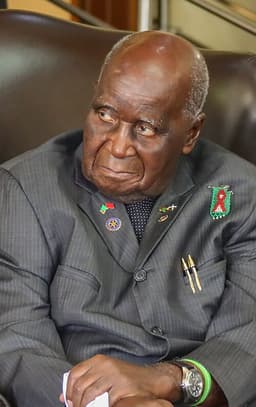
Kenneth Kaunda
Politician · Modern
56.9Total

Napoleon Bonaparte
General · Modern
70.9Total
Basic Information
Born
1924
1769
Died
—
1821
Era
Modern
Modern
Nationality
Zambia
France
Occupation
Politician
General
Civilization
Other
Western
Score Comparison
Military (10%)
50.0
94.0
Political (20%)
68.0
72.0
Influence (20%)
58.0
40.0
Legacy (20%)
46.7
80.0
Leadership (15%)
74.0
78.0
Strategy (15%)
43.9
90.0
TOTAL
56.9
70.9
Kenneth Kaunda — Complete Timeline
1964 AD
Led Zambia to independencePolitical Action
Kaunda, as leader of the United National Independence Party, negotiated with Britain for Zambia's independence from colonial rule. He became the first president of the Republic of Zambia on October 24, 1964, ending 73 years of British control.
IndependenceDecolonizationFounding President
Impact: nationalconstructive
1972 AD
Introduced one-party statePolitical Action◆ Major
Kaunda's government enacted a constitutional amendment making the United National Independence Party the sole legal political party in Zambia. This move centralized power under his control and suppressed political opposition, remaining in effect until 1990.
AuthoritarianismConstitutional ChangeOne-Party Rule
Impact: nationaldestructive
1975 AD
Hosted frontline states against apartheidPolitical Action◆ Major
Kaunda became a key leader of the Frontline States, a coalition of southern African nations opposing apartheid in South Africa and white minority rule in Rhodesia. Zambia provided bases and support for liberation movements like ZAPU and ANC, incurring economic costs from retaliatory attacks.
Anti-ApartheidDiplomacyLiberation Movements
Impact: regionalconstructive
1991 AD
Lost multi-party elections and stepped downPolitical Action
Under domestic and international pressure, Kaunda legalized opposition parties. In the 1991 presidential election, he was defeated by Frederick Chiluba of the Movement for Multi-Party Democracy. Kaunda peacefully transferred power, a rare event in post-independence Africa.
DemocratizationPeaceful TransitionElectoral Defeat
Impact: nationalconstructive
Napoleon Bonaparte — Complete Timeline
1799 AD
Coup of 18 BrumaireOther◆ Major
Napoleon Bonaparte, with support from his brother Lucien and key political figures, overthrew the Directory in a bloodless coup. He established the Consulate with himself as First Consul, effectively becoming the ruler of France. This event ended the French Revolution's most unstable period.
French RevolutionCoupRise to Power
Impact: regional
1804 AD
Promulgation of the Napoleonic CodeOther◆ Major
Napoleon enacted the Civil Code of the French, known as the Napoleonic Code, a comprehensive set of laws that replaced the fragmented feudal legal systems. The code established legal equality, protected property rights, and secularized law. It became the basis for legal systems in many European and world countries.
Legal ReformNapoleonic CodeCivil Law
Impact: globalconstructive
1805 AD
Battle of AusterlitzWar◆ Major
Napoleon's Grande Arm
Napoleonic WarsBattleDecisive Victory
Impact: global
1812 AD
Invasion of RussiaWar◆ Major
Napoleon led the Grande Arm
Napoleonic WarsInvasionDisaster
Impact: globaldestructive
1815 AD
Battle of WaterlooWar◆ Major
Napoleon's French army was defeated by the combined forces of the Duke of Wellington's Anglo-Allied army and Gebhard Leberecht von Bl
Napoleonic WarsBattleFinal Defeat
Impact: globaldestructive
Expert Analysis
kenneth-kaunda-vs-napoleon-bonaparte
# The Emperor and the Teacher: Two Paths to Power, Two Destinies
In the summer of 1815, a man who had once commanded half a million soldiers stood alone on the deck of a British warship, watching the coast of France disappear into the Atlantic mist. He was a prisoner now, bound for a remote island in the South Atlantic where he would die six years later, consumed by bitterness and stomach cancer. In the summer of 1991, another man—older, weary, but dignified—walked out of State House in Lusaka after twenty-seven years in power. He had lost an election, fair and square, and he went home to tend his garden. One was Napoleon Bonaparte, the greatest conqueror of the modern age. The other was Kenneth Kaunda, the founding father of Zambia. They shared a century in name only—both lived in the modern era—but their worlds could not have been more different. What drove one to die in exile and the other to retire in peace? The answer lies not just in their choices, but in the very nature of the power they sought.
Origins
Napoleon was born in 1769 on the island of Corsica, a place that had been sold to France by the Republic of Genoa just a year before. He grew up speaking Italian, not French, and his family were minor nobles of modest means. The French Revolution, which erupted when he was twenty, shattered the old order and opened a path for talent. Napoleon was short, ambitious, and hungry—not for food, but for glory. He devoured military history, studied artillery, and watched as the Revolution devoured its own children. From the chaos, he learned one lesson above all: in a world without rules, the man with the sword makes the rules.
Kenneth Kaunda was born in 1924 in a British protectorate called Northern Rhodesia, a land of copper mines and colonial administrators. His father was a missionary teacher from Malawi, his mother a farmer. Kaunda grew up singing hymns and learning English, but he also saw what colonial rule meant: black men digging in the mines while white men sat in the offices. He trained as a teacher, not a soldier, and when he entered politics, he carried a Bible, not a sword. Where Napoleon saw the world as a battlefield to be conquered, Kaunda saw it as a classroom to be taught.
Rise to Power
Napoleon’s rise was meteoric. At twenty-four, he drove the British out of Toulon and was promoted to brigadier general. At twenty-six, he saved the revolutionary government from a royalist uprising with a "whiff of grapeshot"—a brutal artillery barrage that scattered the mob in the streets of Paris. By thirty, he was First Consul of France, the de facto ruler of a nation of thirty million. His path was paved with victories: the Italian campaign of 1796, the Egyptian expedition of 1798, the Battle of Austerlitz in 1805 where he crushed the combined armies of Austria and Russia. Each triumph fed the next, and by 1812, Napoleon ruled an empire that stretched from Spain to Poland.
Kaunda’s rise was slower, steadier, and entirely different. He became leader of the United National Independence Party in 1960, and his weapon was not the cannon but the negotiation table. In 1964, at age forty, he led Zambia to independence without a shot fired—a rare achievement in southern Africa, where Rhodesia and South Africa were already arming for racial war. His turning point was not a battle but a handshake with British officials who agreed to transfer power. Where Napoleon seized his moment with violence, Kaunda seized his with patience.
Leadership & Governance
Napoleon governed as he fought: decisively, brilliantly, and ruthlessly. His Napoleonic Code, introduced in 1804, reformed French law into a clear, rational system that abolished feudal privileges and protected property rights. It remains the basis of civil law in much of Europe today. He built roads, founded the Bank of France, and centralized education. But he also crowned himself Emperor in 1804, placed his brothers on European thrones, and silenced dissent with a secret police. His military genius was undeniable—his strategy score of 93 reflects a mind that could read a battlefield like a book—but his political score of 75 reveals a fatal flaw: he could not stop conquering.
Kaunda’s leadership was gentler but more flawed. He promoted a philosophy he called "humanism," a blend of Christian ethics and African socialism. He built schools and hospitals, expanded access to education, and made Zambia a haven for liberation movements fighting apartheid in South Africa and Rhodesia. In 1975, he hosted the Frontline States, a coalition of southern African nations that coordinated the struggle against white minority rule. But in 1972, he introduced a one-party state, believing that democracy was a luxury poor nations could not afford. His political score of 64.5 reflects a man who meant well but drifted toward authoritarianism.
Triumph & Tragedy
Napoleon’s greatest triumph was Austerlitz, where he outmaneuvered a larger enemy army and destroyed it. His greatest tragedy was the invasion of Russia in 1812, where he lost half a million men to winter, hunger, and guerrilla attacks. He never recovered. Exiled to Elba in 1814, he escaped, raised another army, and was finally crushed at Waterloo in 1815—a battle he should have won but lost because his generals hesitated, his cavalry charged too early, and the Prussian army arrived just in time. He died on Saint Helena in 1821, at age fifty-one, a prisoner of the British.
Kaunda’s triumph was independence itself—a peaceful transition that spared Zambia the bloodshed of Mozambique and Angola. His tragedy was the slow decay of his dream. By the 1980s, copper prices had collapsed, the economy was in ruins, and Zambians were tired of one-party rule. In 1991, under pressure from protests and international donors, Kaunda legalized opposition parties. He lost the election to Frederick Chiluba, a former union leader, and stepped down without a fight. He was sixty-seven years old. He did not flee, did not call in the army, did not die in exile. He simply left.
Character & Destiny
Napoleon’s character was his destiny. He was brilliant, arrogant, and incapable of stopping. "Power is my mistress," he once said, and he meant it. He could not share power, could not trust his subordinates, could not accept defeat. His ambition was a fire that consumed everything around it, including himself. He died bitter, writing memoirs that blamed everyone but himself.
Kaunda’s character was more complex. He was idealistic, stubborn, and genuinely believed he was doing good. But he was also naive—he thought one-party rule would bring unity, but it brought stagnation. When the moment came to leave, however, he showed a grace that Napoleon never possessed. He accepted the verdict of the ballot box. His legacy score of 61.2 is modest, but it includes something Napoleon’s does not: a peaceful transition of power.
Legacy
Napoleon’s legacy is written in stone and law. The Napoleonic Code, the metric system, the modern French state—all bear his imprint. He is remembered as a military genius and a tyrant, a modernizer and a conqueror. His name appears on streets, monuments, and battlefields across Europe. But his final years were spent in a damp house on a remote island, watched by British guards, dreaming of a glory that had turned to ash.
Kaunda’s legacy is quieter. He is remembered as the father of Zambian independence, a man who wore safari suits and played the piano, who wept in public and forgave his enemies. He lived to be ninety-seven, long enough to see his successor lose power, long enough to watch Zambia stumble through democracy. He died at home, surrounded by family, not in exile but in peace. His total score of 63.0 is far lower than Napoleon’s 82.4, but it measures something different: not how much power a man accumulated, but how well he used it, and when he let it go.
Conclusion
In the end, the difference between Napoleon and Kaunda is the difference between a comet and a candle. The comet blazes across the sky, stunning the world, then vanishes into darkness. The candle burns steadily, gives light to a small room, and goes out unnoticed. Napoleon changed the map of Europe; Kaunda changed the map of one country. But when the comet fell, it left a crater. When the candle went out, the room was still warm. Which is the greater achievement? History will argue, but perhaps the answer lies in a question Napoleon never asked: what is the point of power if you cannot leave it behind?
Rankings
🥇
Napoleon BonaparteLeader
Mil: 94.0Pol: 72.0Inf: 40.0
70.9
🥈
Kenneth Kaunda
Mil: 50.0Pol: 68.0Inf: 58.0
56.9
+14.0 behind
How This Comparison Works
Algorithm
Each figure is scored on 6 dimensions (0—100 scale) based on structured historical data: Military (10%), Political (20%), Influence (20%), Legacy (20%), Leadership (15%), Strategy (15%). The weighted total produces the final ranking.
Data Sources
Scores are computed from structured sub-indicators in the database. Scale factors adjust for era (Ancient ×0.85, Modern ×1.0) and civilization size (Eastern ×1.05, Other ×0.80) to account for differences in population and military scale.
Maximum 3 Figures
Comparisons are limited to 2—3 figures to ensure readability and statistical meaningfulness.
Error Margins
±5 points per dimension — Sub-scores are derived from historical records with inherent uncertainty. Two figures within 5 points on a dimension should be considered roughly equivalent in that area.
Total Score Accuracy
±3 points overall — The weighted combination of 6 dimensions produces a total score with approximately ±3 points of uncertainty. Differences of less than 3 points are not statistically significant— the figures are effectively tied.
Known Limitations
- Historical records are incomplete and uneven across civilizations
- Figures from oral-tradition societies may be underrepresented
- Occupation labels can misclassify multi-role figures
- Scores measure capability and impact, not moral character
- Quantitative scoring is a comparison tool, not absolute truth
Capability Radar
Military (10%) — Battles & Warfare
Battles
20
95
Win Rate
27
90
Expansion
29
95
Political (20%) — Governance & Reform
Reform
55
95
Diplomacy
55
80
Economy
30
85
Influence (20%) — Cultural & Global Reach
Cultural
40
85
Global
40
90
Legacy (20%) — Historical Impact
Historical
50
95
Longevity
30
90
Leadership (15%) — Power & Stability
Tenure
60
85
Stability
25
70
Strategy (15%) — Tactics & Innovation
Strategy
29
95
Tactics
32
98
Reform
36
92
Similar Comparisons
Comments & Discussion
CorsicanThunder6/17/2026
Let's be real, this comparison is nonsense. Napoleon conquered half of Europe by age 35, codified civil law used today, and still found time for a disastrous Russian campaign. Kaunda ran a single-party copper economy into the ground while wearing safari suits. One reshaped continents, the other couldn't even keep Zambia out of debt. Matching them is like comparing a lion to a labrador. Nice guy Kaunda, sure, but Napoleon rewrote history.
矿工总理6/17/2026
拿过统治权杖,用兵如神,拿破仑配得上“天才”二字。卡翁达呢?赞比亚独立后他从没打赢一场经济战争,铜价一跌国家就垮。人家拿破仑打了六十多场会战,只剩滑铁卢栽了;卡翁达27年执政,满嘴“人道主义哲学”,实际只会跟党羽分肥。说他“有尊严下台”不是美德,是黔驴技穷。别拿将军比教书匠。
DataSkeptic426/17/2026
I appreciate the narrative flair, but this comparison lacks statistical rigor. Kaunda oversaw Zambia's GDP per capita drop from ~$1,200 at independence to ~$400 by 1991 (constant dollars). Napoleon's France peaked at 44% of European GDP under his rule. One managed collapse, the other engineered expansion. The "peaceful retirement" angle ignores that Kaunda had zero military options left—his army was 10,000 strong versus France's 600,000. Context matters more than sentiment.
史实测谎仪6/17/2026
浪漫化历史,要看真硬货:拿破仑流放圣赫勒拿时有800人随从伺候,卡翁达退休住普通平房?这倒不假。但拿破仑1796年意大利战役以4万兵破14万奥军,阵斩皮埃蒙特。卡翁达1991年大选输给奇卢巴,仅仅4年后就被政变逼逃英使馆。说“ peacefully garden”之前,记得他求饶式流亡的狼狈。悲剧英雄?卡翁达连悲剧感都没撑起来。
LegionaryRomancer6/17/2026
Tragedy demands scale, and Napoleon provided it—500,000 men lost in Russia, exile, a son who died in Austrian captivity. That's Herodotus-worthy. Kaunda's story reads like a BBC afterschool special: moral high ground, garden, memoirs. I'll take the man who said "There is no immortality but the memory that is left in the minds of men" over the one who sang hymns at state dinners. History remembers conquerors, not conciliators.
铜带遗孤6/17/2026
赞比亚人看这比较只有苦笑。卡翁达统一了73个部落不假,但代价是什么?1970年代饥荒饿死人时他在放声歌唱