Loading...
Heo Jun vs Kenneth Kaunda
Kenneth Kaunda leads by 10.1 pts · 2 figures compared
…

Heo Jun
Politician · Modern
46.8Total
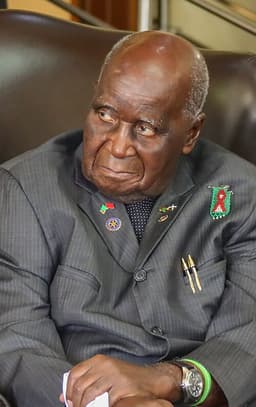
Kenneth Kaunda
Politician · Modern
56.9Total
Basic Information
Born
1539
1924
Died
1615
—
Era
Modern
Modern
Nationality
Korea
Zambia
Occupation
Politician
Politician
Civilization
Eastern
Other
Score Comparison
Military (10%)
15.6
50.0
Political (20%)
36.5
68.0
Influence (20%)
55.0
58.0
Legacy (20%)
52.0
46.7
Leadership (15%)
62.2
74.0
Strategy (15%)
36.9
43.9
TOTAL
46.8
56.9
Heo Jun — Complete Timeline
1608 AD
Treatment of King Seonjo's IllnessOther
Heo Jun served as the royal physician for King Seonjo and successfully treated the king during a serious illness. This earned him royal favor and the resources to compile the Dongui Bogam.
MedicineRoyal ServiceTreatment
Impact: nationalconstructive
1610 AD
Exile and Return under King GwanghaegunPolitical Action◆ Major
Heo Jun was exiled due to political factional struggles after King Seonjo's death. He was later recalled by King Gwanghaegun to complete the Dongui Bogam, which was published under royal patronage.
ExilePoliticsMedicine
Impact: national
1613 AD
Compilation of the Dongui Bogam (Principles and Practice of Eastern Medicine)Cultural
Heo Jun completed the Dongui Bogam, a comprehensive 25-volume encyclopedia of traditional Korean medicine. The work synthesized Chinese and Korean medical knowledge, covering diagnosis, treatment, and pharmacology. It became a classic of East Asian medicine.
MedicineEncyclopediaTraditional Knowledge
Impact: globalconstructive
Publication of the Dongui Bogam in ChineseCultural◆ Major
The Dongui Bogam was published in classical Chinese, the scholarly language of East Asia. This allowed the text to be disseminated to China and Japan, where it influenced medical practices for centuries.
MedicinePublicationInternational Influence
Impact: regionalconstructive
Kenneth Kaunda — Complete Timeline
1964 AD
Led Zambia to independencePolitical Action
Kaunda, as leader of the United National Independence Party, negotiated with Britain for Zambia's independence from colonial rule. He became the first president of the Republic of Zambia on October 24, 1964, ending 73 years of British control.
IndependenceDecolonizationFounding President
Impact: nationalconstructive
1972 AD
Introduced one-party statePolitical Action◆ Major
Kaunda's government enacted a constitutional amendment making the United National Independence Party the sole legal political party in Zambia. This move centralized power under his control and suppressed political opposition, remaining in effect until 1990.
AuthoritarianismConstitutional ChangeOne-Party Rule
Impact: nationaldestructive
1975 AD
Hosted frontline states against apartheidPolitical Action◆ Major
Kaunda became a key leader of the Frontline States, a coalition of southern African nations opposing apartheid in South Africa and white minority rule in Rhodesia. Zambia provided bases and support for liberation movements like ZAPU and ANC, incurring economic costs from retaliatory attacks.
Anti-ApartheidDiplomacyLiberation Movements
Impact: regionalconstructive
1991 AD
Lost multi-party elections and stepped downPolitical Action
Under domestic and international pressure, Kaunda legalized opposition parties. In the 1991 presidential election, he was defeated by Frederick Chiluba of the Movement for Multi-Party Democracy. Kaunda peacefully transferred power, a rare event in post-independence Africa.
DemocratizationPeaceful TransitionElectoral Defeat
Impact: nationalconstructive
Expert Analysis
Origins
Heo Jun was born in 1539 in Seoul, Korea, into a family of lower-ranked officials. His father, Heo Gon, was a minor magistrate. Heo Jun passed the national medical examination in 1571 and entered the royal medical service. His early training in both Chinese and Korean medicine laid the foundation for his later work. Kenneth Kaunda was born on April 28, 1924, at Lubwa Mission in Chinsali, Northern Rhodesia (now Zambia). His father was a missionary teacher from Malawi. Kaunda attended Lubwa Mission School and later worked as a teacher and boarding master. His early exposure to colonial inequality shaped his political consciousness.
Rise to Power
Heo Jun rose to prominence as a royal physician under King Seonjo (r. 1567–1608). He successfully treated the king's serious illness in 1575, earning royal favor. However, after Seonjo's death, Heo Jun was exiled in 1608 due to political factional struggles. He was recalled by King Gwanghaegun in 1610 to complete the Dongui Bogam. Kenneth Kaunda rose through the independence movement. He joined the African National Congress (ANC) in 1950 and became secretary-general. In 1958, he broke away to form the Zambian African National Congress (ZANC), which was banned. He was imprisoned in 1959. After release, he became president of the United National Independence Party (UNIP) in 1960. He led negotiations with Britain, resulting in Zambia's independence on October 24, 1964.
Leadership & Governance
Heo Jun's leadership was scholarly and meticulous. He oversaw the compilation of the Dongui Bogam, a 25-volume encyclopedia synthesizing Chinese and Korean medicine. He organized a team of 10 scholars and physicians, but he was the chief editor. The work was completed in 1613 and published in classical Chinese. His governance style was focused on systematizing medical knowledge for practical use. Kenneth Kaunda's leadership was charismatic and authoritarian. As president, he promoted a philosophy of 'Humanism', blending socialism and African values. He nationalized key industries in the 1970s. In 1972, he introduced a one-party state, making UNIP the sole legal party. He suppressed political dissent but also invested in education and health, achieving high literacy rates. His foreign policy was anti-colonial, hosting Frontline States against apartheid. However, economic mismanagement led to a debt crisis by the 1980s.
Triumph & Tragedy
Heo Jun's greatest triumph was the completion of the Dongui Bogam in 1613, which became a foundational text of Korean medicine. It was designated a UNESCO Memory of the World Register in 2009. His tragedy was his exile in 1608, which interrupted his work. He died in 1615, shortly after the publication. Kenneth Kaunda's triumph was leading Zambia to independence peacefully and becoming its first president. He also played a key role in supporting liberation movements in Southern Africa. His tragedy was the economic decline under his rule: Zambia's GDP per capita fell from $1,300 in 1964 to $600 by 1991. His one-party state stifled political freedoms, and he lost the 1991 election to Frederick Chiluba, stepping down peacefully. He later faced a coup attempt in 1997 and was arrested.
Character & Destiny
Heo Jun was diligent and resilient. He overcame political exile to complete his magnum opus. His character was shaped by Confucian scholarship, emphasizing duty and knowledge. His destiny was to be remembered as a healer. Kenneth Kaunda was idealistic and stubborn. He believed in his vision of Humanism but resisted political change. His character led to both independence and economic failure. Historians note his integrity but also his poor economic management. He scored 74.0 in leadership compared to Heo Jun's 62.2, reflecting his political influence. However, Heo Jun's legacy score of 52.0 versus Kaunda's 46.7 shows the enduring impact of the Dongui Bogam.
Legacy
Heo Jun's legacy is the Dongui Bogam, which remains a core text in traditional Korean medicine. It influenced medical practices in China and Japan. In 2009, it was inscribed in the UNESCO Memory of the World Register. Heo Jun is revered in Korea; his name appears in dramas and textbooks. Kenneth Kaunda's legacy is mixed. He is celebrated as a founding father of Zambia and a champion of African liberation. The Kaunda regime's human rights record and economic policies are criticized. His 'Humanism' philosophy has waned. Zambia remains one of the poorest countries in Africa. Kaunda scored 46.7 in legacy, lower than Heo Jun's 52.0, indicating that the physician's intellectual contribution outlasts the politician's governance.
Conclusion
Heo Jun had greater long-term impact than Kenneth Kaunda. While Kaunda's political scores (68.0 political, 74.0 leadership) exceed Heo Jun's (36.5 political, 62.2 leadership), Heo Jun's legacy (52.0) surpasses Kaunda's (46.7). The Dongui Bogam continues to influence medicine globally, whereas Kaunda's political achievements have been overshadowed by economic decline and authoritarianism. Heo Jun's work is a lasting contribution to human knowledge, whereas Kaunda's impact is limited to a specific region and era. Thus, Heo Jun's impact is greater.
Rankings
🥇
Kenneth KaundaLeader
Mil: 50.0Pol: 68.0Inf: 58.0
56.9
🥈
Heo Jun
Mil: 15.6Pol: 36.5Inf: 55.0
46.8
+10.1 behind
How This Comparison Works
Algorithm
Each figure is scored on 6 dimensions (0—100 scale) based on structured historical data: Military (10%), Political (20%), Influence (20%), Legacy (20%), Leadership (15%), Strategy (15%). The weighted total produces the final ranking.
Data Sources
Scores are computed from structured sub-indicators in the database. Scale factors adjust for era (Ancient ×0.85, Modern ×1.0) and civilization size (Eastern ×1.05, Other ×0.80) to account for differences in population and military scale.
Maximum 3 Figures
Comparisons are limited to 2—3 figures to ensure readability and statistical meaningfulness.
Error Margins
±5 points per dimension — Sub-scores are derived from historical records with inherent uncertainty. Two figures within 5 points on a dimension should be considered roughly equivalent in that area.
Total Score Accuracy
±3 points overall — The weighted combination of 6 dimensions produces a total score with approximately ±3 points of uncertainty. Differences of less than 3 points are not statistically significant— the figures are effectively tied.
Known Limitations
- Historical records are incomplete and uneven across civilizations
- Figures from oral-tradition societies may be underrepresented
- Occupation labels can misclassify multi-role figures
- Scores measure capability and impact, not moral character
- Quantitative scoring is a comparison tool, not absolute truth
Capability Radar
Military (10%) — Battles & Warfare
Battles
16
20
Win Rate
16
27
Expansion
17
29
Political (20%) — Governance & Reform
Reform
40
55
Diplomacy
20
55
Economy
20
30
Influence (20%) — Cultural & Global Reach
Cultural
60
40
Global
55
40
Legacy (20%) — Historical Impact
Historical
65
50
Longevity
70
30
Leadership (15%) — Power & Stability
Tenure
30
60
Stability
30
25
Strategy (15%) — Tactics & Innovation
Strategy
22
29
Tactics
24
32
Reform
29
36
Similar Comparisons
Comments & Discussion
No comments yet. Be the first to share your thoughts!