Loading...
Ferdinand VII of Spain vs Zayed bin Sultan Al Nahyan
Zayed bin Sultan Al Nahyan leads by 18.7 pts · 2 figures compared
…
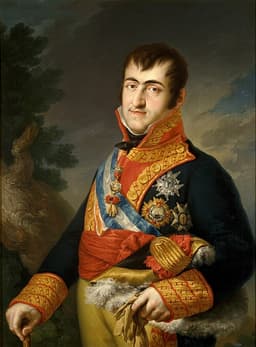
Ferdinand VII of Spain
Emperor · Modern
45.1Total
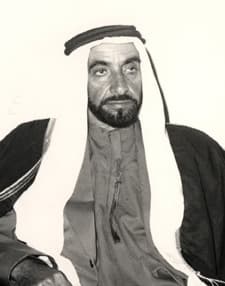
Zayed bin Sultan Al Nahyan
Emperor · Modern
63.8Total
Basic Information
Born
1784
1918
Died
1833
2004
Era
Modern
Modern
Nationality
Spain
UAE
Occupation
Emperor
Emperor
Civilization
Western
Middle Eastern
Score Comparison
Military (10%)
14.9
11.3
Political (20%)
32.2
82.0
Influence (20%)
51.0
68.0
Legacy (20%)
41.7
72.0
Leadership (15%)
74.0
85.0
Strategy (15%)
45.0
25.7
TOTAL
45.1
63.8
Ferdinand VII of Spain — Complete Timeline
1808 AD
Accession to the thronePolitical Action◆ Major
Ferdinand VII became King of Spain after the abdication of his father Charles IV. His reign was interrupted by Napoleon's intervention and the Peninsular War, but he was restored in 1814.
SuccessionMonarchy
Impact: national
1814 AD
Abolition of the Constitution of 1812Political Action
Upon returning to Spain, Ferdinand VII abolished the liberal Constitution of 1812 and restored absolute monarchy. He persecuted liberals and reinstated the Inquisition, reversing the reforms of the Cortes of C
ConstitutionAbsolutismReaction
Impact: nationaldestructive
1820 AD
Trienio LiberalPolitical Action◆ Major
A military revolt led by Rafael del Riego forced Ferdinand VII to reinstate the Constitution of 1812, beginning the Trienio Liberal. Ferdinand was effectively a constitutional monarch for three years.
Liberal RevolutionConstitutionRevolt
Impact: national
1823 AD
French intervention and restoration of absolutismWar◆ Major
A French army, the Hundred Thousand Sons of Saint Louis, invaded Spain to restore Ferdinand VII's absolute power. The liberal government fell, and Ferdinand resumed repressive rule.
InterventionAbsolutismCongress of Vienna
Impact: regionaldestructive
1830 AD
Pragmatic Sanction of 1830Political Action◆ Major
Ferdinand VII issued the Pragmatic Sanction, abolishing Salic Law and allowing his daughter Isabella to inherit the throne. This led to the Carlist Wars after his death.
SuccessionLawCarlist Wars
Impact: national
Zayed bin Sultan Al Nahyan — Complete Timeline
1970 AD
Oil Revenue Investment in InfrastructureReform◆ Major
After the discovery of oil in Abu Dhabi in the 1950s, Zayed directed oil revenues toward building modern infrastructure: roads, hospitals, schools, and housing. This transformed Abu Dhabi from a poor region into a wealthy state.
OilDevelopmentInfrastructure
Impact: nationalconstructive
1971 AD
Formation of the United Arab EmiratesPolitical Action
Zayed bin Sultan Al Nahyan, as ruler of Abu Dhabi, played a key role in uniting seven emirates to form the United Arab Emirates on December 2, 1971. He became the first President, a position he held until his death.
UnificationUAEIndependence
Impact: regionalconstructive
1990 AD
Environmental Conservation InitiativesReform
Zayed established the Zayed International Prize for the Environment and implemented policies to protect wildlife and habitats, including the creation of nature reserves. He was a pioneer in environmentalism in the Gulf region.
EnvironmentConservationAwards
Impact: regionalconstructive
Women's Rights ReformsReform◆ Major
Zayed supported women's education and employment, appointing women to government positions and promoting their participation in the workforce. These reforms were progressive for the region at the time.
Women's RightsEducationReform
Impact: nationalprogressive
2004 AD
Death and LegacyOther◆ Major
Zayed died on November 2, 2004, after a long illness. His funeral drew massive crowds, and he was mourned as the founding father of the UAE. His legacy includes a stable, prosperous federation.
DeathLegacyFounding Father
Impact: nationaltragic
Expert Analysis
Ferdinand VII of Spain vs Zayed bin Sultan Al Nahyan
# The Throne and the Sand: Two Monarchs, Two Destinies
In 1823, a French army of 100,000 men marched across the Pyrenees to restore Ferdinand VII of Spain to absolute power. In 1971, a desert ruler named Zayed bin Sultan Al Nahyan persuaded six neighboring emirs to surrender their sovereignty and form a nation. Both were monarchs. Both inherited thrones in times of upheaval. Yet one spent his reign tearing down what his own people had built, while the other built something that had never existed. The question is not merely what they did—but why.
Origins
Ferdinand VII was born in 1784 into the most crumbling of empires. Spain’s golden age was two centuries past; its treasury was drained, its navy humiliated, its American colonies restless. His father, Charles IV, was a weak king dominated by his wife and her lover, Manuel Godoy. Young Ferdinand grew up in a court of intrigue, learning that power was a prize to be seized, not a trust to be earned. When Napoleon invaded Spain in 1808, Ferdinand saw his chance: he conspired against his own father, forced Charles to abdicate, and became king—only to be immediately imprisoned by Napoleon at Valençay.
Zayed bin Sultan Al Nahyan was born in 1918 in a very different world: the desert emirate of Abu Dhabi, where life revolved around date palms, pearl diving, and Bedouin honor. His father, Sultan bin Zayed, was assassinated when Zayed was a child, and his brother Shakhbut ruled for decades. Zayed grew up in the oasis of Al Ain, learning the skills of a desert leader—falconry, camel breeding, tribal diplomacy. He saw his people living in poverty, with no schools, no hospitals, no roads. In the 1950s, oil was discovered, but his brother Shakhbut hoarded the revenues, afraid that change would destroy tradition.
Rise to Power
Ferdinand returned to Spain in 1814 after Napoleon’s defeat. The Spanish people had fought a brutal guerrilla war against the French, and in their absence, liberal reformers had drafted the Constitution of 1812—a progressive document that limited royal power, established a parliament, and guaranteed civil rights. When Ferdinand crossed back into Spain, he was met with cheers. But he had no intention of sharing power. He abolished the Constitution, arrested liberal deputies, and restored the Inquisition. His political score of 51.5 reflects a man who understood the mechanics of power but never its purpose.
Zayed’s rise was slower and more deliberate. In 1966, the ruling family of Abu Dhabi deposed his brother Shakhbut for mismanaging oil wealth. Zayed became ruler. He immediately began spending oil revenues on schools, hospitals, and roads. He did not see power as something to be hoarded, but as something to be used. In 1971, when the British withdrew from the Persian Gulf, Zayed convinced the rulers of Dubai, Sharjah, Ajman, Umm al-Quwain, Fujairah, and later Ras al-Khaimah to unite into a single nation. His political score of 82.9 reflects a leader who built consensus where others saw only rivalry.
Leadership & Governance
Ferdinand VII ruled as an absolute monarch in an age when absolutism was dying. His military score of 32.2 and strategy score of 30.0 reveal a man who never understood that the world had changed. He relied on French bayonets to crush his own people, and when liberal revolts broke out in 1820, he was forced to accept the Constitution again—only to invite French intervention three years later. The Hundred Thousand Sons of Saint Louis restored him, but at a terrible cost: Spain became a pariah in Europe, its economy stagnated, and its empire disintegrated.
Zayed governed with a leadership score of 78.9 and strategy of 65.8. He did not rule by decree; he ruled by persuasion. He distributed oil wealth not to enrich himself, but to build a modern state. By 1990, the UAE had universal education, free healthcare, and one of the highest standards of living in the Middle East. He appointed women to government positions, funded environmental conservation, and established the Zayed International Prize for the Environment. Where Ferdinand saw his people as subjects to be controlled, Zayed saw them as partners in a shared future.
Triumph & Tragedy
Ferdinand’s greatest triumph was also his greatest tragedy: the Pragmatic Sanction of 1830, which abolished Salic Law and allowed his daughter Isabella to inherit the throne. He believed he was securing his dynasty. Instead, he ignited a civil war that would tear Spain apart for generations. When he died in 1833, he left behind a nation divided between absolutists and liberals, Carlists and Isabellines. His legacy score of 57.1 reflects a king who sowed chaos and reaped ruin.
Zayed’s triumph was the creation of the UAE itself. When he died on November 2, 2004, his funeral drew massive crowds—not just from the Emirates, but from across the Arab world. He left behind a nation that was stable, prosperous, and respected. His legacy score of 73.9 reflects a founder who built something that outlasted him.
Character & Destiny
Ferdinand VII was a man of suspicion and resentment. He trusted no one, forgave nothing, and learned nothing. His leadership score of 72.0 is deceptive: it measures his ability to hold power, not to wield it wisely. He was the kind of king who would rather rule over ruins than share a palace. His destiny was to be the last absolute monarch of Spain, a tragic figure who proved that power without purpose is just tyranny.
Zayed was a man of patience and vision. He understood that leadership was not about commanding, but about serving. He once said, “Wealth is not money. Wealth is men.” His destiny was to be the father of a nation, a Bedouin sheikh who used oil wealth to build something unprecedented in the Arab world: a federation of equals.
Legacy
Ferdinand VII is remembered as a reactionary, a king who turned his back on the future and dragged Spain into the past. His name is synonymous with betrayal and stagnation. The Constitution of 1812 became a symbol of lost hope, and his reign is studied as a cautionary tale of what happens when leaders refuse to adapt.
Zayed bin Sultan Al Nahyan is remembered as the founding father of the UAE, a visionary who transformed a desert into a global hub. His face appears on currency, his name adorns streets and universities, and his philosophy of generosity and unity continues to guide the nation. He is mourned not just as a ruler, but as a father.
Conclusion
Two monarchs, two worlds, two legacies. Ferdinand VII inherited an empire and left a ruin. Zayed bin Sultan Al Nahyan inherited a desert and left a nation. The difference was not in their circumstances, but in their character. One believed that power was a right; the other believed it was a responsibility. One clung to the past; the other built for the future. In the end, history does not judge kings by how long they ruled, but by what they left behind. Ferdinand left a throne. Zayed left a home.
Rankings
🥇
Zayed bin Sultan Al NahyanLeader
Mil: 11.3Pol: 82.0Inf: 68.0
63.8
🥈
Ferdinand VII of Spain
Mil: 14.9Pol: 32.2Inf: 51.0
45.1
+18.7 behind
How This Comparison Works
Algorithm
Each figure is scored on 6 dimensions (0—100 scale) based on structured historical data: Military (10%), Political (20%), Influence (20%), Legacy (20%), Leadership (15%), Strategy (15%). The weighted total produces the final ranking.
Data Sources
Scores are computed from structured sub-indicators in the database. Scale factors adjust for era (Ancient ×0.85, Modern ×1.0) and civilization size (Eastern ×1.05, Other ×0.80) to account for differences in population and military scale.
Maximum 3 Figures
Comparisons are limited to 2—3 figures to ensure readability and statistical meaningfulness.
Error Margins
±5 points per dimension — Sub-scores are derived from historical records with inherent uncertainty. Two figures within 5 points on a dimension should be considered roughly equivalent in that area.
Total Score Accuracy
±3 points overall — The weighted combination of 6 dimensions produces a total score with approximately ±3 points of uncertainty. Differences of less than 3 points are not statistically significant— the figures are effectively tied.
Known Limitations
- Historical records are incomplete and uneven across civilizations
- Figures from oral-tradition societies may be underrepresented
- Occupation labels can misclassify multi-role figures
- Scores measure capability and impact, not moral character
- Quantitative scoring is a comparison tool, not absolute truth
Capability Radar
Military (10%) — Battles & Warfare
Battles
10
4
Win Rate
5
9
Expansion
5
12
Political (20%) — Governance & Reform
Reform
5
90
Diplomacy
20
95
Economy
10
90
Influence (20%) — Cultural & Global Reach
Cultural
15
70
Global
20
70
Legacy (20%) — Historical Impact
Historical
30
75
Longevity
20
65
Leadership (15%) — Power & Stability
Tenure
60
85
Stability
10
85
Strategy (15%) — Tactics & Innovation
Strategy
5
16
Tactics
5
16
Reform
5
18
Similar Comparisons
Comments & Discussion
No comments yet. Be the first to share your thoughts!