Loading...
Ferdinand I of Leon vs Wu Zetian
Wu Zetian leads by 10.8 pts · 2 figures compared
…
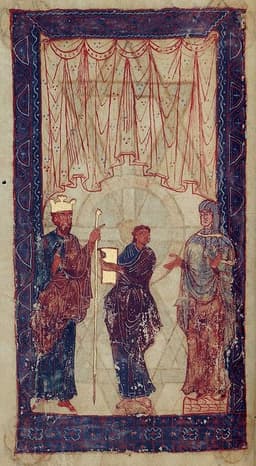
Ferdinand I of Leon
Emperor · Medieval
59.2Total

Wu Zetian
Emperor · Medieval
70.0Total
Basic Information
Born
1015
624
Died
1065
705
Era
Medieval
Medieval
Nationality
Leon
China
Occupation
Emperor
Emperor
Civilization
Western
Eastern
Score Comparison
Military (10%)
70.0
60.0
Political (20%)
68.0
62.7
Influence (20%)
56.4
65.0
Legacy (20%)
49.2
80.0
Leadership (15%)
66.0
78.0
Strategy (15%)
57.5
66.3
TOTAL
59.2
70.0
Ferdinand I of Leon — Complete Timeline
1029 AD
Inheritance of the County of CastilePolitical Action◆ Major
Ferdinand I inherited the County of Castile from his father Sancho III of Navarre. He later expanded his territory through conquest and marriage, laying the foundation for the Kingdom of Castile.
Impact: regionalconstructive
1037 AD
Conquest of LeónWar◆ Major
Ferdinand I defeated and killed King Bermudo III of Le
Impact: regional
1056 AD
First Emperor of SpainPolitical Action◆ Major
Ferdinand I was crowned 'Imperator totius Hispaniae' (Emperor of all Spain) in 1056, claiming suzerainty over all Christian and Muslim rulers in Iberia. This title reflected his military dominance and political ambition.
Impact: regional
1065 AD
Division of the kingdomPolitical Action◆ Major
Upon his death, Ferdinand I divided his kingdom among his sons: Sancho II received Castile, Alfonso VI received Le
Impact: regionaldestructive
Wu Zetian — Complete Timeline
655 AD
Became Empress ConsortPolitical Action◆ Major
Wu Zetian was elevated from concubine to empress consort of Emperor Gaozong of Tang in 655. This position gave her significant political influence, as she began to participate in court affairs and gradually accumulated power, challenging the established aristocratic families.
Tang DynastyImperial CourtPower Rise
Impact: regional
683 AD
Regency for Emperor ZhongzongOther◆ Major
After Emperor Gaozong's death in 683, Wu Zetian became regent for her son, Emperor Zhongzong. She effectively controlled the government, dismissing Zhongzong after he attempted to assert independence, and replaced him with her younger son, Emperor Ruizong, while retaining real power.
Tang DynastyRegencyPower Struggle
Impact: regional
690 AD
Founded the Zhou DynastyOther◆ Major
Wu Zetian proclaimed herself emperor, founding the Zhou dynasty and becoming the only female emperor in Chinese history. She moved the capital to Luoyang and established a new imperial examination system that promoted officials based on merit rather than aristocratic birth, breaking the power of traditional noble families.
Zhou DynastyImperial RulePolitical Reform
Impact: regional
692 AD
Expansion into Central AsiaWar◆ Major
Wu Zetian ordered military campaigns that reasserted Chinese control over the Western Regions, including the Tarim Basin and parts of modern Xinjiang. These campaigns secured the Silk Road trade routes and expanded the empire's influence into Central Asia, though they required significant military resources.
Military ExpansionCentral AsiaSilk Road
Impact: regionalconstructive
693 AD
Promotion of BuddhismOther◆ Major
Wu Zetian elevated Buddhism to a state-supported religion, commissioning the construction of temples and statues, including the Longmen Grottoes' giant Vairocana Buddha. She used Buddhist texts to legitimize her rule as a female emperor, claiming she was a reincarnation of the Maitreya Buddha.
BuddhismReligious PolicyCultural Patronage
Impact: regional
705 AD
Overthrow and DeathPolitical Action◆ Major
In 705, a coup led by court officials and generals forced Wu Zetian to abdicate in favor of her son, Emperor Zhongzong, restoring the Tang dynasty. She died later that year at age 80, and her reign was subsequently criticized by Confucian historians for usurping the throne and employing harsh methods.
Tang DynastyCoupAbdication
Impact: regionaldestructive
Expert Analysis
Wu Zetian vs Ferdinand I of Leon
### The Crown and the Throne: Wu Zetian and Ferdinand I, Two Medieval Paths to Power
In the year 690, in the Forbidden City of Luoyang, a sixty-six-year-old woman, once a lowly concubine, donned the dragon robe of the Son of Heaven. Half a world away, in 1056, a warrior-king in León, Spain, placed a crown upon his own head and declared himself *Imperator totius Hispaniae*—Emperor of all Spain. Both Wu Zetian and Ferdinand I claimed a title no one in their lands had held before: a female emperor in China, a Spanish emperor in the fractured Christian north. Their stories, separated by four centuries and an ocean of culture, are both tales of ambition, conquest, and the forging of legacies. Yet the differences in their origins, their rule, and their ultimate fates reveal the profound ways in which personality and circumstance shape history.
### Origins: The Concubine and the Heir
Wu Zetian was born in 624, into the twilight of the Sui dynasty. Her father was a minor official, her family of no great nobility. Her path to power was the narrowest of doors: the imperial harem. She entered the court of Emperor Taizong as a low-ranking concubine, a woman whose value was measured by her beauty and her ability to bear sons. In a civilization where women were expected to be silent, she learned to read, to write, and to master the art of political survival. Her world was one of whispers, poison, and the constant threat of oblivion.
Ferdinand I, born in 1015, was a prince from birth. His father, Sancho III of Navarre, was the most powerful Christian ruler in Iberia. Ferdinand inherited the County of Castile in 1029, a land of hard frontiers and constant war against the Moorish taifa kingdoms. His world was one of steel, horses, and feudal oaths. He was not a courtier but a warrior, and his rise would be measured not by intrigue but by the clash of armies on the battlefield.
### Rise to Power: Seduction and the Sword
Wu Zetian’s ascent was a masterpiece of psychological warfare. After Taizong’s death, she was sent to a Buddhist convent, a fate of quiet obscurity. But she had already seduced his son, the new emperor Gaozong. By 655, she had returned to court, eliminated her rivals—including the empress and a favored concubine, whose deaths she orchestrated with chilling efficiency—and become the new empress. Her power grew not through military might but through the manipulation of the imperial bureaucracy, the cultivation of spies, and the systematic destruction of aristocratic families who opposed her. When Gaozong suffered a stroke in 660, she ruled in his name, and after his death, she placed her own sons on the throne, only to depose them when they proved inconvenient. By 690, she had had enough of pretense. She proclaimed herself Emperor of the Zhou dynasty, a title no woman had ever held in China.
Ferdinand’s rise was simpler and bloodier. In 1037, he marched against King Bermudo III of León, who claimed the lands of Castile. At the Battle of Tamarón, Ferdinand killed Bermudo in single combat and seized his kingdom. He was now King of León and Castile, the most powerful Christian ruler in Spain. His legitimacy came from the sword. In 1056, he had himself crowned *Imperator totius Hispaniae*, a title that harked back to the Visigothic kings and asserted his claim over all the Christian and Muslim rulers of the peninsula.
### Leadership & Governance: The Reformer and the Crusader
Wu Zetian was a political genius. She understood that her position was precarious, not because of her gender but because of her class. To secure her rule, she broke the power of the old aristocratic clans and promoted men of talent, regardless of birth. She expanded the civil service examination system, opening the door to commoners and creating a new bureaucratic elite loyal to her. She also expanded the empire’s borders, sending armies into Central Asia and Korea. Her military score is a modest 62, but her political score of 80 and leadership of 82.5 reflect her true strength: she was a master of statecraft, not war. Her reign was one of relative peace and prosperity, though it was maintained by a network of secret police and informants that kept the court in terror.
Ferdinand was a king of the frontier. His military score of 60.1 and leadership of 78 tell the story of a man who led his armies from the front. He fought the Moors relentlessly, extracting tribute from the taifa kingdoms of Toledo, Seville, and Zaragoza. He was not a reformer but a conqueror. His political score of 72 reflects his ability to unite the fractious Christian kingdoms under his banner, but his strategy score of 45.7 suggests he was more a hammer than a scalpel. His genius lay in his personal courage and his ability to inspire loyalty in his knights.
### Triumph & Tragedy: The Dragon Throne and the Divided Kingdom
Wu Zetian’s greatest triumph was her survival. She ruled for fifteen years as emperor, a feat that defied the entire patriarchal structure of Chinese civilization. Her tragedy was that her dynasty did not survive her. In 705, at the age of eighty-one, she was overthrown in a coup led by her own ministers, who restored the Tang dynasty. Her sons and grandsons would rule after her, but her name was often erased from official histories. She had achieved the impossible, but at the cost of being remembered as a usurper and a monster.
Ferdinand’s tragedy was different. His greatest moment was the conquest of León and his imperial coronation. But in 1065, as he lay dying, he made a fateful decision: he divided his kingdom among his three sons. Sancho II received Castile, Alfonso VI received León, and García received Galicia. This partition, born of a feudal mindset, immediately plunged Spain into civil war. Within a decade, the brothers were fighting each other, and the dream of a united Christian Spain was shattered. Ferdinand’s legacy was not an empire but a family feud.
### Character & Destiny: The Spider and the Lion
Wu Zetian was a spider, weaving webs of intrigue. She was ruthless, intelligent, and utterly pragmatic. She had no compunction about killing her own children—rumor says she smothered her infant daughter to frame her rival—or exiling her sons. Her character was shaped by the brutal reality of the Chinese court: a woman could only rule by being more cunning and more merciless than any man. Her destiny was to be a singular anomaly, a figure so extraordinary that she could never be repeated.
Ferdinand was a lion, roaring at the head of his armies. He was brave, charismatic, and devout, a king who saw himself as a warrior for Christ. His character was shaped by the Reconquista, the centuries-long struggle to drive the Moors from Spain. He was not a schemer but a fighter. His destiny was to be a stepping stone, a king who laid the foundation for the future unification of Spain but who, by his own hand, ensured that unification would not come in his lifetime.
### Legacy: The Eternal Empress and the Forgotten Emperor
Wu Zetian’s legacy is complex. In China, she is remembered as a villainess—a woman who corrupted the Confucian order—and as a pioneer. Her influence score of 70.9 and legacy score of 85 reflect her enduring fascination. She is the only woman to have ruled China in her own right, and her reign is a subject of endless debate. Did she strengthen the empire or weaken it? Was she a tyrant or a visionary? The question remains unanswered.
Ferdinand I is largely forgotten outside of Spain. His legacy score of 65.2 is modest. He is remembered as a warrior-king, but his division of the kingdom overshadowed his achievements. He is a footnote in the story of the Reconquista, a prelude to the more famous reign of his son Alfonso VI, who would conquer Toledo. Yet his imperial title, *Imperator totius Hispaniae*, was a dream that would only be realized centuries later by his successors.
### Conclusion: Two Crowns, One Question
Wu Zetian and Ferdinand I both reached for a crown that was not meant for them. One was a woman in a man’s world; the other was a king in a world of kings. One ruled through the manipulation of the mind; the other through the strength of the arm. One built a dynasty that crumbled at her death; the other built a kingdom that he himself tore apart. Their stories ask a question that haunts history: Is it better to be feared or loved? Wu Zetian chose fear, and she died in her bed. Ferdinand chose love, and his kingdom died with him. In the end, both achieved greatness, but neither achieved permanence. They remind us that power, no matter how brilliantly won, is always a fragile thing.
Rankings
🥇
Wu ZetianLeader
Mil: 60.0Pol: 62.7Inf: 65.0
70.0
🥈
Ferdinand I of Leon
Mil: 70.0Pol: 68.0Inf: 56.4
59.2
+10.8 behind
How This Comparison Works
Algorithm
Each figure is scored on 6 dimensions (0—100 scale) based on structured historical data: Military (10%), Political (20%), Influence (20%), Legacy (20%), Leadership (15%), Strategy (15%). The weighted total produces the final ranking.
Data Sources
Scores are computed from structured sub-indicators in the database. Scale factors adjust for era (Ancient ×0.85, Modern ×1.0) and civilization size (Eastern ×1.05, Other ×0.80) to account for differences in population and military scale.
Maximum 3 Figures
Comparisons are limited to 2—3 figures to ensure readability and statistical meaningfulness.
Error Margins
±5 points per dimension — Sub-scores are derived from historical records with inherent uncertainty. Two figures within 5 points on a dimension should be considered roughly equivalent in that area.
Total Score Accuracy
±3 points overall — The weighted combination of 6 dimensions produces a total score with approximately ±3 points of uncertainty. Differences of less than 3 points are not statistically significant— the figures are effectively tied.
Known Limitations
- Historical records are incomplete and uneven across civilizations
- Figures from oral-tradition societies may be underrepresented
- Occupation labels can misclassify multi-role figures
- Scores measure capability and impact, not moral character
- Quantitative scoring is a comparison tool, not absolute truth
Capability Radar
Military (10%) — Battles & Warfare
Battles
55
65
Win Rate
60
70
Expansion
60
75
Political (20%) — Governance & Reform
Reform
50
85
Diplomacy
55
80
Economy
45
85
Influence (20%) — Cultural & Global Reach
Cultural
40
85
Global
30
70
Legacy (20%) — Historical Impact
Historical
45
90
Longevity
40
85
Leadership (15%) — Power & Stability
Tenure
65
90
Stability
50
75
Strategy (15%) — Tactics & Innovation
Strategy
55
75
Tactics
50
60
Reform
40
80
Similar Comparisons
Comments & Discussion
Gilded Dagger6/16/2026
Ferdinand was a conqueror by birthright, but Wu Zetian clawed her way to power through sheer intellect. The man never had to prove he could read a room full of rivals—she survived an imperial harem, which is basically a real-life "Game of Thrones" with higher stakes. He inherited a kingdom; she invented an empire. That’s not just difference, that’s a chasm.
龙吟铁马6/16/2026
说武曌是“女皇帝”?她根本是政治黑客。唐朝那套男尊女卑的代码,她全给重写了。费迪南一世算什么?他那“西班牙皇帝”头衔,不过是收复失地运动里的自我加冕,合法性和她比差远了。一个靠血统,一个靠本事,高下立判。
Numeric Nihilist6/16/2026
“Emperor of all Spain”? Sounds grand, but numbers don’t lie. Ferdinand’s kingdom of León had a population around 500,000, fragmented into warring fiefs. Wu Zetian ruled a unified Tang China with over 50 million people, a state that could field armies of 500,000. He was a regional warlord with a fancy title; she managed a proto-superpower. Let’s not equate apples to celestial oranges.
星火燎原6/16/2026
费迪南一世那套“帝国”叙事,本质是基督教封建联盟的吹嘘。他死后帝国立马分裂给三个儿子,可见他压根没靠制度扎根。武曌呢?她创立了科举殿试,重农兴商,治下人口过千万,政权稳了十五年。一个亡于内斗,一个亡于政变,但她的系统活得更久。谁更配称“大帝”?用脚趾头想都知道。
Plainspeak Pragmatist6/16/2026
Let’s be real: Wu Zetian crushed it because she had to. Ferdinand I played the hand he was dealt; she dealt her own cards from scratch. He was a Christian knight with a sword; she was a woman who out-strategized an entire Confucian bureaucracy. I’d take her over him any day if I needed a ruler who could think three moves ahead.
铁血凤凰6/16/2026
说来说去,费迪南不过是旧剧本里的标准男主:血统+武力。武曌才是破局者。她从一个五品小官的女儿,爬上九五之尊,靠的是一套自创的“权谋操作系统”。别说女人不行,她打破了千年规矩。费迪南?换个名字,换个时代,谁还记得这号人物?武曌的传奇,没有复制品。评价历史,要凭硬通货:创新和突破。