Loading...
Ferdinand I of Leon vs Wedem Arad
Ferdinand I of Leon leads by 10.7 pts · 2 figures compared
…
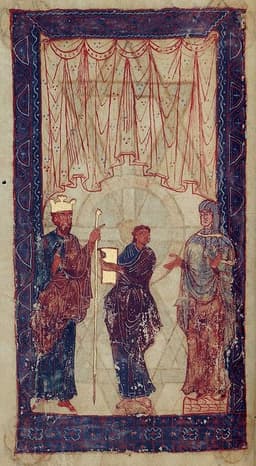
Ferdinand I of Leon
Emperor · Medieval
59.2Total
Wedem Arad
Emperor · Medieval
48.5Total
Basic Information
Born
1015
1270
Died
1065
1314
Era
Medieval
Medieval
Nationality
Leon
Ethiopia
Occupation
Emperor
Emperor
Civilization
Western
Other
Score Comparison
Military (10%)
70.0
50.0
Political (20%)
68.0
35.1
Influence (20%)
56.4
58.0
Legacy (20%)
49.2
45.8
Leadership (15%)
66.0
55.3
Strategy (15%)
57.5
39.6
TOTAL
59.2
48.5
Ferdinand I of Leon — Complete Timeline
1029 AD
Inheritance of the County of CastilePolitical Action◆ Major
Ferdinand I inherited the County of Castile from his father Sancho III of Navarre. He later expanded his territory through conquest and marriage, laying the foundation for the Kingdom of Castile.
Impact: regionalconstructive
1037 AD
Conquest of LeónWar◆ Major
Ferdinand I defeated and killed King Bermudo III of Le
Impact: regional
1056 AD
First Emperor of SpainPolitical Action◆ Major
Ferdinand I was crowned 'Imperator totius Hispaniae' (Emperor of all Spain) in 1056, claiming suzerainty over all Christian and Muslim rulers in Iberia. This title reflected his military dominance and political ambition.
Impact: regional
1065 AD
Division of the kingdomPolitical Action◆ Major
Upon his death, Ferdinand I divided his kingdom among his sons: Sancho II received Castile, Alfonso VI received Le
Impact: regionaldestructive
Wedem Arad — Complete Timeline
1306 AD
First Contact with EuropePolitical Action◆ Major
Wedem Arad sent an embassy to Europe, likely to the court of Pope Clement V in Avignon. This was the first recorded diplomatic contact between Ethiopia and a European power since antiquity, establishing a precedent for future Ethiopian-European relations.
Impact: regional
Expert Analysis
Ferdinand I of Leon vs Wedem Arad
# The Emperor Who United, and the Emperor Who Reached Out
In the year 1056, Ferdinand I of León stood before his court and accepted a crown that no Spanish king had worn before: “Imperator totius Hispaniae,” Emperor of all Spain. It was a title bold in its ambition, yet rooted in centuries of Christian struggle against Moorish rule. Half a world away, in 1306, another emperor—Wedem Arad of Ethiopia—dispatched an embassy to the court of Pope Clement V in Avignon, France. His goal was not conquest, but connection: the first recorded diplomatic contact between Ethiopia and Europe. One man sought to unify a fractured land through war; the other sought to open a door to a distant world. Their paths could not have been more different, yet both were driven by the same fundamental question of their age: how does a ruler secure his kingdom’s place in history?
Origins
Ferdinand I was born into the violent, shifting politics of medieval Iberia. His father, Sancho III of Navarre, had forged a powerful realm through marriage and conquest, and young Ferdinand grew up watching the chessboard of Christian kingdoms—Navarre, León, Castile, Aragón—move against each other and the Moorish taifas. When Sancho died, Ferdinand inherited the County of Castile in 1029, a modest territory but one rich in strategic potential. He was a product of the Reconquista, a world where faith and feudalism intertwined, and where a king’s legitimacy was measured in blood and land.
Wedem Arad, by contrast, ruled a kingdom that had never been conquered by Islam. Ethiopia’s Solomonic dynasty claimed descent from the biblical King Solomon and the Queen of Sheba, a lineage that gave its emperors a sacred, almost mythic authority. The highlands of the Horn of Africa were isolated, surrounded by Muslim sultanates and pagan tribes, yet fiercely Christian. Wedem Arad inherited a realm that had stood for centuries, but one that was increasingly aware of its isolation. His upbringing would have been steeped in the rituals of the Ethiopian Orthodox Church, a tradition that looked eastward to Jerusalem and Alexandria, not westward to Rome.
Rise to Power
Ferdinand’s rise was swift and brutal. In 1037, he challenged King Bermudo III of León, a rival who claimed suzerainty over Castile. At the Battle of Tamarón, Ferdinand killed Bermudo and claimed León for himself. It was a decisive moment: a count became a king, and a kingdom was born. Ferdinand did not stop there. Over the next two decades, he methodically subdued the Christian lords of Galicia and Portugal, then turned south to extract tribute from the wealthy Moorish taifas of Toledo, Seville, and Badajoz. His path was one of relentless expansion, each victory feeding the next.
Wedem Arad’s rise was quieter, less documented. He came to power in 1270, inheriting an empire that had weathered the Zagwe dynasty’s overthrow and the restoration of Solomonic rule. His legitimacy was not won on a battlefield but reaffirmed through the Church and the noble families of Tigray and Amhara. If Ferdinand’s path was a sword, Wedem Arad’s was a scepter—he ruled by tradition, not conquest.
Leadership & Governance
Ferdinand governed as a warrior-king, but he was also a shrewd politician. He understood that the Moorish taifas, though wealthy, were divided and vulnerable. Rather than conquer them outright, he imposed a system of *parias*—annual tribute—that filled his coffers without draining his army. This allowed him to build alliances, reward his nobles, and project power across Iberia. When he crowned himself Emperor in 1056, it was not an empty gesture: he had earned the title through strategic brilliance and military might.
Wedem Arad’s governance was more inward-looking. He maintained the feudal structures of the Ethiopian highlands, balancing the power of regional governors and the Church. His reign saw no major wars, no dramatic expansions. Instead, his most significant act was diplomatic. The embassy of 1306 was a gamble: sending envoys to Europe meant crossing hostile Muslim territories, and the message they carried—an offer of alliance against common enemies—was unprecedented. It was a move of remarkable foresight, a recognition that Ethiopia could not remain forever isolated.
Triumph & Tragedy
Ferdinand’s greatest triumph was his coronation as Emperor, a moment that symbolized the unification of Christian Spain under one crown. Yet his greatest tragedy came with his death. In 1065, he divided his kingdom among his three sons—Sancho II received Castile, Alfonso VI received León, and García received Galicia. It was a decision that shattered his life’s work. Within years, the brothers turned on each other, plunging the realm into civil war. Ferdinand had conquered a kingdom, but he could not conquer his own blood.
Wedem Arad’s triumph was quieter but no less significant: the embassy to Europe opened a channel that would later be used by Ethiopian emperors to seek aid against Muslim invasions. Yet its tragedy was that it bore no immediate fruit. Pope Clement V was preoccupied with the Avignon Papacy and the Crusades; the response, if any, was lost to history. Wedem Arad reached out across the world, but the world was not ready to reach back.
Character & Destiny
Ferdinand was a man of iron will and clear vision. He saw Iberia as a chessboard and moved his pieces with cold precision. But his flaw was a medieval one: he saw his kingdom as a personal inheritance, not a nation. Dividing it among his sons was not a failure of strategy but of worldview—he could not imagine a Spain that was more than the sum of its royal family.
Wedem Arad was a man of faith and patience. He did not seek glory through war; he sought security through connection. His destiny was to be a bridge builder, but the bridge he built would not be crossed for centuries. His legacy lies not in what he achieved, but in what he attempted.
Legacy
Ferdinand I is remembered as a unifier, the first to claim the title Emperor of Spain. But his division of the kingdom ensured that the Reconquista would be delayed for generations. His son Alfonso VI would eventually reunite the realm, but the scars of fraternal war lingered. Today, Ferdinand is a footnote in Spanish history, overshadowed by later kings like Ferdinand and Isabella.
Wedem Arad is remembered in Ethiopian chronicles as a pious emperor who sought the world beyond the highlands. His embassy is a milestone in Ethiopian-European relations, a first step on a long, difficult road. In the 20th century, Emperor Haile Selassie would invoke that early contact to cement Ethiopia’s place in the community of nations.
Conclusion
Two emperors, two worlds. Ferdinand I conquered and divided; Wedem Arad reached out and waited. One sought to dominate his neighbors, the other to befriend distant strangers. Both were limited by the horizons of their age—Ferdinand could not see beyond his family, Wedem Arad could not see beyond his faith. Yet in their different ways, both understood that a kingdom’s survival depends on more than walls and swords. It depends on vision. And vision, whether it looks inward or outward, is the rarest gift a ruler can possess.
Rankings
🥇
Ferdinand I of LeonLeader
Mil: 70.0Pol: 68.0Inf: 56.4
59.2
🥈
Wedem Arad
Mil: 50.0Pol: 35.1Inf: 58.0
48.5
+10.7 behind
How This Comparison Works
Algorithm
Each figure is scored on 6 dimensions (0—100 scale) based on structured historical data: Military (10%), Political (20%), Influence (20%), Legacy (20%), Leadership (15%), Strategy (15%). The weighted total produces the final ranking.
Data Sources
Scores are computed from structured sub-indicators in the database. Scale factors adjust for era (Ancient ×0.85, Modern ×1.0) and civilization size (Eastern ×1.05, Other ×0.80) to account for differences in population and military scale.
Maximum 3 Figures
Comparisons are limited to 2—3 figures to ensure readability and statistical meaningfulness.
Error Margins
±5 points per dimension — Sub-scores are derived from historical records with inherent uncertainty. Two figures within 5 points on a dimension should be considered roughly equivalent in that area.
Total Score Accuracy
±3 points overall — The weighted combination of 6 dimensions produces a total score with approximately ±3 points of uncertainty. Differences of less than 3 points are not statistically significant— the figures are effectively tied.
Known Limitations
- Historical records are incomplete and uneven across civilizations
- Figures from oral-tradition societies may be underrepresented
- Occupation labels can misclassify multi-role figures
- Scores measure capability and impact, not moral character
- Quantitative scoring is a comparison tool, not absolute truth
Capability Radar
Military (10%) — Battles & Warfare
Battles
55
15
Win Rate
60
20
Expansion
60
10
Political (20%) — Governance & Reform
Reform
50
20
Diplomacy
55
55
Economy
45
15
Influence (20%) — Cultural & Global Reach
Cultural
40
20
Global
30
40
Legacy (20%) — Historical Impact
Historical
45
35
Longevity
40
30
Leadership (15%) — Power & Stability
Tenure
65
40
Stability
50
30
Strategy (15%) — Tactics & Innovation
Strategy
55
10
Tactics
50
10
Reform
40
5
Similar Comparisons
Comments & Discussion
TheUnifier6/16/2026
Ferdinand I wasn't just some Reconquista warlord playing emperor for court flattery. He actually backed up that "Imperator" title by forcing the taifas of Seville, Badajoz, and Toledo to pay him parias tributes while expanding Castilian-Leonese power deep into former Visigothic territory. That crown meant something because he made the Moors recognize it. Meanwhile, Wedem Arad's embassy to Avignon got nothing—Europe ignored Ethiopia for another century. One emperor banked on war and won; the othe
帝国棋手6/16/2026
斐迪南一世那个“全西班牙皇帝”的头衔不是吹出来的——他靠武力逼塞维利亚和托莱多的穆斯林小王国年年纳贡,把自己的边境推到杜罗河以南。韦德姆·阿拉德派使者去阿维尼翁找教皇,结果法国人对埃塞俄比亚连个回函都没给。外交是弱者的幻想,剑才是君主的语言。你看看谁的名字留在了地图上?
PariasCollector6/16/2026
Forget the pope's silent shrug for Wedem Arad. Ferdinand's real genius was playing the Muslim taifas against each other while squeezing them dry with parias—tribute payments that funded his wars against Christians in Navarre and Aragón. He wasn't some crusader idealist; he was a pragmatist who taxed enemies and allies alike. That's how you unify Spain: by being richer and more ruthless than everyone else. Ethiopia's overture was noble but naive—Avignon had zero incentive to care.
狮心独行者6/16/2026
10世纪的伊比利亚基督徒靠生育和刀剑扩充地盘,斐迪南一世娶了桑查公主后吞并莱昂,把两个基督王国捏成一个。韦德姆·阿拉德呢?他派使者穿越大漠去见克莱芒五世,以为欧洲人会帮他对抗穆斯林,结果人家正忙着迁教廷到阿维尼翁,谁管你非洲的异端战争?孤独是非洲帝国的宿命,斐迪南明白:联盟不如吞并。
RedClayScribe6/16/2026
The real difference here is that Ferdinand inherited a civil war zone and ended up dying in 1065 with his realm intact—only for his sons to immediately carve it up. That failure of succession sums up the medieval ambition trap: unify too well, and your heirs destroy it. Wedem Arad's embassy failed but planted a seed—Ethiopia kept knocking on Europe's door, and eventually got the Portuguese muskets that saved them against Adal. Diplomacy is slow; conquest is fast and fragile.
断戟使者6/16/2026
斐迪南一世死前把王国分给三个儿子,结果立刻兄弟阋墙、国土四分五裂——他统一西班牙的帝国梦活了不到十年。